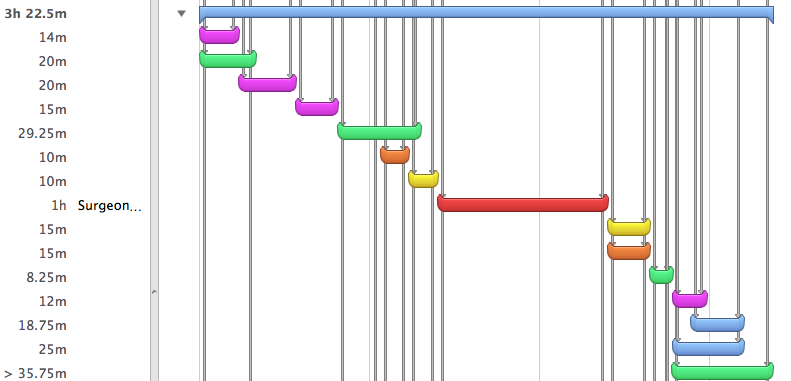
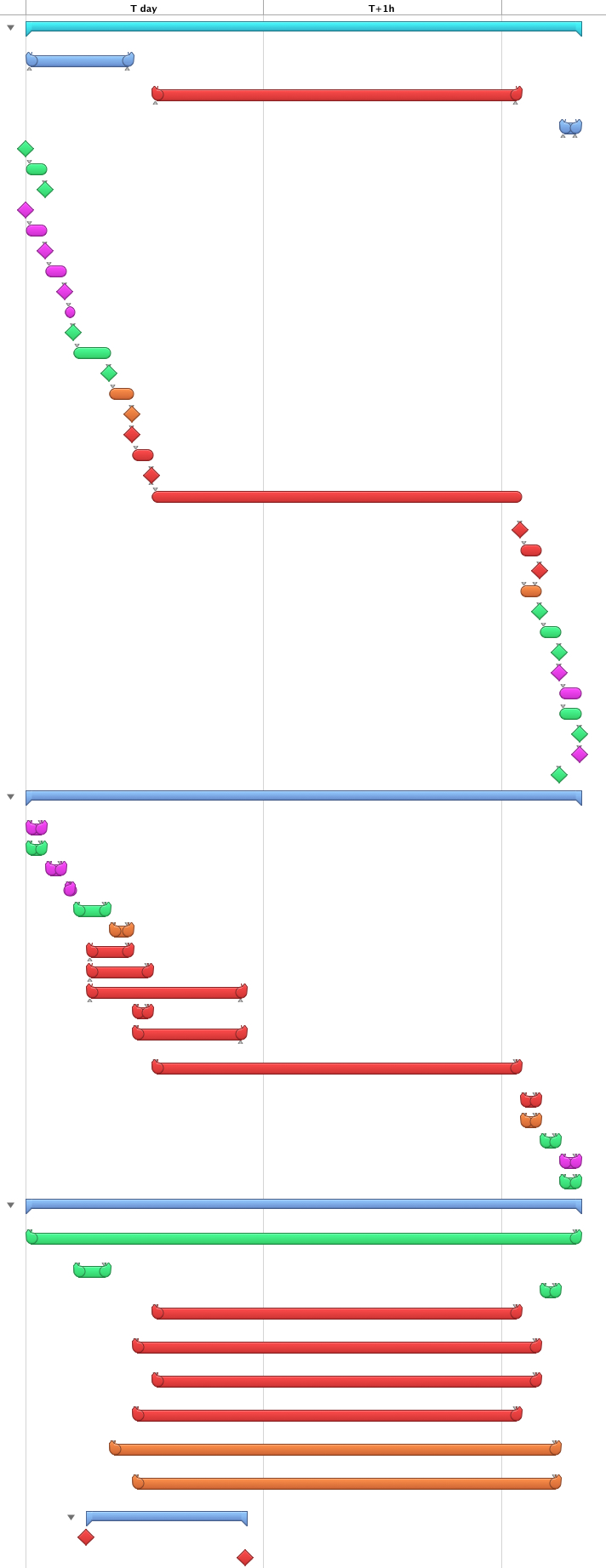
TOC in the OR visualized…


Ah….  theory of constraints…

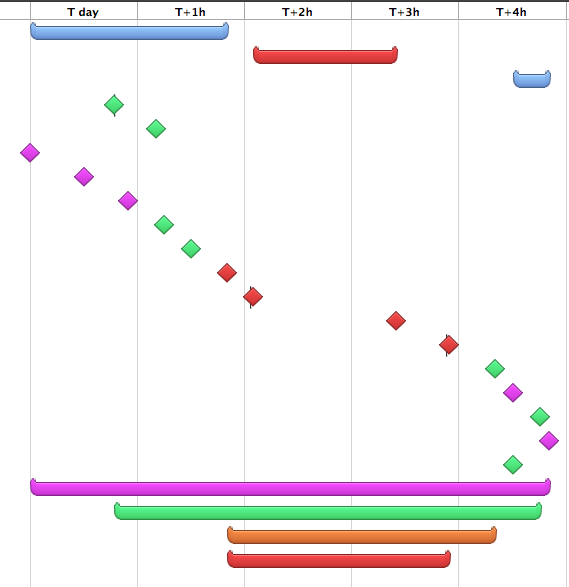
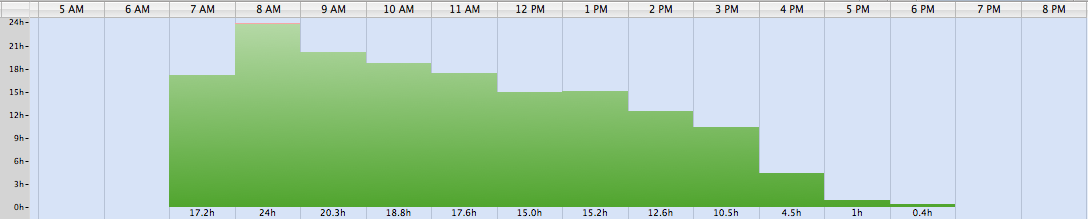
This is a visual representation to help with handling constraints in the OR.  For those who use TOC, be aware that the person represented by the green bar (‘Anes MD presence’) could be simultaneously supervising four rooms at once; and he acts more like a fireman in that he may be called to any of them (and to any other room in the OR) at any time to put out ‘fires’ that affect the patient’s safety.

All of these durations can be optimized (shortened) by the normal six-sigma, lean, etc. techniques; and said techniques are often implemented by personnel who have never heard the words ‘six sigma, lean, etc.’  Common sense and experience are  the words they use. Interestingly, I’ve never heard any one say that they had a black-belt in common sense…

‘Anes presence’ could be a CRNA, an RA, or MD anesthesia.  If it’s an MD, then 7.5 is redundant.

‘Surgeon assistant presence’ could be a ‘Physician Assistant (PA)’, a ‘first assist’, an RN or the surgeon herself.  If it’s the surgeon herself, then 7.4 is redundant.

Posted in anesthesiologist, scheduling, surgeon | Tagged , , , , , , | 1 Comment

butterflies and nails…


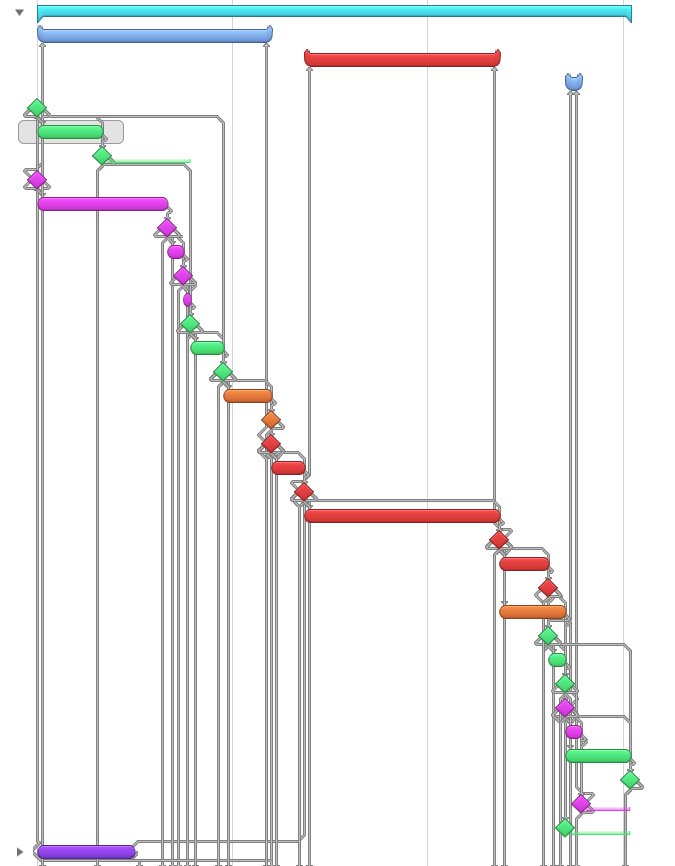
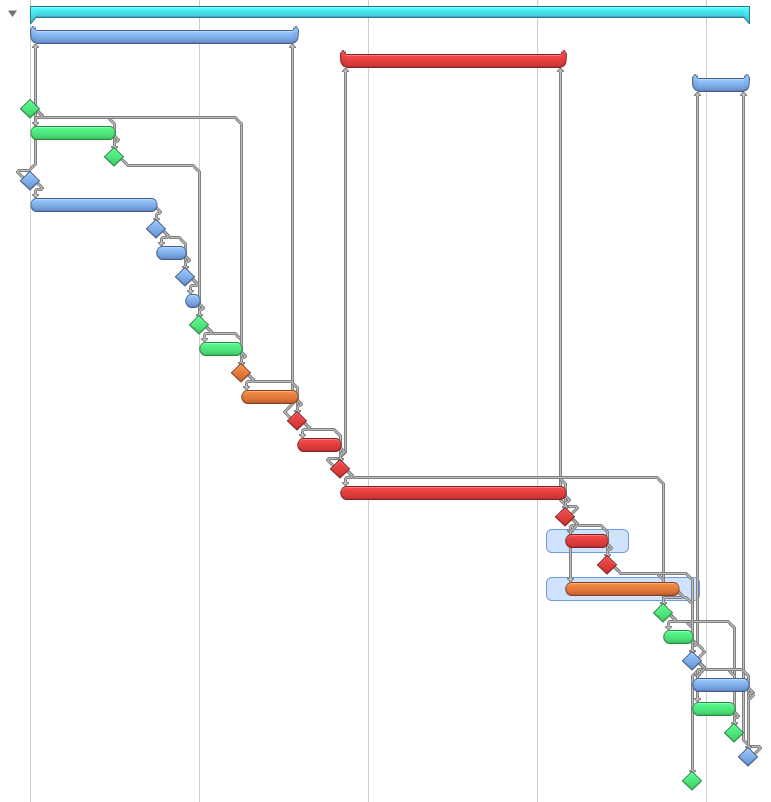
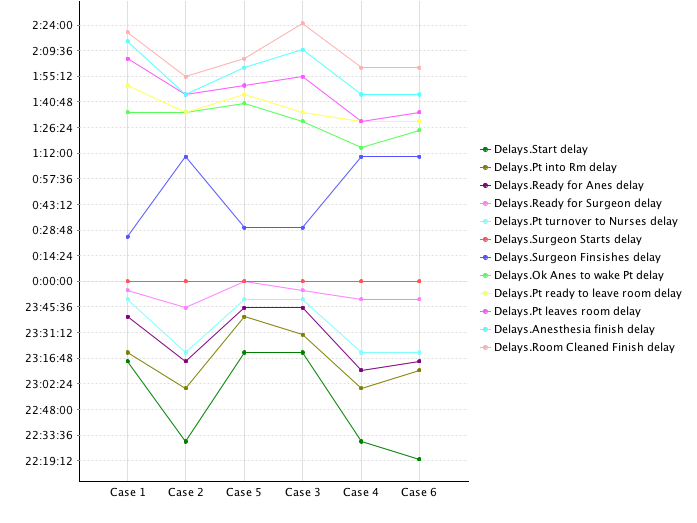
Below is a graph of durations in the scheduling and process of just the in-room surgical parts of a typical OR case.  Most of the items can be altered by policy and by the conscious effort of the people involved in doing the tasks. There are lots of connections and some necessary events—hence the title of this blog:”butterflies and nails”.  A few items that can be altered have a profound effect on the flow of the case and OR schedule for the day (time and money) like the butterfly that beats it’s wings in China and causes a hurricane in the Bahamas.  And some items, like ‘for lack of a nail for the shoe of the horse–which lost the battle–which lost the war’, can be critical.  A good model can help find the nails and the butterflies that are important (concepts, models, and simulation).  Of course, a bad model is like a bad GPS….over the cliff and through the woods.

One take home point is that there are many factors influencing the outcomes of a process.  Anyone who gives you a couple of statistical numbers or accounting calculations and says something is impossible, not feasible, a money loser, or great— without giving you a model that explains and jives with the reality you know—should be suspect of being mad, and possibly dangerous.

Posted in anesthesiologist, healthcare reform, scheduling, surgeon | Tagged , , , | Leave a comment

Big Bwana and little bwana…


Everything in the below graph is adjustable (and is derived from less data than is normally collected in an OR). It’s quite useful when deciding how to create your portfolio of surgeons, anesthesiologists, or nurses to limit the short-comings, and exploit the strengths, of the individuals and cases.  It’s a portfolio.  You pay hedge fund and mutual fund operators incredible amounts of money for guessing on their portfolios, often with little return to show for it. You have your own portfolio at the hospital…with a much better chance of big returns if you let skilled people handle the scheduling and running of the OR.  Would you let your neighbor create a hedge fund for you?  Who’s running your OR?

Big Bwana-the systems engineer, and little bwana-the cost accountant were hunting for large game in Kenya when they ran out of bullets.  The angry lion looked at them and their guide and began to charge. Little bwana said, “I’m an accountant and know that there are no bullets left, we’re doomed !!”  The safari guide began putting on his running shoes.  Big Bwana said, “Guide, I’m an accomplished systems engineer and know that there’s no way you can outrun that lion.”  . The guide replied, “I don’t need to outrun the lion, just you Bwanas.”

Don’t waste your resources optimizing processes that don’t matter.  Which ones matter?  That’s what this dynamic graph is for.  Put your fast people where their skills make a difference, and your slow people where their skills don’t.  Put your fast cases where they can burn through the day… and your slow cases in the slow lane out-of-the-way.  Discover what abilities, and which people, are of value to maximizing throughput, and attach a realistic monetary amount to those skills.  Same thing with cases… How does an individual case, or surgeon, affect the entire output of the OR.  Every OR is different. Simulate.  Think outside the bwana…

Posted in anesthesiologist, board of directors, CEO, healthcare reform, scheduling, surgeon | Tagged , , , , , , , | Leave a comment

the surgeon as a constraint…


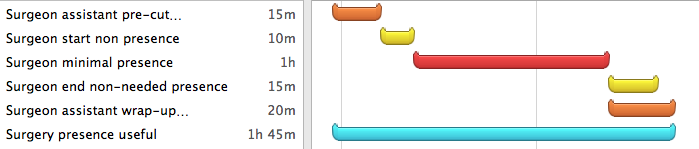
This graph shows components of surgical time during a typical surgical case:

red bar:   primary surgeon needs to be present and is present

top yellow bar:   surgeon needs to be present, but isn’t–he’s late and everyone is waiting for him

bottom yellow bar:   surgeon could leave and allow assistants (residents, PA, first assist) to finish

top orange bar:   this is when the patient is being positioned and prepped.

bottom orange bar:   this is the time it takes to close and dress the wound, and take the patient out of any unusual position or device

Analysis:

Most surgeons will be in the room for the total of the yellow and red bars.  The first yellow bar is purely wasted time by the surgeon.  The second yellow bar has trade offs in that by staying, the surgeon could be shortening the length of the bottom orange bar -the wrap up time (but this is by no means certain).

The top orange bar is when the surgeon is not necessary, but he can dramatically decrease this time if he is present to coordinate and clarify.

Depending on what you want as your constraint (usually, but not always, whatever is in shortage) you can have the surgeon assisting before and after the time he absolutely needs to be available for the case.  Again, the top yellow bar is an exception to trade offs as it is totally wasted time.

Cost accounting would never catch these important facts, nor clarify the tradeoffs involved.

Posted in healthcare reform, scheduling, surgeon | Tagged , , , , , | Leave a comment

divide and concur….


Once you visually see the requirements for anesthesia presence during a case, you can also see the potential for saving down-time and better utilizing particular skills when personnel are scarce.   I did leave out the pre-op visit in this graph since most everyone (groups) is aware of and coordinates that task among themselves (well, almost everyone) since it is a major source of time waste if not jointly handled.  During anesthesia training, one person will follow the patient through all these events for the sake of continuity and learning, but in the real world that doesn’t need to be the case.

And…believe it or not, some people are much better and faster at specific tasks than others.  A good inducer may not be a good wakeup person; and some people take three times as long as another to hand off a patient.

If the physician anesthesiologist is the constraint, the setup, maintenance, and handoff durations can be handled by others.  This is commonly done by CRNAs, sometimes by anesthesia techs, OR nurses, PACU nurses…   It can make a big difference in expense and throughput in the OR.

Posted in anesthesiologist, healthcare reform, scheduling, surgeon | Tagged , , , , , | Leave a comment

the cost of late surgeons… and the revenue from early surgeons


The purple bars represent the time saved for nursing staff and anesthesia if there is a policy for the surgeon to be ready to cut 30 minutes (adjustable) before the scheduled start of cases in the morning.  The effects of policy time alterations for an entire day’s scheduling can be simulated in less than a minute for future cases, and for past cases. Individual cases changes can be seen immediately.  If routine data is entered for each case, a retrospective cost to the OR of a surgeon’s showing up early or late is easily viewed. The financial effects (numbers) can be setup to calculate automatically depending on pay scales or opportunity costs at a specific hospital.

Posted in anesthesiologist, board of directors, CEO, healthcare reform, scheduling, surgeon | Tagged , , , | Leave a comment

Typical OR case dissected with details…


These are the relevant milestones and intervals in a typical OR case.  I left off the details so as not to detract from the comparison to the normal representation of an OR case as a single block of time with the case name, the surgeon’s name, and maybe a patient identifier.  How can you analyze a single block? Are you using the equivalent of a meeting room scheduler for your OR?  How about a scheduler that you paid $100,000 for that gives you all the patients’ vital signs… but doesn’t help you move the patient through the OR quickly, profitably,  or save your surgeons hours of time?

There’s a lot of data, and a LOT of information that is useful but will never be used because of the lack of awareness about the events and relationships that make up a case.  Are you still using an old scheduler, and collecting irrelevant data that goes into a hard-disk black hole?  Can’t play what-if?  Can’t tell who’s productive and who isn’t?  Where are the constraints?  Bad policies don’t pop out at you?  Who’s in charge there?……….  Why?

If you can’t fix your own sink or toilet, put in an irrigation system, hang a door, work on your car—if you have to hire someone to clean your pool, iron your clothes, fix your computer—if you can’t cook………………..You get someone who can.   So why not for running the OR?

It may be that you know if your sink or toilet is stopped up, your plants are dying, you door is falling off its hinges, your car doesn’t start—your pool is full of algae, your clothes are wrinkled, your computer makes funny noises and beeps constantly—you burn your pot while boiling water………………..   Do you know the potential of your OR?  Is it stopped up, dying, full of sludge?

Time to fix that.

Typical OR Case

Posted in anesthesiologist, board of directors, CEO, healthcare reform, scheduling, surgeon | Tagged , , , , , , | Leave a comment

So much data…so little time


Posted in anesthesiologist, CEO, healthcare reform, scheduling, surgeon | Tagged , , , , | Leave a comment

Simulations… let’s not repeat the same old mistakes


Simulations (for scheduling) have for the longest time been the realm of computer nerds.  Not any more.

There is now the ability (with some initial assistance) to let the workers on the ground modify and correct the black-box algorithms that the computer nerds created.  All those erroneous premises and assumptions encased within the simulator will come to light and be corrected.

Realistic what-ifs can be tested.

Competing processes can be tested.

While in the middle of a process, project or case schedule— constraints can be changed, resources reapplied or their numbers changed— different outcomes can be seen.

Very specific ‘what might have been’ reviews are possible; change only the events or people you want.

This is great for getting people on the ground level to buy into improving their processes, or for management to understand the various departments’ processes for better integration.

Posted in healthcare reform, scheduling | Tagged , | Leave a comment

Visual analytics for an OR case…


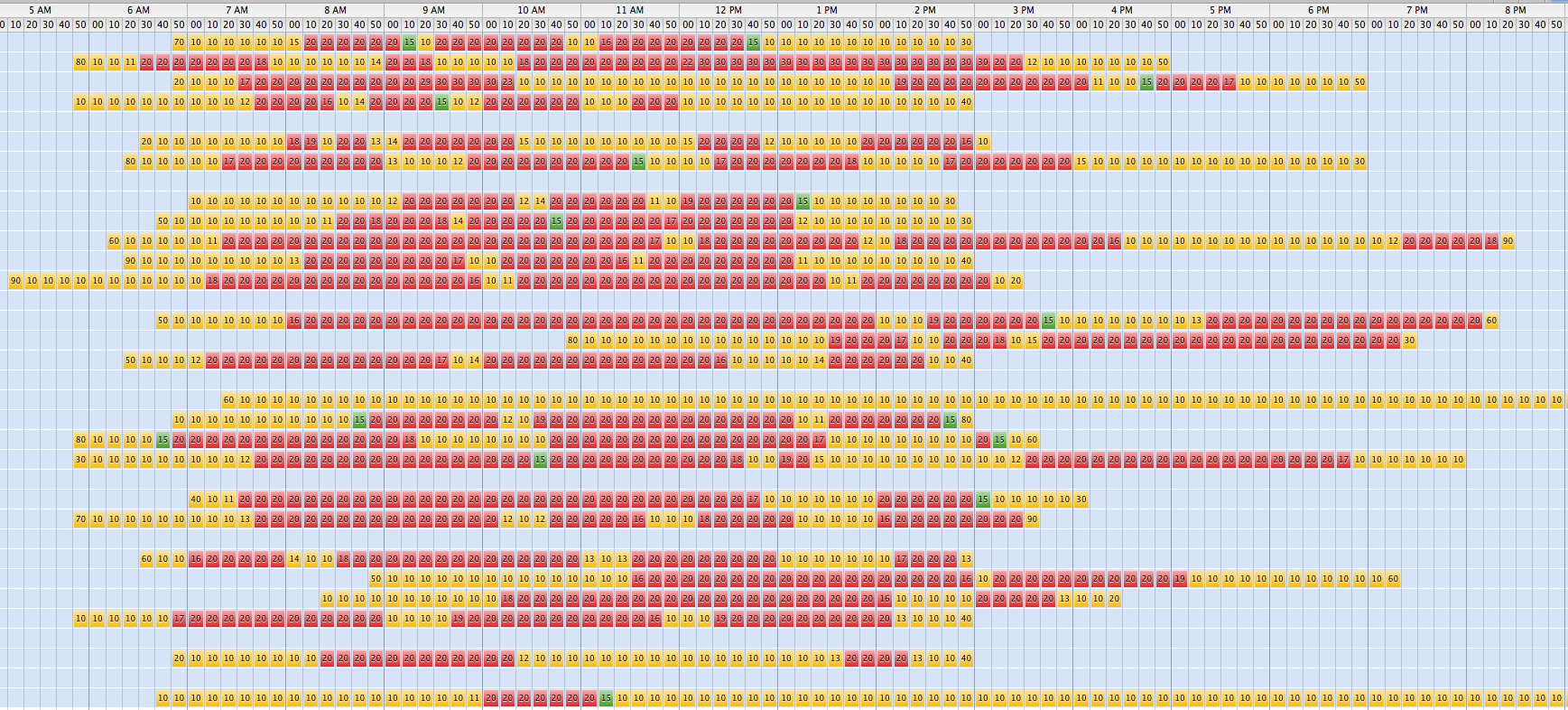
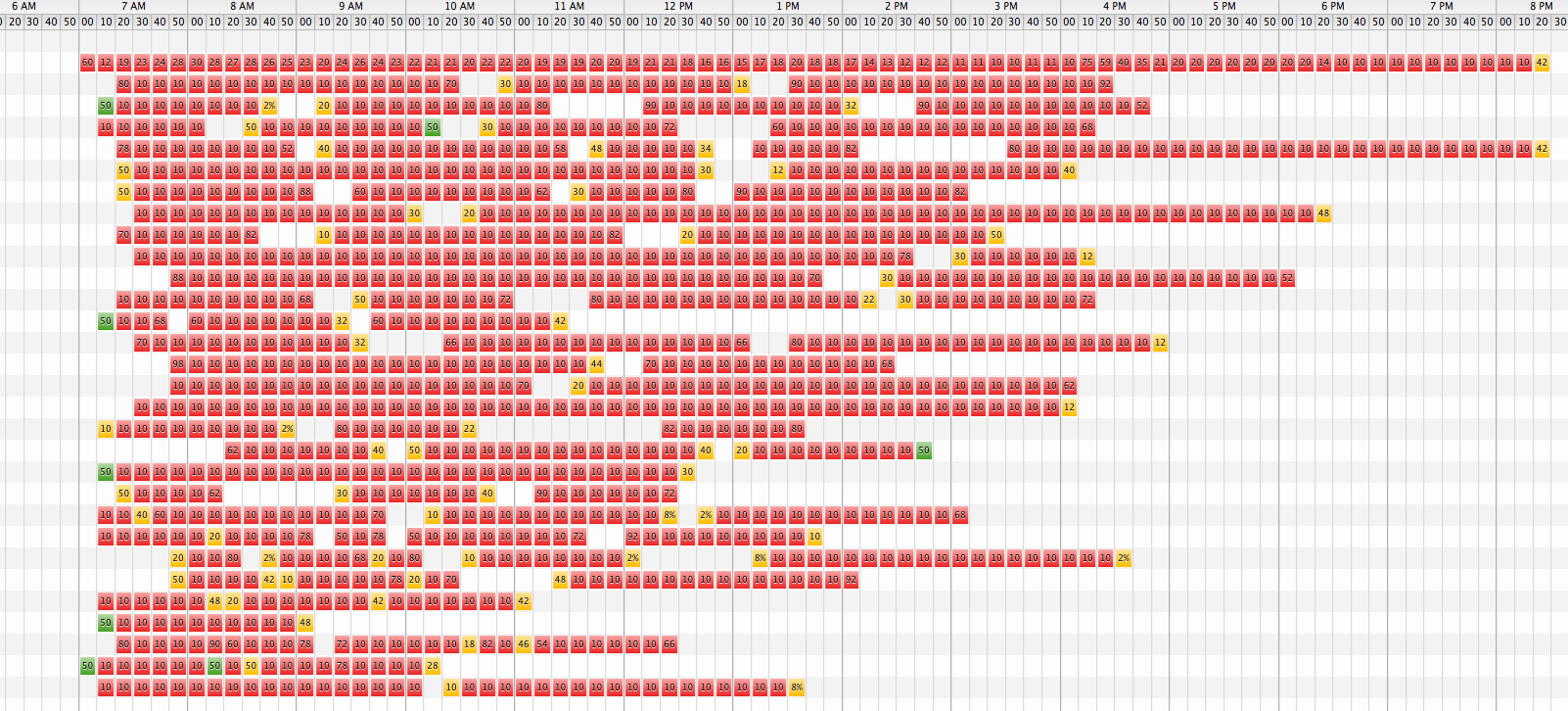
Visual analytics for an OR case:  Lots of information if you understand the code….   You can tell whether surgery, anesthesia, or the hospital personnel are on top of things and you can compare differences in techniques with resulting effects when a couple of cases are put side by side:  Also….it’s collapsible—you see only what you want which helps with clarity.

The purpose of this graph is to emphasize that there is a lot more to scheduling a single OR case than you might imagine.  Every colored bar represents an important part of the operation or a milestone that can be manipulated to your benefit or detriment.

Scheduling and analytics combined:

Posted in anesthesiologist, scheduling, surgeon | Tagged , , , , , | Leave a comment

FT: “Chief profitability officers still rare”


The Financial Times has new articles emphasizing that the CFO needs to know more systems engineering, have better analytical skills, and understand IT better.  Surprised?

Chief probability officers still rare

Competitive difference is in the analysis

Finance heads need much wider view of IT

Posted in board of directors, CEO, healthcare reform | Tagged , , , , , | Leave a comment

FT: “Competitive difference is in the Analysis”


I’ve been discussing this, and showing examples, on my weblog for some time.  Here’s a (The) major financial newspaper saying the same thing:

Competitive difference is in the analysis

Posted in board of directors, CEO, healthcare reform | Tagged , , , , , | Leave a comment

FT: “Finance heads need much wider view of IT”


For those of you who won’t subscribe to Financial Times…

Finance heads need much wider view of IT

The Financial Times is a premier newspaper dedicated to the finance world: CFOs, CEOs, CFAs. If you pass the article along, a CFO might actually read it.  And, many a CEO was once a CFO.
Posted in board of directors, CEO, healthcare reform | Tagged , , , , , | Leave a comment

sample requirements for vice-chair of anesthesia department…


Below is a copy of a letter I sent for a position as vice-chair of anesthesia at a large teaching hospital.  I’ve long thought that most vice-chairmen needed to expand their skill sets.
.
Dear Dr. —-,
As you proceed with your search, I would like to clarify my approach to the description for Vice Chair for Clinical Anesthesia. It’s a bit different than how it was done when I was a senior consultant at KFSH&RC in Saudi Arabia teaching residents, and while teaching at Tufts during a locum tenens.  However, I thought both of those could be improved upon.

Operating Room

Scheduling:
Analysis of current OR scheduling program and modification (if necessary) to have it render more immediately useful information to coordinate the day’s schedule, and to collect data for longer term analysis of policies,  procedure dependent intra-op delays due to technique or equipment, and personnel evaluations with the intent to discover good practices and those that need improving.  Locate constraints, define and decrease designated turnover times to the minimum requested or that which is financially best while decreasing risks to patient and personnel.

There are two schedulers that I have modified for use in the OR (and outside the OR).  Each has certain attributes that make it a better choice depending upon the situation.  Each can be used to run the day’s schedule while collecting data for later analysis.  The later analysis is done by transferring the data to a multi-dimensional spreadsheet that can easily handle a billion records yet is versatile enough for rapid discovery of patterns from any recorded attribute (field).  If patterns are discovered, or if outliers are discovered, contextual information is available by going back to the original scheduler for the details and relationships of all factors relevant to each instance of interest.

This should permit quick evaluation of best practices of scheduling between cases (inter-case), and discovery of best practices intra-case (ex: anterior vs lateral approach to hip operation).  Relative merits of regional vs general anesthesia and their effects on the whole days schedule should become apparent as would improvement of individual residents ability to induce or block patients.  The improvement of surgical residents (based on time to perform procedures or parts of procedures) can easily be tracked so that attendings can focus on areas that individual residents may need additional instruction.

Communication:
There are several free or inexpensive communication systems that can be adapted and implemented depending upon the currently available system.  The system should help coordinate activity within a service (gen surgery, anesthesia, etc) or within a working environment (OR and floor, radiology, etc.) and relieve the need for an intermediary to pass on information.  Their communication systems also permit collection of information for pro-active, or retro-active, analysis of problems and events if desired.

Data collection:
As above, plus designing and using the appropriate database for collection and analysis of whatever data needed for evaluation of personnel, procedure, or equipment.

Quality improvement:
Using the above to coordinate with other departments to achieve designated goals of quality and financial improvement.


Teaching objectives: 

Anesthesia: regional, ob, pediatrics, neuro, general, ortho, etc.; game theory and options, risk management, constraint theory, rapid turnover, efficiency; compare and contrast hospital anesthesia systems and cultures in and outside the US.

Business: Finance, real options, risk management; accounting theory pitfalls in practice; constraint theory


Managerial objectives:

Call and Holiday Scheduling:
Discussion, evaluation, and implementation of various systems for equitable scheduling with the goal of maximizing personal utility functions either through rigid scheduling techniques or fictitious currency techniques (stock market approach).

State and agency requirements:
Using hospital and personal connections to understand and fulfill regulatory requirements.


Thank you for your consideration,

Brian D Gregory, MD, MBA

Posted in anesthesiologist, scheduling | Tagged , , , , , , , , | Leave a comment

new scheduler…timeline and map integration


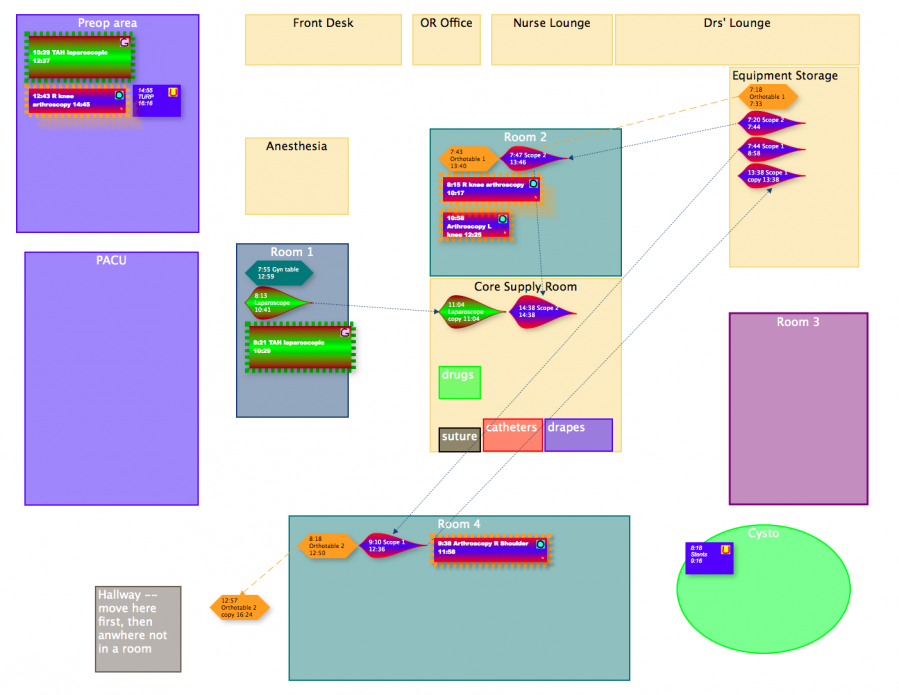
Operating rooms are expensive assets; you don’t want them sitting idle when people need them. Each room may be equipped differently; you want to schedule procedures in the most appropriate room. To complicate matters, some procedures require special equipment that takes time to move from place to place. You don’t want to haul a ton of equipment across the hospital if you don’t have to, and it’s good to pre-position things at your leisure, rather than having everyone wait while someone fetches a cart, scope, or bed from storage or another room.

A missing component of most OR schedulers is the capability to see spacial relationships that give a more intuitive feel for case, room, and equipment use. The map below show cases (width is proportional to length of case compared to others), and it has lines and time-stamps that track the movement of equipment.  It can be tailored to the individual needs of a specific OR.

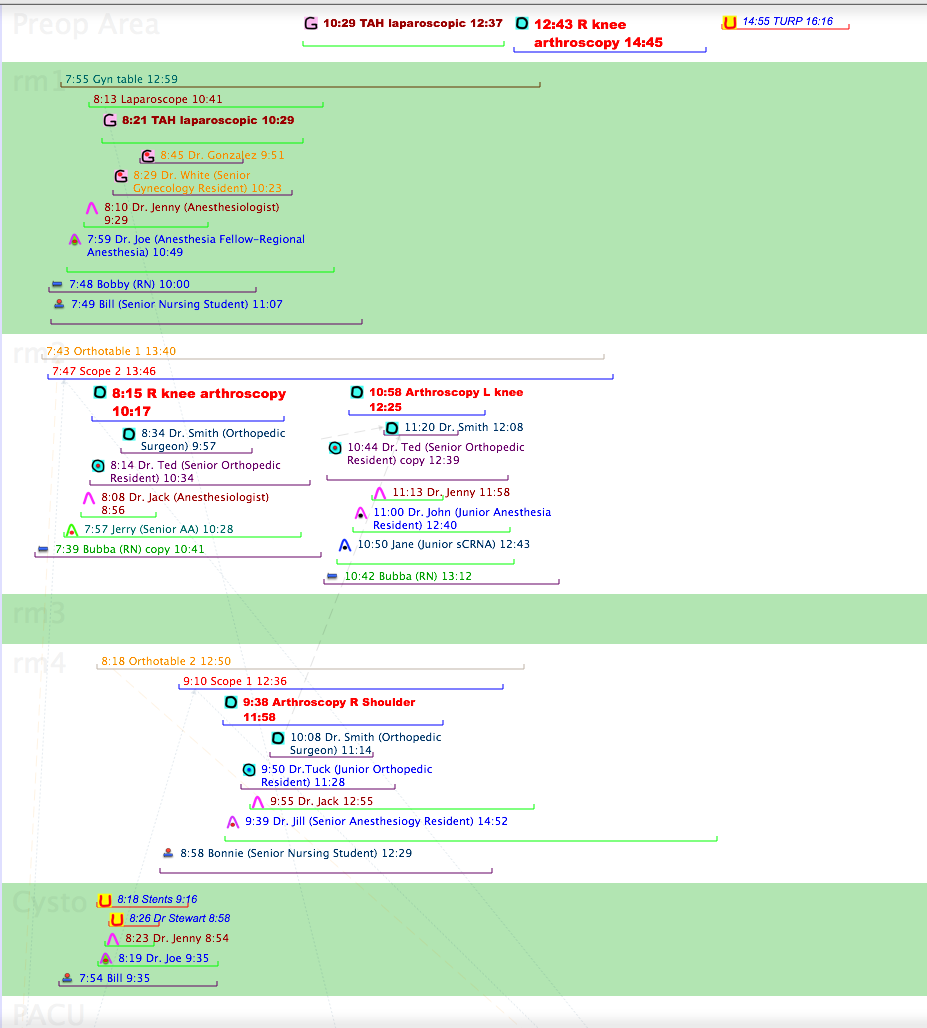
This blog is showing the concept of using a Map view in concert with a Timeline view for scheduling. You can change the scheduling data in each view. The views work in concert in an iterative process that helps catch omissions of reasoning and data input that stand out in the alternative view. Depending on needs or wants,it can keep track of where everything is at just the moment, or it can be adapted for logging detailed time-purpose-location data that a systems engineer or designer would love to see.  Though not shown, the system is also easily capable of printing or sending a schedule for each participant (with graphical context of the rest of the OR included, or not).

Purpose:
Allows tracking of equipment in space and time,
allows recognition of distance and moving costs when making scheduling decisions,
the arrows indicate the sequence of movement which is further defined by the timestamp on the event,
verifies correct equipment with case by border and pattern coding,
allows later logistical analysis

Map View:  click on images for larger view

Timeline View below…  integrated

Posted in anesthesiologist, CEO, healthcare reform, scheduling, surgeon | Tagged , , , , | Leave a comment

practical uses for emotional intelligence…


Emotional Intelligence

Posted in healthcare reform | Tagged , | Leave a comment

board can struggle with data puzzle…


Board can Struggle with Data Analysis

I’ve discussed visual analytics before, and its ability to bring actionable information to both the CEO and worker on the floor.  The Financial Times has just published the above Special Report saying that boards of companies are in need of someway to understand the data they’re given in order to act upon it.  Looks like we’re on the same page: examples of putting data put into understandable and actionable form for healthcare is the core of this weblog.

I would add that dynamic visual analytics is the next step in increasing data understanding.  It’s difficult to show on a weblog, but the idea is that of an analytic tool that can let the board member or process worker quickly and intuitively manipulate the graphical display to show relationships among the data.

Posted in board of directors, CEO, healthcare reform | Tagged , , | Leave a comment

non-expert decison making: perils of democracy…


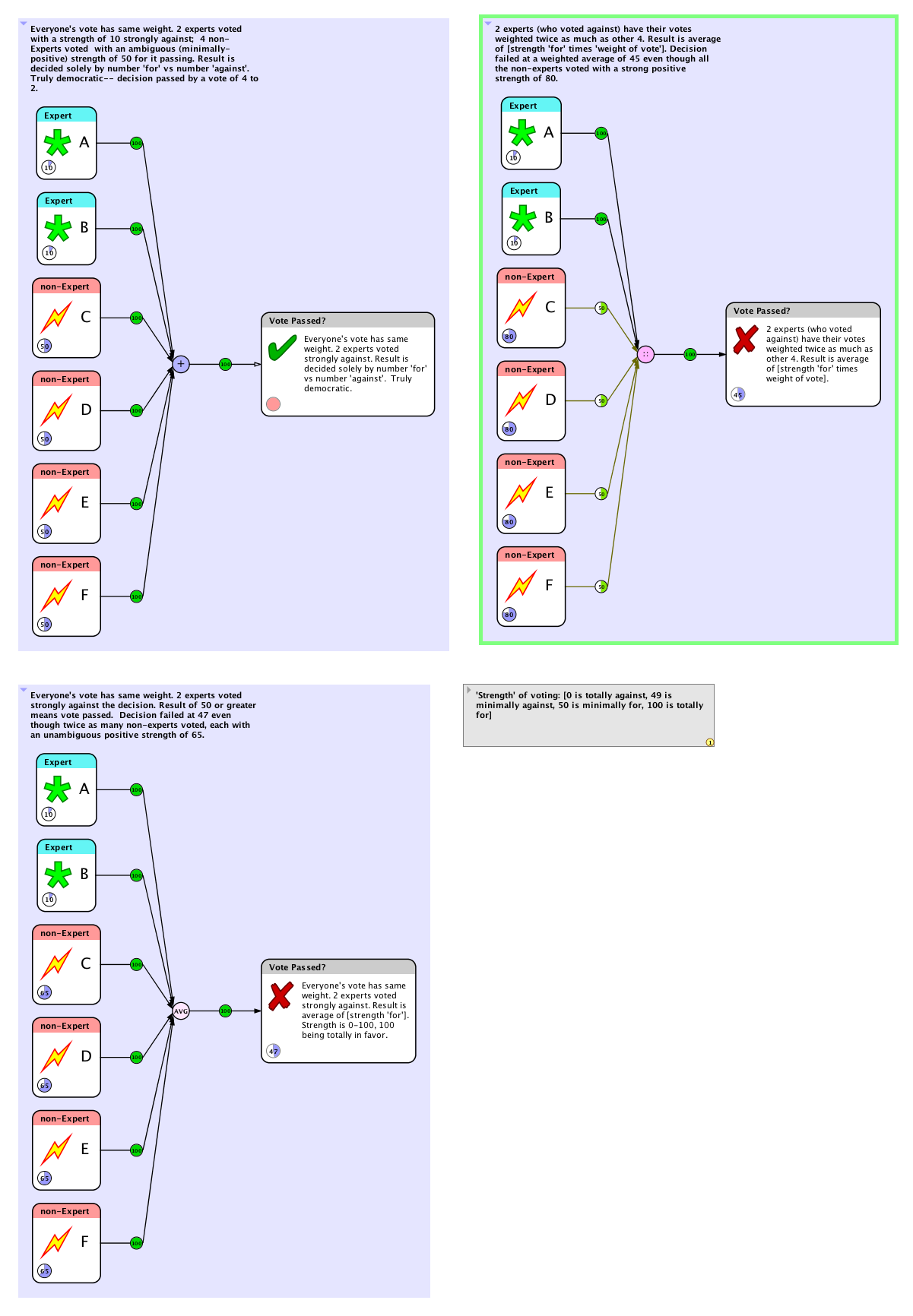
When making an individual decision, or whether voting as a group, the ‘strength’ of one’s conviction on a topic should be modified by one’s expertise before coming to a final resolution.  All decisions have pros and cons, all of different importance and ramifications. The following shows mathematically a simple example of the interplay between ‘expertise’ and conviction with possible ‘wrong’ resolutions.  In small groups, a more rigorous decision resolution method than a simple raising of hands would be useful for better defining the problem and recording the strength of convictions for future reference and analysis.

The first chart shows a normal vote that disregards how strongly each individual feels about the subject at hand.

The second chart shows what happens if you gives the ‘experts’ a stronger voice (their votes count twice as much as everyone else’s), and weigh everyone’s vote by the strength of their conviction (opinion) on the subject at hand.  This method gives experts the strongest ability to affect the outcome of the voting.

The third chart gives everyone an equal vote, but those with the strongest opinions will be able to effect the vote more than those who don’t by indicating a stronger conviction (closer to 0 or 100).  Experts tend to have stronger opinions and this gives them the chance to express that view.  This method does not let the expert influence the outcome as much as in the second chart, but it could be considered more fair since anyone (non-expert included) could rank his own conviction toward 0 or 100; but, hopefully, those who know little about the topic at hand would rate their own conviction closer to the median of 50.

It’s possible to use any of the methods above, or all of them depending on the circumstances and matter being discussed.

non-expert decision making Click on the photo or URL for a larger view.

Posted in anesthesiologist, CEO, healthcare reform, surgeon | Tagged , , , , , | Leave a comment

new OR scheduler…


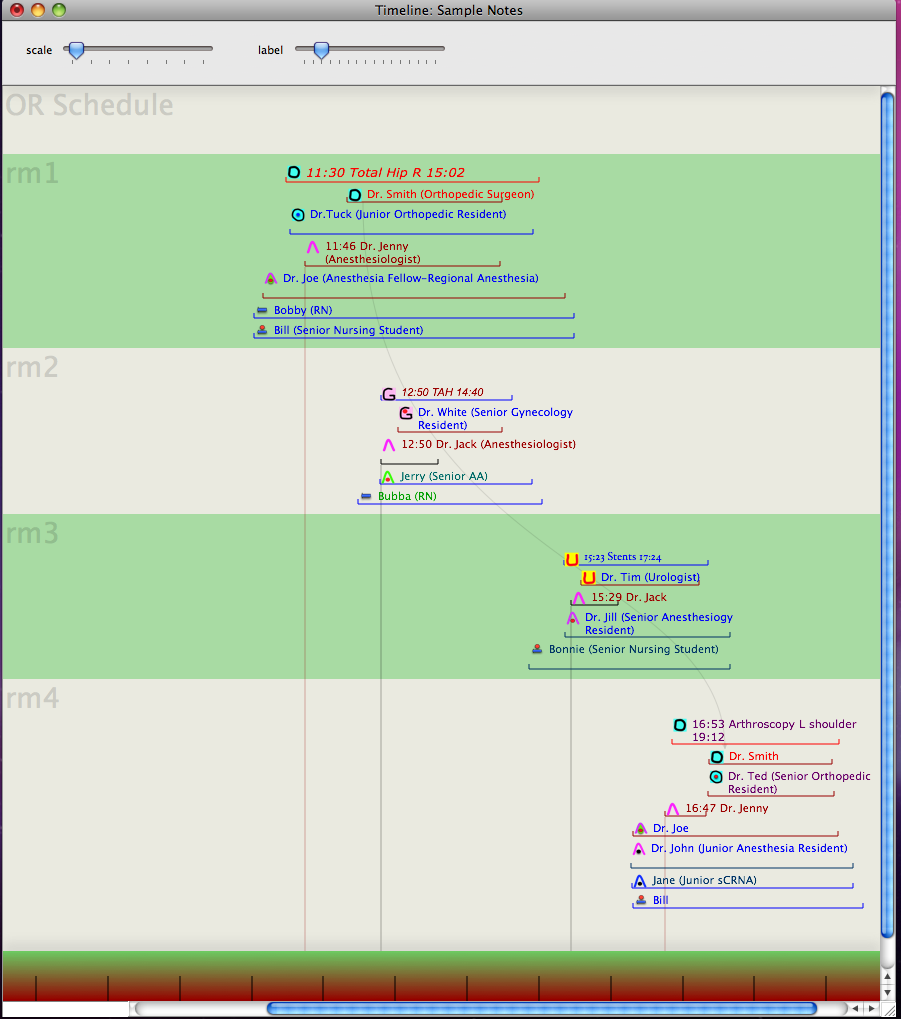
I’ve been experimenting with a new scheduler.  There are many options for visually representing information about OR cases. The scheduler is easily adapted for collecting data to analyze later. The scheduler also has a map view that can include even more visual parameters… a multivariable categorical analyst’s dream.

(click on image for larger view) [Each room shows the multiple people involved in one case]

Surprisingly, most OR schedulers have very little information readily available to see the ‘whole’ picture: multiple people temporally coordinating their actions at one location (with support from off-site) with the ability to abruptly alter their plans.  Sounds like a military campaign, doesn’t it.  Can you imagine admirals and generals standing in front of the typical OR board and planning a coordinated air and land attack on Bagdad during the Iraqi war? The tools would be woefully inadequate, the strategy disjoint.  So why do we use backward systems for coordinating medical operations?  So much time and resources are wasted because it’s so hard to see what’s going on where with who, and when. (reminds me of an Abbott and Costello routine: YouTube – Who’s on first?)

In this scenario:

In real time, you can run the OR and keep track of the time that anyone (or any equipment) from any department is involved with a specific OR case. Most of the data for individuals has already been set up, and the corresponding times are easily adjusted with drag and drop functionality.

The icon in front of each operation name is unique to the department doing the operation. The icon in front of each person is unique to that person’s department and rank in the department so that a description is not necessary to know how each department is represented in the room.

For this screen save, I decided to let the vertical lines show when the supervising anesthesiologist has to be present for a surgical case whether doing it herself, or supervising.  For Dr. Jenny, her vertical color is red.  For Dr. Jack, his vertical color is black.  Each has two cases, and each can easily see where and when she is needed.  I could just as easily show vertical lines for any individual which would lead directly to the cases in which they are involved without losing any of the context of those cases (other people involved, room, time frame, etc).

Other areas of the hospital can be added to the schedule such as clinics, radiology, or ER.

Posted in anesthesiologist, scheduling, surgeon | Tagged , , , | Leave a comment

sample new OR scheduler


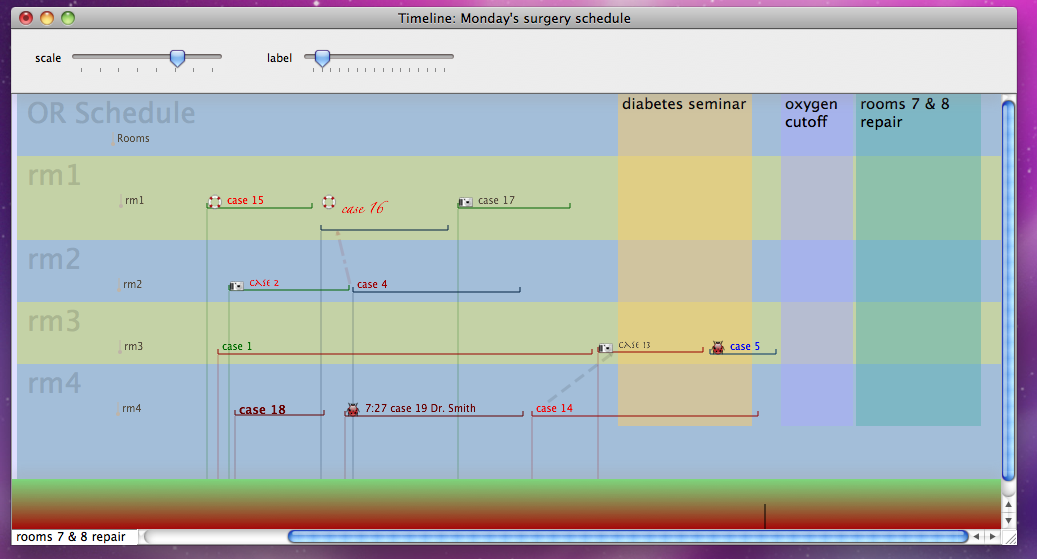
For all those OR schedulers out there, here’s a new approach.  I left most of the data off on purpose to emphasize the information that the graphics—lines, blocks, fonts, colors, sizes, and proximity— can show.  When in the program, pages of information along with unlimited fields about each case can be seen and inputted by clicking on the case name. The lines can be labeled with any information.  Dragging and adjusting each case time automatically updates the data fields for those attributes and can be exported to any database or spreadsheet.   Data collection, and changes in data collection are easy to do.

Every attribute can be altered to represent different data.  In this graph, Dr. Smith’s icon is a ladybug since her online name is …’ladybug’.  Dr. Jones is a sailor and chose a life preserver as his icon. The camera icon belongs to Dr. White; he likes photography.  If desired, you could have a picture of your black labrador as your icon.

Each font represents a distinct OR room setup.  The color of the horizontal line for each case represents a category of procedure, the vertical line represents the ASA of the patient and the potential difficulty and slowness of anesthesia in starting the case. However, the representation of every attribute can be changed.  Make the bottom colors maroon and gold if those were your school colors, or make them represent who was in charge of the OR that day.  The vertical lines also give you a good idea of ‘crunch time’  –lots of cases starting at once– and the difficulty in starting them (the color of line).

Posted in anesthesiologist, scheduling, surgeon | Tagged , , , , , , | Leave a comment

hold the mayo…


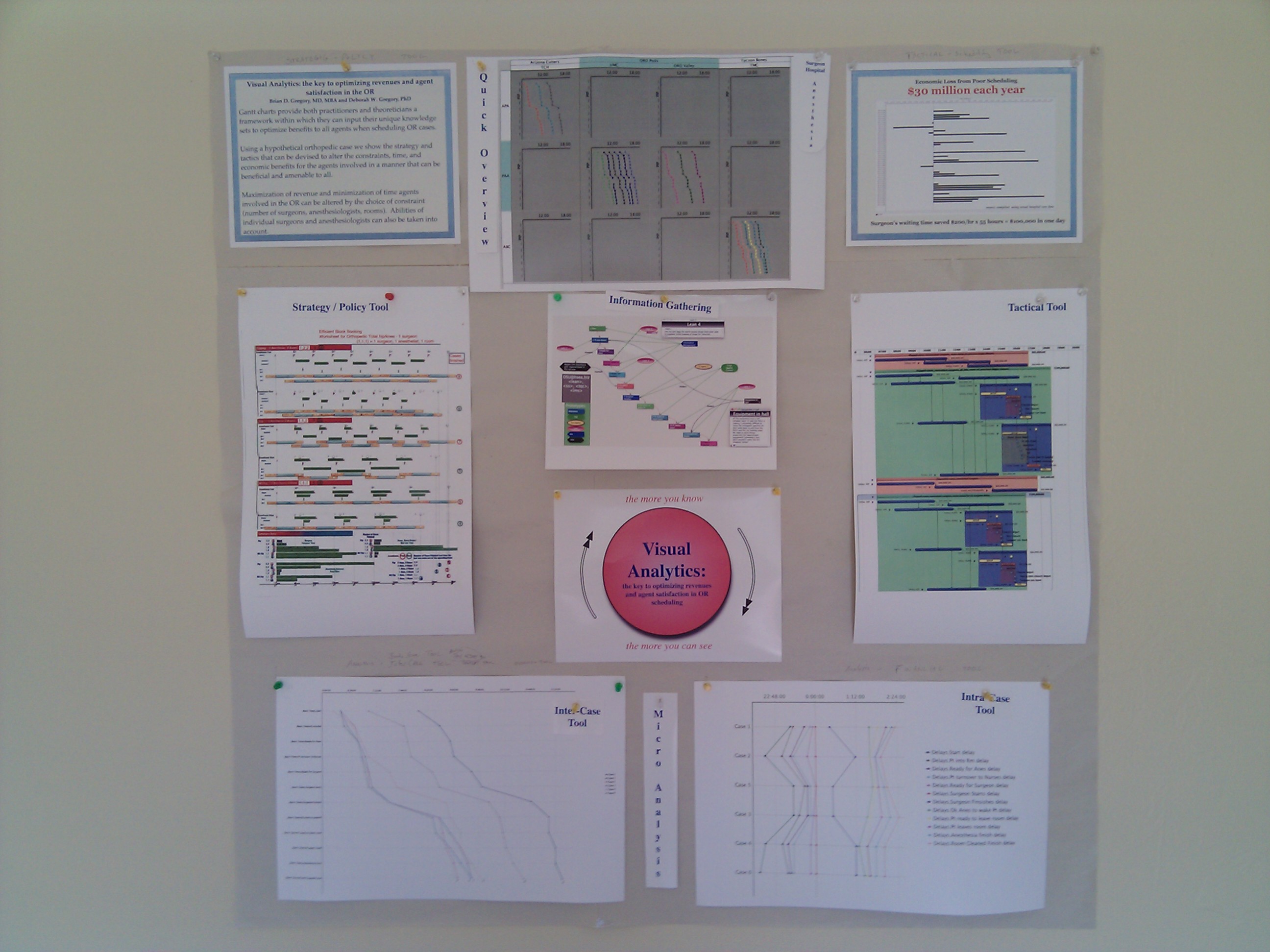
Unfortunately, I forgot to take a picture of my poster presentation at the Mayo Clinic’s 3rd Annual Healthcare Systems Engineering meeting. However, I did take a picture as I was putting it together the week before.  Here it is, in all its rough stage glory…

Posted in anesthesiologist, CEO, healthcare reform, scheduling, surgeon | Tagged , , , | Leave a comment

business interest…


When we started this blog, we didn’t know how well it would be received.  Even though there were few comments, we could follow how many viewers had dropped by to have a look and download our graphs and articles.  We have now, however, chosen to privatize the more informative articles that had previously been public.  If you have a business interest in this information, for either conceptual or implementation purposes,  or wish us to make your OR much more competitive, profitable, and safe contact us at:

brian@ortimes.org

Thank you.

Posted in anesthesiologist, CEO, healthcare reform, scheduling, surgeon | Tagged , , | Leave a comment

time to call it a day…


About two weeks ago, I returned after having honored a request from a Mayo researcher to give my poster presentation (a rational and extremely profitable OR scheduling and analysis system that I’ve actually used) at the Mayo Clinic’s 3rd Annual Healthcare Systems Engineering conference in Rochester Minnesota.  While there,  I had the pleasure of meeting a couple of people with whom I’d been talking shop on Yahoo’s hme group site, and met a couple of more bright people with whom I’d really like to chat again.  Some of the lectures were good.  Some not.  I was amazed that things I had implemented 14 years ago have just begun to be topics of conversations on the theoretical level.  Not sure what to think…except that it could explain why I’ve had so few comments on my blog posts.

As for my poster presentation

It was a combination of 20+ years of clinical OR practice, economics/finance, risk management, and systems engineering.  Yep, not a whole lot of people with enough background to appreciate it.  Guess it’ll be another 14 years (or forever).

The best lecture, was on the last day by a fellow in charge of research (I believe) at Mayo. He said that it was a rare researcher, often a pariah, who draws from many different fields to create game changing improvements.  He implied that you don’t learn that ability, you are born with it.    Question: Is the person who recognizes talent like the person who has the talent for asking the right question?  Both find the right answers.

I’ve been posting on this blog for 8 months, hoping for discussions and input.  They have been few and far between.  Lots of downloads which can be seen from my blog statistics, but not much given back to me through way of comments. I’ve always said that when one stops learning from a conversation, one should walk away.

One final note:

A degree in education gives you teaching principles for good teaching, it doesn’t mean you know the subject enough to teach it well (it’s better for the expert in a field to learn to teach).  A degree in systems engineering teaches you principles, it doesn’t mean you know a different field well enough to effectively implement those principles (it’s better for the expert in a field to learn systems engineering).

Corollaries:

1) Simulations are based on premises.  Lots of premises.  They are logic equations.  If any of the premises are wrong, then the simulations are junk.  You need to know the constraints on the premises to interpret the simulations.  If you don’t intimately know the subject, you risk creating absurd or useless conclusions.  How do you know junk when you see it?  Because you’ve seen what happens in real life.

2) Teach everyone systems engineering.  It’s like teaching people to read, but easier.  The economic return will be worth it.

3) Teach everyone economics and finance.  The economic return will be worth it.

4) Teach everyone risk management.  The life (quality of life) you save may matter to you.  And, the economic return will be worth it.

Take care.  I’ve a sunset to watch

Posted in healthcare reform | Tagged , , , | Leave a comment

Visual analytics wins again… :)


Gamers beat algorithms at finding protein structures

Posted in healthcare reform, scheduling | Tagged | Leave a comment

Protected: theory, tools, and techniques… abstract


This content is password-protected. To view it, please enter the password below.

Posted in anesthesiologist, CEO, scheduling, surgeon | Tagged , , , , , | Enter your password to view comments.

understanding visual analytics… and others


What’s wrong with this picture; I see what you mean; I hear where you’re coming from; Something doesn’t feel right:

These statements represent analytics.

Analytics can be defined as the presentation of input in such a way that it taps into the much broader wealth of knowledge and experience that you hold.  Much as a picture of dots lets you see a larger, whole picture,  good analytics helps you fill in the dots with what you know from all your theory, prior work, and play.

Analytics creates a loose framework to help integrate your current senses and data with your broader knowledge and appreciation of the context of the situation.  Context will effect the interpretation of any sense, and the framework can help in applying the context.

Analytics can be thought of as an aid to intuition.  Since intuition is thought of as an assimilation and assessment of thoughts in our subconscious,  a loose visual framework can help coach you into understanding your gut feelings without forcing you into a rigid thought process as so many statistics do.  Many statistical analyses and their resulting graphics tend to eliminate the context of a situation and decrease the ‘degrees of freedom’ in order to achieve a specific number that gives little help in solving complex problems.  For example: The average blood pressure in a hospital is 120/80; does that mean we can discard all the vasopressers, vasodilators, and diuretics?

How about the use of numbers from an arterial line or Swan-ganz catheter? A projection of multi-factoral influences onto a two-dimensional axis  (arterial tracing, Swan-Ganz numbers) and erroneously discarding the other observations.  Too much emphasis on micro-analyzing the subtleties of the two-dimensional projection of a multifactorial effect is a mistake.  Concurrent observance of other factors increases understanding  and decreases time, cost, and morbidity in finding solutions. The proper analytics can help focus the narrower statistical and invasive analyses to where they do the most good.  Experience and theory helps forms the intuition that analytics taps in to.

Visual analytics is common in conversation today.  But sight is not the only sense that cues us to understanding a situation.

For example:

In anesthesia we used to listen to heart and breath sounds with a precordial stethoscope continuously throughout a case.  Subtle changes in sound often occurred long before any other signs that something was amiss.  Now-a-days we’ve substituted a pulse oximeter and capnography which is both a gain, and a loss, in monitoring a patient.

Baseball combines visual and auditory analytics.  An outfielder relies on both to catch a ball.

Noise leading up to a potential car crash.

An expert car mechanic uses auditory and tactile information as much as visual.

A physician feeling pulses, warmth of a limb, and listening to heart sounds…integrative.

A monkey swinging through the trees has excellent kinesthetic and visual analytics.

A trapeze artist has great hand-eye coordination, a combination of kinesthetic and visual analytics.

Gustatory and olfactory analytics permit a good cook to make a savory dish without a cookbook.

Beethoven, the German composer and pianist, had excellent auditory analytics.  He knew what sounds went well together.  He composed, conducted, and performed even when completely deaf.   A child prodigy, in auditory analytics.

Mozart was the same, an excellent composer.

Many mathematicians are musicians.

Einstein was not a great mathematician, although he was a great theorist.  His power came from understanding relationships and building frameworks to explain the world even though he needed help to model those relationships mathematically.

Analytic abilities evolved out of the necessity to survive.  Experience is integral to analytics as is theory which is often created from experience. With it we solve problems and see potential.

Analytics help one  focus on the important factors and ignore ‘noise’.

A language, when understood well, permits people to slur and leave out words.  A foreigner, though he speaks english, can have great difficulty understanding pig-Latin though children do so with ease.  When you understand the framework of a language, then ‘noise’ is more tolerable.

And, multiple sense analytics can be fun.  Imagine auditory (Bolero) with olfactory (lavender) with visual (lace) with tactile (massage oil).

With Visual Analytics, the more you know the more you’ll see… and  the more you’ll know.
Posted in anesthesiologist, healthcare reform | Tagged , , , | Leave a comment

the law of unintended consequences…staffing anesthesiologists


Value: easily and potentially > than $1,000,000 a year

Let’s suppose that a hospital wants fellowship trained anesthesiologists to do all their cases: pediatric anesthesia fellowship for all pediatric cases, neuroanesthesia fellowship for all neuro cases, ob-gyn fellowship for all ob-gyn cases, and cardiac fellowship for all cardia cases.  Now, for the sake of clarifying an idea, let’s suppose that this hospital has 4 surgeons: a neurosurgeon, a cardiovascular surgeon, an ob-gynecologist, and a pediatric surgeon.  Each does one case a day.  The CardioVascular surgeon does one CABG between 7:00 and 9:00 every morning.  The pediatric surgeon does a T&A between 9:30 and 10:00 every day. The neurosurgeon does a craniotomy between 11:00 and 2:00 every day; and the ob-gynecologist does a hysterectomy between 3:00 and 4:00 every day.  The routine never varies.

If the hospital is serious about requiring fellowship trained anesthesiologists for all it’s cases, then the hospital will require 4 anesthesiologists who they will subsidize because none of the anesthesiologist will be making the median income by doing only one case a day.  If the hospital does not require fellowship training, then one anesthesiologist will cover all the cases and make a good living.

Requiring fellowship training is expensive with regard to scheduling.  It may also be expensive with regard to risk to the patients.  Do you have 4 anesthesiologists on call every night?  Do the anesthesiologists need to keep up their skills by doing a variety of cases?  In the long run, is your legal risk decreased?

There can be a long debate about whether fellowship training is a good or bad thing.  Some people claim that it dumbs down anesthesiologists.  Their contention is that you never put just a head or uterus to sleep, every patient has a heart, and airway management is a practice intensive skill, so every anesthesiologist has to be aware of how to deal with sick hearts, potential strokes, and managing airways which is achieved by doing all types of cases.  Many of these skills are perfected after many years and thousand of patients.  To claim that a pediatric fellowship trained anesthesiologist (after doing between 300 and 1000  cases) is better than a non-pediatric fellowship anesthesiologist (who was trained with pediatric patients and who has done 0ver 10,000 or 20,000 pediatric cases) is sheer folly. What requiring a fellowship trained anesthesiologists does do is set a legal standard that makes it easier for lawyers to sue the hospital.  Taken to an extreme, a hospital could eventually be required to have on staff 3 or 4 times as many fellowship trained anesthesiologists as non-fellowship trained anesthesiologists to cover all the cases.

As I said, this is a thinking exercise.  Every situation is different, and I’m just trying to get across a simple idea that can become quickly complicated in terms of revenue, costs, health risk, and legal risk. For more on this, see my blog post: the fungible anesthetist… « Healthcare Systems Engineering and Analysis

A similar situation (but in reverse) has been the combining of services of multiple specialties under the domain of ‘Hospitalist’ in an effort to increase throughput and decrease costs.

Posted in anesthesiologist, CEO, healthcare reform, scheduling | Tagged , , , , , , | 2 Comments

Using what you have…


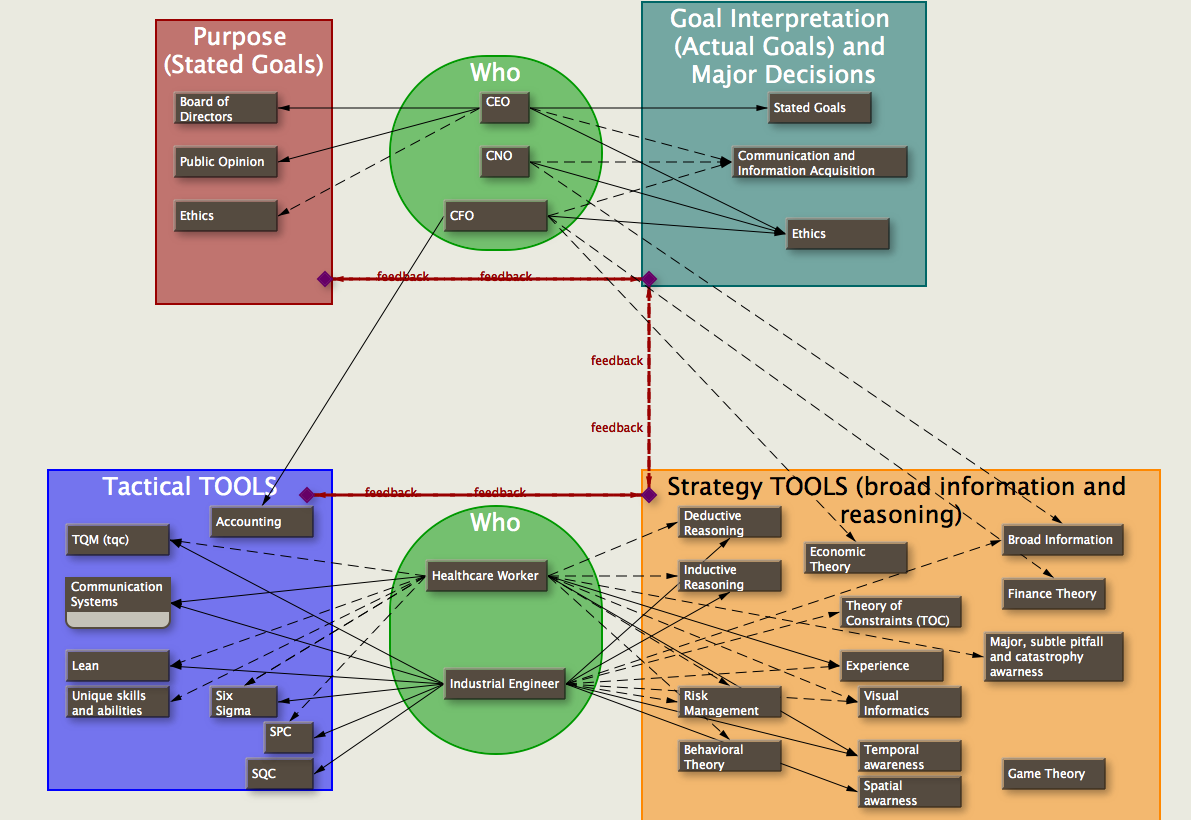
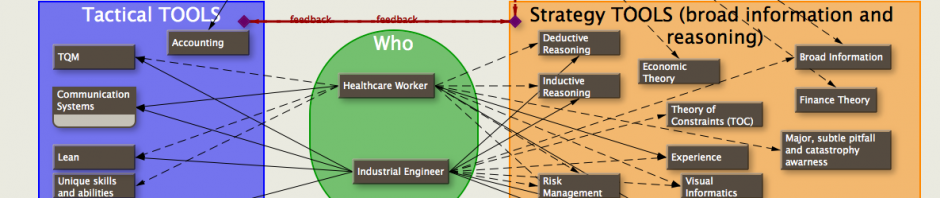
The graph below contains sets of useful abilities/tools for running a hospital. Each black line connects a group of people to abilities and tools they use (solid black) or might use (dashed black).  Every hospital will show a different set of connections for different persons, and this particular graph in no way represents every hospital. In one hospital, an industrial engineer might be an expert with strategic tools;  in a different hospital, the CFO or a physician might have that ability. My point is that someone in the hospital needs these abilities, and the persons making the decisions for the hospital need access to those people and their thoughts.  A good, modern communication and information system for accessing those thoughts would create a flatter corporate structure for tapping into the resources and abilities that are present.

Posted in healthcare reform | Tagged | Leave a comment

Conflict of interests for surgeons?…


I’ve seen this potential for abuse over the years.  It’s probably just jealousy on my part… we get donuts from the reps, some of the surgeons get all expense paid trips to exotic (well, sometimes exotic) locations.  There may be nothing really going on here, but the potential for abuse is real both for surgeons and hospitals who engage in agreements.

New Hips Gone Awry Expose U.S. Kickbacks in Doctors’ Conflicts – Bloomberg

Posted in CEO, healthcare reform, surgeon | Tagged , , , | Leave a comment

Operations-a-Finance….cost accounting vs managerial accounting vs others


“If discussing shop with a Finance person, one thought is to get a feel of where they are coming from. How difficult is it to get them to use “GAAP” in the conversation and what is their attitude about it?”

GAAP is used for financial reporting and should not be used for managerial accounting.  A CPA uses GAAP, but a CMA ( IMA – Institute of Management Accountants ) doesn’t.  CMAs run industries, CPAs make the industry look good to investors (my opinion), try to decrease taxes, and try to get big bonuses for the top executives.  Also, GAAP is slowly being phased out to a similar, though different, standard used in many other countries.

“The US GAAP provisions differ somewhat from International Financial Reporting Standards, though former SEC Chairman Chris Cox set out a timetable for all U.S. companies to drop GAAP by 2016, with the largest companies switching to IFRS as early as 2009.”

In your finance department, if you deal with someone who does not take a managerial accounting approach (a throughput account approach would also be good), you’ll have some difficulty communicating with them.  In any event, the focus should be on increasing cash flow for the company as a whole, which usually is accomplished by increasing throughput and decreasing cost through all the various techniques (constraint theory, lean, TQM, etc) that operations management people have been trained to do.  A CMA (more than a CPA) knows that operations people are integral to changing the cash flow.  Whatever the cash flow, the CPA for the hospital can still manipulate the numbers to alter a profit & loss statement more to his liking… but more easily if there is increased cash flow.  Cash flow, itself, (free cash flow and other variants) is not as easily manipulated.  Also, without positive cash flow, the hospital tanks no matter what the income statement shows.

So, assuming the hospitals accounting is organized by departments and then consolidated for the hospital, you need to get the statements for each department and show how your operations management techniques can change the amount on line items of each department’s statement.  Sometimes that line item will be independent, and sometimes it will be a proportion of an overhead cost to the hospital. Even if it’s a proportion of an overhead cost, if you can show how your technique decreased that proportion.

Take a department, or subset of a department, and see if you can alter its productivity or costs through any of your techniques.  (You’ll need to interact with the people actually doing the work in that department to see what would be useful, and I suspect there are at least a few people within that department who would be happy to tell you what is needed.) Get with the finance department and see how much your technique could affect cash flow for that department.  Then see how much it would affect productivity and cash flow in other departments.  (Caveat: Alexander Kolker described at Children’s Hospital of Wisconsin shows a simulation on increased ER throughput which served to only move the bottleneck to the ICUs and ORs.  So unless those departments also improve, there is not much advantage in ‘leaning up’ the ER.)  There should be line items in the accounts for each department that would be directly affected by these changes.
[Line items (accounts) are by their nature very gross means of analyzing cause and effect. An account operates as a single number that is the result of a multivariate interaction.  Compare an account (simple categorical grouping) to analyses that are done in operations management to discover cause and effect: analysis of variance, linear regressions, statistical grouping/clustering.  So a line item would not be a good means of identifying the exact strategy or technique (TQM, lean, constraint) you used to cause the change, but you need it to be specific enough to show that YOU caused the change.]

Or…
Take a look at the accounts for departments that have a lot of interaction.  Get with those departments and ask them what changes would help them work together better. If there’s nothing in the chart of accounts (line items) for those departments that would be affected by improving those interactions, it may be that the finance department’s chart of accounts needs tweaking.  Maybe they need a new line item to adequately notice (in the way they’re accustomed to noticing) the positive effect you can create.  It would give you a chance to ‘educate’ the finance department about operations.

So, try to set up the situation where you can affect the line item accounts of individual departments (services) within the hospital. You may also be able to have the finance department create or alter some line items to more adequately represent cost centers.  Ideally, you’ll find some simple change in a department (or process) that has dramatic effects on accounts throughout the hospital.  Another way to look at this is that all those people in various departments who know there’s a ‘better way’ need a sponsor (you) who can interact with the heads of the hospital (through your operations and financial expertise) and cause positive changes.
—————
Lean accounting, throughput accounting and others…
Returning to the concept of ‘Tell me what you measure, and I’ll tell you what they do’, lean accounting is a technique that attempts to focus the attention of the accountants more on process…and process converts to money.  There are other approaches to accounting that focus on important factors such as throughput accounting.

Throughput accounting focuses on bottlenecks. According to throughput accounting, if you’re not ‘leaning’ the right thing, you’re wasting your time (not exactly true, but you get the idea).

You could design an accounting system…let’s call it ‘marginal accounting’… in which you keep track of the marginal contribution to revenue from a secondary process (decide what the primary process should be with constraint theory).  Pick the secondary (marginal) product that makes use of any capacity under utilization or waste products from the primary activity that returns the most money.  Michaelangelo could have made extra money selling gravel from the chips off his David.  If he’d tried to profit from focusing on gravel first, he’d have been much poorer and less famous.  So in ‘marginal accounting’, sequence matters.

How about one more system…let’s call it ‘opportunity cost accounting’.  In opportunity cost accounting, you keep track of how much money you didn’t make by not taking advantage of changing situations (opportunities).  This would make management pounce on new opportunities as soon as they arise.  No more ‘business as usual’, because it would become apparent immediately in the accounting statements (and they’d be fired).

The point is that accounting needs to evolve faster, provide better information at some level, and help improve decision-making and processes instead of hindering them.  A proper accounting system will help you make better decisions, but the bottom line…the cash flow… will be in all of them, and that’s the final score.


Posted in CEO, healthcare reform | Tagged , , , | Leave a comment

Protected: Concerning hospitals hiring physicians…


This content is password-protected. To view it, please enter the password below.

Posted in CEO, healthcare reform | Enter your password to view comments.

Protected: Scheduling Abstractions…


This content is password-protected. To view it, please enter the password below.

Posted in healthcare reform, scheduling | Enter your password to view comments.

disruptive physician?


Police: Former colleague kills Yale doctor at home

Posted in Uncategorized | Leave a comment

the power of graphics…


It looks as though politicians have finally discovered the use of graphics to discover relationships and elucidate truth.  The Huffington Post today hand an article commenting on the ‘Jedi Master’ of graphics, Edward Tuft and his potential affect on political discourse:

“And the Democrats STILL seem decades behind Wall Street when it comes to the importance not just of video but of data visualization. For every thousand Bloomberg charts visualizing the Crash of 08 and illustrating the absurdity of derivatives, the White House has produced only one chart of any visual resonance. The Good News here: The White House has tapped the Guru of data visualization,Edward Tufte, to serve on the Recovery Independent Advisory Panel and, in that role, “to foster transparency on Recovery spending by providing the public with accurate, user-friendly information.” One hopes the White House Communications shop and Blue State Digital gurus – Hell, even Axelrod and Plouffe – take him to the White House Mess to learn a few more lessons from The Jedi Master. (The Dems 21t century Dream Team Consulting Firm: Axelrod, Plouffe, Tufte, Lakoff, Westen & Rospars/Phillips/Hughes. Now THEY would be worth any retainer…)

And, in fact, there are signs that the Obama braintrust is getting some Tuftian religion.”

Posted in Uncategorized | Leave a comment

OR throughput, flipping rooms with fast and slow anesthesia…


I found some graphs that I put together a couple of years ago.   The results are born out empirically (at least by my experience in the OR). Lots of information about who to hire, who to fire, who to use under which circumstance, how to flip rooms, and more.

This is the type of graph that needs to be explained in an hour-long seminar. Personally, I think it’s a work of art, but then most parents think their children are cute.  The graph is best looked at while drinking a cup of coffee and taking the time to see relationships.

OR throughput parameters

OR throughput parameters 1

Posted in anesthesiologist, scheduling, surgeon | Tagged , , , | 2 Comments

only the beginning…


In my last year of anesthesia residency, an attending told the graduating class “You’re just beginning.  We hope we’ve taught you enough so that you won’t kill anyone.”

A surgical friend of mine said that he was very good technically his first year in practice.  It wasn’t till about five years later that he had evolved into a good surgeon.

And lastly,

From “No One Would Listen” by Harry Markopolos -the financial fraud investigator and forensic accountant the exposed the corruption and ineptitude of the SEC.

“Although I don’t dislike business schools, I believe half of what they teach students will be obsolete within five years and the other half is just outright false. Generally, they teach formulas that no one uses, case studies that no longer apply in the real world, and concepts that are just going to get people into trouble if they try to apply them. These formulas are an attempt to model the financial world in a simplified form, but they can’t possibly take into account the extraordinary complexity of the markets. It’s important to know these formulas, though; once you’ve mastered them you can begin to make the necessary adjustments for the real world.”

Posted in anesthesiologist, CEO, surgeon | Tagged , , , | Leave a comment

Fiscally responsible OR expansion…


This post is in response to a question posted in the Yahoo group (hme) about ‘triggers’ for OR room/suite expansion.  As usual, in healthcare, nothing is easy:

The decision to increase the number of OR’s can’t be made solely on the basis of the number of cases or % utilization per room. First there are the difficulties with those definitions:

1. A room could have 13 cataracts procedures done in the same time it takes to do 1 craniotomy; 4 TAHs (Total Abdominal Hysterectomy) in the time it takes to do 1 craniotomy; 3 Total Hips in the time it takes to do 1 craniotomy…. etc. So how are you counting the cases?

2. It’s very common to have a differences in duration of the same procedure. A factor of 2 or 3 is common; a factor of 4 or 5 is not unusual. I used to work with OB-GYNs who did hysterectomies in 15 minutes, C- sections in 20 min. We could take a woman into an OR and be out in 30 minutes. I’ve also worked with OB-GYNs who’d take 3 hours to do the same. These are extremes, but the times were normal for each surgeon. The point is, if you’re considering OR utilization, you could dramatically alter that parameter by changing the surgeon who is working in the OR.

Neurosurgery and plastic surgery are two of the specialties that tend to have large variations in the average times (factors of 3 or 4) dependent on surgeon. I also worked with one opthalmologist who could do 6 cataracts by the time it took another to do 1.

3. If you do a lot of orthopedics with epidurals or blocks, much of the time for the case can be related to anesthesia. If the blocks are done in the preop holding area, instead of the OR, you’ve again dramatically reduced your OR utilization time (but might need a larger holding area). Drop by a military hospital to see the effective use of blocks. You can also significantly decrease the time in the OR used to sleep, prep, and wake up the patient with a block.

[Just to be clear, the use of the term ‘block’ for anesthesia is not the same as the use of the term ‘block’ for “block scheduling’ unless you’re talking about the room in which you do blocks.  In that case, you could ‘block schedule’ the block room.]  ::grin::

4. An OR can run 24 hours a day. By utilization, do you mean total time out of 24 hours? Or out of the normal (whatever normal is for your hospital) working hours — like between 8am and 3am? Associated with this is the mis-classification of OR procedures as emergencies and not scheduled during the regular hours. In this case, you might have surgeons misclassifying cases as emergencies because they can’t get the times they want during the normal work day. This will screw up your calculations, increase your expenses (non-standard work hours are usually incredibly expensive, inefficient, and much more risky).

Then there’s the question of flipping rooms:

Flipping rooms is a form of ‘block scheduling’. In this case, you use two or three different rooms for 1 surgeon so that he can quickly go from one case he has finished to start the next case. This time lag is what surgeon’s perceive as ‘turnover time’. The cumulative time to sleep and prep the patient before the surgeon is in the room, and the time to ‘dress’ the patient and wake the patient up after the surgeon has left, can be as long as the time the surgeon is needed. The net result for the surgeon is to finish 2 cases by the time he would normally do 1.— It’s a good way to get surgeons to start to use your facility, but you might need an extra OR for flipping if you’re not sure how to do it effectively.

Then there’s the question of trauma:

Do you leave an OR open for trauma? If you have a large facility, you may not need to designate a special room for trauma at any one time; one of the ORs will be finishing its current case and be available for use for the trauma in any 30 minute period.  I’ve only once see an OR that was notified of a trauma less than 30 minutes before its arrival in the OR.

Double usage:

I’ve worked at places that used the extra OR in the OB suite for overflow from the regular OR. In fact, in one place we were considering knocking out a wall so that the 2 rarely used OB ORs could expand the existing ‘normal’ ORs. This would have been an effective 50% increase in capacity. If there were a pending C-section, then of course one of the ORs would be reserved for that potential surgery.

And… there are more consideration, but you get the idea.

 
Posted in CEO, scheduling | Tagged , , , , | Leave a comment

Comments…SPC vs SQC


Thanks Wayne for clarifying…

“We agree much more than disagree – especially about using all the tools and methods at one’s disposal.   🙂  Yes, if you say “process control” that covers a lot of ground.  But SPC really is very specific.

You’re confusing SQC and SPC – but this is done a lot.  SQC typically refers to *many* of the tools of QI together, most often to the “Basic 7 Tools” – one of which is SPC (others are the fishbone, check sheet, Pareto chart, etc.).  The confusion is so bad that I’ve even seen some claim that it’s called SPC for variables along the process, while SPC on the process output variables is called SQC.  Ah, but it’s really a minor point.

I am a *very big* proponent of exploratory graphical analysis – just as you describe it.  I gave a half-day workshop at a Society for Health Systems conference (back on 9/11/2001) called “Multivariate Exploratory Graphical Analysis” (MEGA – “You can see a lot just by looking!”) that covered the principals you mention.  Read all of Tufte’s books and Cleveland’s, Robbins, researched the Web, reading Visual Statistics, etc.  I use Spotfire and Tableau, tried to use ViSta but it has real problems with data input.  My contention is if we can get easy-to-learn, easy-to-use, robust (and not too expensive) dynamic / interactive / simultaneous multi-view graphics programs in the hands of our subject-matter experts (the clinicians) they’ll discover opportunities and make improvements much faster than the relatively few of us working on QI now.”

Posted in healthcare reform | Tagged , , | Leave a comment

Process control revisited…Information architecture


In reference to comments about the graph on the blog “How to Tell the Productive Surgeons from the non-Productive”

I agree, it’s a terrible graphic, but it’s not the real graphic. The ‘real’ graphic is actually a set of data that can use any of the ‘milestone’ times as a baseline for all the other times involved in an individual case. By choosing the baseline, discrepancies in groups of sequences are more readily seen, and the effect of one part of an operation on prolonging another part to cause a net loss or gain in time until completion can be played with so as not to just assume that saving time on part of a procedure will cause an overall gain by the end of the procedure.  It also permits playing ‘what-ifs’ with altering the sequence of actions within a procedure to get a consistent and reliable milestone that has enough time to queue  a second procedure to begin its setup time.   It’s much easier to show with the program I use than explain in words or by a single graph on a blog.

Now, for some rambling….

As to what SPC is, where is the line drawn between fishbone diagrams, 2-sigma lines, patterns of 3 above the line, etc. and that of hard core probability? It’s all about detecting patterns to see if there is a tendency that you need to adjust or  to use to your advantage  .  Classic charts like those of Shewart are suggestions that were applicable to the processes that people were trying to control.  When you get into healthcare, the interactions can be much more complicated, and the patterns may need to be more complicated to show as much information as possible at once, but that can be understood, with practice, by someone who can and will alter some action to effect a beneficial change. There are books on my shelves that are compendiums of specialized graphics used by different industries.  Also, there is lots of software nowadays that tries to graphically represent information by use of our sense of color, shape, relative position and size, fluctuations and more.  One good example is Tinderbox by Mark Bernstein (www.eastgate.com) that permits such control of visual cues that it has a dedicated following of people who use it for visual exploratory analysis of data.  This then invites the question of when should one use a narrow SPC chart instead of other exploratory techniques which are consistent with the ideas of process discovery, improvement and control.

Healthcare is not yet a fine art, at least in the OR.  Anesthesia has always been considered half art and half science.  I’ve surgeon friends who say the same thing about surgery.  If the half art, half science idea is true, then exploratory analysis is essential and any technique—numerical or graphical–that readily shows patterns (hopefully with better understanding) that leads to better outcomes should be pursued.  The ability to rapidly explore different ideas to clarify complicated interactions seems most easily done with visual cues (often graphs, but not necessarily graphs).  Edward Tufte’s work was just the beginning.  Look at the development of software games; take the Wii for instance, or take the forced feedback joysticks, or the auditory cues for World of Warcraft.  A lot of work is ongoing to maximize the presentation of data in a form that our human senses are adept at analyzing.

So, I’m saying that ‘process control’ is still a developing field and its techniques are being furthered not just by ‘process control experts’ but by numerous others who are developing tools for its use.

Then there’s the discussion of integrating healthcare process control with financial analysis to make healthcare more profitable and/or affordable.  That get’s to be real fun.  How’s your finance background?

Posted in Uncategorized | Leave a comment

Process control…


All the charts and graphs that you see in this blog are process control charts—like every efficient, productive industry (Boeing, GE, Toyota) uses. Every day, even during the day, you use these charts to see where processes need changes to make the flow of product more efficient, profitable, and safer.  To design and use a process control chart, someone at some level needs to understand and have an intimate knowledge of the process that’s being controlled.  Where are the process control charts in medicine?

As I’ve perused the web in search of healthcare management system groups and websites, there’s  a lot of emphasis on ‘lean’ management, six-sigma, etc.  Nice words, and nice techniques.  But they are only tools–hammers and saws.  You need to be an architect, one who understands how all the aspects of a house fit together,  to build a comfortable sustainable house. Similarly, you need to be a good architect to build a good healthcare system. The tools–lean management, six-sigma, quality control, etc–without someone who has detailed knowledge of the healthcare process you’re trying to control, will be poorly and wastefully used to create an expensive shack instead of an inspired edifice.  Knowing how to use a saw is just the beginning.

Posted in CEO, healthcare reform | Tagged , | Leave a comment

Geek humor…


On spaghetti and resource locking:

A brief, yet helpful, lesson on elementary resource-locking strategy « The Reinvigorated Programmer

Posted in scheduling | Tagged | Leave a comment

Disruptive behavior… zero tolerance by Joint Commission; Is your hospital in compliance?


Physician and nurse executives team up to fight disruptive behavior

The American College of Physician Executives and the American Organization of Nurse Executives are joining forces to stamp out disruptive behavior. The two organizations are providing resources and guidance to foster excellence in nurse and physician relationships throughout the country. Resources include Web-based classes and a variety of on-line articles on decreasing disruptive behavior. The issue is so widespread that The Joint Commission published a Sentinel Event Alert addressing intimidating and disruptive behaviors in July 2008. In addition, The Joint Commission issued a statement requiring that health care organizations adopt zero tolerance policies for disruptive behavior by January 1, 2009. According to an ACPE survey, more than 95 percent of respondents said they had witnessed disturbing, disruptive and potentially dangerous behaviors among physicians on a regular basis. (Contact: Carrie Weimar, ACPE, cweimar@acpe.org or (800) 562-8088)

Issue 40: Behaviors that undermine a culture of safety | Joint Commission

Posted in anesthesiologist, CEO, surgeon | Tagged , , | Leave a comment

mathematician, technician, or healthcare professional…


There are different tools for evaluating what has been done and what should be done.  Confuse the two at your own risk.

The finance industry caused significant damage to the world economy because they confused the two.  Given any set of data, patterns will inevitably emerge; but that doesn’t prove cause and effect.  Applied mathematicians in the finance community were using their models of stock price changes to make huge bets in the market.  Many were not interested in the details of the underlying company, only in the past movement of the company’s price in the stock market. Their game was even self reinforcing as long as the other big players used the same algorithms to price the stock.  The competition evolved into who had the faster computer, and who had first access to the algorithm; not which company was the most sound and had the best cash flow.

Then, somewhere in the world, a butterfly beat its wings.  And everything came tumbling down.

Small changes can make a huge difference.  Multiple stable equilibrium points exist. Positive feedback loops exist. Scientist know this— chemists, physicists, mechanical engineers, electrical engineers, biologists, practicing physicians…and many mathematicians.  These researchers and practitioners use mathematics every day, but they realize that any inference, any prediction of the future from the analysis, is dependent on including all the significant factors that influence the outcome. Their premises must be comprehensive and correct—leave out an important variable or make an erroneous assumption and huge mistakes are made.  The conclusion of applied math, incorrectly applied without specific knowledge of the context of the application, is dangerous.  In 1989 the arrogance of a couple of Nobel prize economists with their mathematical calculations caused a banking crisis and potential world crisis that required the concerted efforts of several countries to avert. They thought they knew all the variables involved.  In 2008 history repeated itself.

Anyone in any field with intimate knowledge of their job knows there are a plethora of  variables that one considers before taking action.

Artificial intelligence has just this past year been able to drive a car in the desert.  The conditional statements in the computer algorithms to cover all the combinations of problems encountered are overwhelming. But a twelve year old can easily drive the same car through the desert (if he can see over the dashboard and tape blocks to the pedals for the accelerator and brakes).  Computers and calculations can’t replace human decision making.

It’s impossible for the mathematical analyses you see in academic journals to take into account all the variables involved.  To better simulate real life, the analyses would include conditional statements that cover  all potential variables.  They don’t.  They might be entirely valid for that one place and time, and only with the restriction that you aren’t allowed to use your innate human abilities to adapt to any changes and alter the outcome.

The ability to adapt comes from experience and understanding.  Experience comes from seeing similar situations multiple times.  Understanding comes from knowing which factors are important, which aren’t, and what the outcome will be (understanding the theory).  Experience without theory works most of the time; but experience with theory is what makes the difference between a technician and a professional.

Are you an applied mathematician with limited practical experience, are you a technician, or are you a healthcare professional?  You may have a job description as one, but you may be any combination.

Posted in anesthesiologist, healthcare reform, surgeon | Tagged , , , | Leave a comment

Tower of Babel…


Tower of Healthcare Babel

One of the major anesthesia journals is still publishing articles on the financial benefits of using shorter acting drugs for anesthesia.  Anyone with two neurons and a synapse who practices anesthesia has known this for over a decade.  When will the so-called experts publish cutting edge information that isn’t obvious and which has dramatic effects on practice?  A major problem is narrowness of vision.  If all you know is anesthesia, then you can’t incorporate the wealth of information in other fields.  The abysmally simple suggestion of using short acting agents to decrease costs is akin to telling a carpenter to use a hammer and nails to build a house; tell him something he doesn’t know.

Imagine an academic carpenter trying to tell other builders how to construct a house with only a hammer for a tool.  He could publish thousands of multivariable analyses and analyses of regression on the materials that make up a hammer, do hundreds of  linear regressions on the velocity needed to pound nails, and do whatever categorical analyses on brand, logistic regressions on the hammer maker, cluster analysis on nails …  All of these analyses would be insignificant compared to making a saw available to the construction crews. Carpenters already know how to use a hammer and have adapted its use in an infinity of ways, but with the addition of a saw, they could radically increase their speed, change their system for house building, and profit immensely (think what a toolbox full of tools would make possible!).

Don’t go to a medical journal to learn finance.  Then again, don’t go to a financial journal to learn medicine.  The same logic applies.  Healthcare business magazine articles are usually written and edited by people who don’t have intimate, hands on experience in taking care of patients.  They aren’t aware of the variables involved, don’t know what they don’t know, and don’t have the experience or theory to find good solutions to particular problems.

Two worlds speaking different languages with different skill sets.  Both are very necessary to bring healthcare into the 21st century.  They have to communicate well.  We need translators.

No wonder healthcare is a dinosaur among industries. There are few real leaders, those with a foot in both worlds. No wonder there’s such a fight to retain the status quo.  They don’t know how to merge the two.  Until the leaders begin to communicate significant relevant information to both worlds in languages they understand, we’ll have a Tower of Babel—a chaotic attempt to build a healthcare system.

Posted in CEO, healthcare reform | Tagged , , | Leave a comment

Let sleeping children lie…


While I was at KFSH&RC in Saudi Arabia, a Kiwi friend of mine who was head of the radiation oncology department asked me if my department (anesthesia) could help them expedite their pediatric radiation treatments.  It would take them all day to do 4 or 5 children.  I got the anesthesia department involved and turned the ‘all day’ into 75 minutes.  It freed up 4 of their employees for the rest of the day and the children went home wide awake in 30 minutes instead of checking out in 5 hours and remaining groggy all day.  The parents were much happier.  It worked so well that we published a study from the cases.  It was an easy chore for one anesthesiologist, and the study showed that it was safer, much cheaper, and made everyone happier.

I’ll take any criticism of the data collection as it was my design.  We had the hospital statistician do the analysis, but anyone who does these sedations knows the benefits in savings of time and grief.  Notice that this study was done in 1996-1997 before it was common to have anesthesia involved with the sedation.

Pediatric Radiation Study KFSHRC

Posted in anesthesiologist, CEO, scheduling | Tagged , , , | Leave a comment

‘When Worlds Collide’…. Finance and Healthcare


There’s an insightful book authored by the current CEO and co-COO of Pimco (also past investment manager of Harvard Management Company, Harvard University) Mohamed A. El-Erian called ‘When Markets Collide–Investment Strategies for the Age of Global Economic Change’. The book discusses how financial markets, and players, will have to adapt to the changing economies of the world.  Failure to do so has caused the economic problems we’ve experienced for the past two years.  The advise and analogies he gives could as well be for the participants of the healthcare industry in the USA.  The current business-as-usual mindset will no longer work.  Much of the past analyses in finance, and tools used to alter economies and make fortunes, are based on premises and situations that no longer apply.  He likened the situation to teams of young children playing soccer— two groups of kids huddled together chasing the ball wherever it goes on the field.  As they grow older and more experienced, they learn to strategically position themselves on the field to take advantage of the options open by passing the ball.  The young children don’t think ahead; their view is likened to data analysts whose views are backward looking and do not take into account changing fundamentals and thoughtful consideration of the range of possible moves.

For those who have enough of a finance and economic background to follow the book, ‘When Markets Collide’ is a guide to being strategically wise and risk averse.  It’s better to understand the forces affecting your economy than to believe that actions that worked in the past will continue to do so  in the future.  The ability to temporarily ‘fix’ things can blind you to the need for more far reaching interventions.  Awareness of change, a deep understanding of how things work, and the ability to create tools that let  you understand the effects of your actions and controllably alter your actions for the desired result … these requirements are universal.

Posted in CEO, healthcare reform | Tagged , , | Leave a comment

“PowerPoint is evil”


In a prior post I made the statement that cost accounting was EVIL.  This recent article about Dr. Edward Tufte’s (Professor Emeritus of Political Science, Statistics and Computer Science at Yale University) appointment to a post in the Obama administration reminded me of how decades ago I came about critically analyzing the appropriate usage of mathematics and graphs.  One of his most memorable sayings, “PowerPoint is evil”, implies much more about our society than our inability to make decent graphs.  Thank you Dr. Tufte…

“PowerPoint is evil” author to monitor stimulus spending

Posted in CEO, healthcare reform | Leave a comment

“We’re so good at medical studies that most of them are wrong.”


We’re so good at medical studies that most of them are wrong

I ran across the above article this morning. The title is self-explanatory. It references other articles and discussions (JAMA, American Association for the Advancement of Science, National Institute of Statistical Services) about the failure of statistical studies in medicine.

This is another example of mathematics used incorrectly.  There are over 30 fields of mathematics.  Understanding the premises behind each is necessary to use it correctly.  Understanding the context  when one uses a particular form of math is necessary to keep from creating garbage results. Quantum mathematics doesn’t help you value a company, and linear algebra does little for the field of game theory.

A friend of mine, a general surgeon, once said that he was quite good, technically, as soon as he finished his surgical residency.  It wasn’t until after a few years later, when he learned when not to cut, that he became a good surgeon.

Posted in healthcare reform, scheduling | Leave a comment

When you’re lost, use a map…


see also: TA(throughput accounting) and TDABC (time driven activity based costing)…the fabric, the ‘warp and woof’ of healthcare accounting?

I had a brief, but interesting conversation with a CMO of a large hospital recently.  To his credit, he’s trying to make a dysfunctional hospital run better.  We talked about the OR, and how the hospital is effectively paying the surgeons to show up 10 minutes early to start cases. I’ve already discussed the actual mechanics of surgeons not showing up early for cases in the paper OR Start Time Costs under the ‘scheduling’ tab of this blog (a bit dry, but if you understand it, it’s quite enlightening).

To me, paying surgeons to show up on time for cases is a strategic error.  It increases cost, will not work well for long, takes a lot of finagling to make it legal, and keeps the hospital from coming up with a real solution.  I diagrammed the ‘thought process’ below to try to show another solution.  Most of the premises I make are supported by documentation earlier in this blog.  I have not yet supported the premise that cost accounting is EVIL.

A quick rant…

Cash flow is where it’s at. Capital budgeting is done with cash flows, and once you’ve purchased something, it’s a sunk cost…Make the most of your purchase by looking forward and maximizing your cash flow from then on.  You already tried to guess what direct costs would be for your products, but chances are you weren’t correct (unless you have a crystal ball), and chances are that many other things will have changed as well.  From then on, you adapt, and maximize your cash flow with whatever you have.  There are multiple analogies to everyday life, and most people would do the ‘right’ thing if it weren’t for cost accountants, many who were trained to be CPAs who are trained to deal with the IRS which makes up complicated rules to get their cut of the take. The concept of ‘real options’ has helped financial decisions become realistic, and ‘real options’ deals with cash flow… not cost accounting.

rant is over…

Below is the ‘thought process’ map I made to show a strategic decision process in deciding how to decrease costs and increase surgeons’ cases in the OR.  If you don’t understand it, enjoy it as art. Click on the map to enlarge it.


Posted in CEO, scheduling | Tagged , , , , | Leave a comment

How to Tell the Productive Surgeons from the non-Productive


Intra-Case Times
Graph comparing total knee cases

An easily manipulated graph comparing total knee cases

The previous blogs were concerned with economic gains for the different parties (surgeon, anesthesia, hospital) by optimizing the relationship each case had with another case (inter-case) — the OR schedule.  Each OR is dramatically different, and what works for one won’t work for another.  If you don’t have the means of seeing what’s going on, you’ll find it difficult or impossible to achieve your best returns.

In addition to seeing what’s happening between cases (inter-case), attention needs to be paid to what happens during a case (intra-case).  This has a dramatic effect on the inter-case schedule.  As an extreme example, if every case took only 10 minutes, the OR schedule would be quite short.  A opthalmologist doing ECCE & IOLs will have a completely different OR than an orthopod doing hip and knee replacements.  Considering just ophthalmologists, some can perform 3 cataract surgeries an hour in one room, or 6 in an hour with flipping rooms, while other ophthalmologists take over an hour for one cataract surgery.   Considering orthopods, the surgical approach to replacing a hip, or type and brand of  prosthesis, can double the surgical time.

An easy way of comparing and visualizing the effects of techniques, approaches, ancillary help, and individual people will quickly highlight areas that need one’s focus, attention, and possible intervention.  If a surgeon repeatedly quickly finishes a facet of a procedure, it’d  be worth discovering his technique.  If an anesthetist routinely has an unusually short induction time for a procedure, it’d be worth finding out why—either to emulate because it’s a slick technique, or to stop because it’s dangerous.  Prolonged times on parts of particular procedures could also be related to post-op complications such as infections. Inter-case scheduling is important, but intra-case analysis can have as much or more profound effect on productivity and risk management.

From the above graph, you would have a good idea of which surgeon has his PA do most of his work, which one does not show up on time to start his case, which room quickly preps the patient for surgery, which anesthetist is on time and does a quick induction.  The analysis is limited only by the data you collect.

Posted in anesthesiologist, CEO, scheduling, surgeon | Tagged , , , , , , | 2 Comments

communication…life line


With today’s technologies, there are multiple ways for anesthesiologists and surgeons to keep organized and transfer documents while driving in the city, roaming the halls of the hospital, or during a case in the OR.  No one should have to hunt for a photocopier.  Anesthesia records or surgeon’s notes can be securely sent to your office within seconds of completing them, and feedback for verification is just as quick.

Confidential text conversations, individual and group conversations, can be more secure and independent of any hospital system. It’s inexpensive.  And it’s indispensable for running an efficient schedule and maintaining quality control.  The hard part is knowing which of these technologies to use, and how to properly set them up to be productive.

Posted in anesthesiologist, scheduling, surgeon | Tagged , , , , | Leave a comment

the fungible anesthetist…


See also: staffing anesthesiologists…the law of unintended consequences 

I’m emphasizing anesthetists as the fungible commodity (since they can be more readily fungible, and expensive), however it could be anything such as nurses, surgeons, equipment, OR rooms, etc.  The existence of similar type cases, availability of more than one surgeon to work on any particular patient, residents, PAs, duplication of equipment or alternative equipment for any particular procedures, even alterating the sequencing of parts of particular cases can be used to expedite the flow of patients through the OR (and presumably the positive cash flow) and/or decrease the time required so that the participants (surgeons) can do office hours or surgery elsewhere for even more income. Every OR is different so it’d be almost impossible to construct a software program that could schedule all the cases and still make the participants happy.  What you can do, though, is to educate the personnel in the OR in how to take advantage of options, and create tools that helps clarify these options (and results) that they can make.

After  a good bit of theorizing, and several days of running scheduling simulations, I’ve come to the following conclusions:

Scheduling facts…

Fungibility is a good thing. Fungible implies that one object can take the place of another.  Ideally, anesthetists are fungible: any anesthetist can do any case.

Some OR rooms are fungible—any case can be done in the room.  The cysto room isn’t very fungible, neither are many OB surgical suites (mostly due to location).

Surgeons are the least fungible.  For a given case, you’re pretty much stuck with one surgeon as a choice for  that patient’s case (training facilities are different).

People, in general, are more fungible than OR rooms. It is easier to move people around than OR rooms with their setups.

All the above are reasons that in a crowded OR, if you optimize the total time in the OR for the surgeons, you’ll also optimize the total time in the OR for the anesthesiologists if the main purpose is to do as many cases as quickly as possible while utilizing every available OR room.

Also,

You can decrease the total number of anesthetists and still shorten the surgeons’ total OR times, but the workdays will last longer and the surgeons will have less choice on the time of day they work.  This can, however, significantly increase the anesthetists’ income.

Letting surgeons schedule cases whenever they want is very costly for anesthesia and the OR.  For the hospital, extra expense incurred in the OR by catering to surgeons may be  recouped by revenue from other services and labs for  the patient.  Anesthesia has no such benefit and only suffers expense unless they have another source of revenue during the time gaps such as patients on an active pain service they can tend to.

If you have anesthetists who aren’t fungible, you decrease your options.  Total down time for anesthesia, surgeons, and the hospital will increase.  An anesthestist who does only one type of case is a liability.

Surgical groups which have members who can work on each other’s patients, and whose members are in surgery at the same time, increase the options for scheduling cases for fast turnover.  Fungible surgeons are handy, but rare.  I’ve seen it in OB groups, a neurosurgical group, and some urology groups.

An OB operating room attached to the main OR so that non-OB cases can be done in the OB rooms, and OB cases can be done in the non-OB rooms, is much more productive than an OB theatre separate from the main OR.  Also, the OB surgical team will stay more up-to-date with the main OR’s standard guidelines for sterility and techniques when having to work with the main OR surgery nurses.

Posted in anesthesiologist, CEO, scheduling, surgeon | Tagged , , , , , | 1 Comment

incentive, compensation, transparency


Incentive, Competitiveness, Transparency

If most of anesthesiologists are supervising CRNAs, the anesthesiologists’ job is to increase the amount of the CRNAs’ billable time at the facility. Have the anesthesiologists do all the pre-ops, IVs in the pre-op area, and care in the PACU while the schedule is arranged to keep the CRNAs busy in the OR rooms (most of that time is billable) or have the the CRNAs provide continuous care from the pre-op area through the end of the case (also billable).

A CRNA who refuses to help while not in an OR room is adding insult to financial injury (expense with no revenue).  The anesthesiologists’ job is to keep the cases flowing quickly, and should be his principle focus whenever a CRNA can take over his other chores prepping patients for surgery.  A CRNA in a room, waiting on a surgeon, is netting income.  A CRNA sitting in the lounge, waiting on a surgeon, is accruing loss.  A CRNA sitting in the lounge while the anesthesiologist is starting an IV is taking time away from the supervision of the case flow.

Ideally, you should have a form of incentive for billable hours, plus monitoring to ensure the competition does not sabatoge workflow. Usually, several incentivized people working together to expedite the case load is better than one. One incentive scenario is for a percentage of  the total billed hours of the day to be divided among the hours worked by the CRNAs.  Extra compensation could be given for each case started.  Worked correctly, this would encourage quick turnover of cases while discouraging competition between the CRNAs.  The anesthesiologists’ roll would be to keep the cases flowing so the CRNAs could make as much money as possible. Does this sound familiar?

The problem then would be  how to incentivize an individual anesthesiologist to maximize the billable hour case flow.  I’ve seen major problems with this.  With an even split of the income among anesthesiologist, I worked in a group in which the CRNAs had a difficult time getting an anesthesiologist to start a case and sign the chart.  When the policy was quietly changed by some of the more senior anesthesiologists so that revenue was divided among those anesthesiologists with their names on the chart, there would be 4 or 5 anesthesiologists’ signatures on every chart, but still difficulty in getting an anesthesiologist to start and supervise the case.  Some of the anesthesiologists assumed others would always take up the slack.  The problem was in accruing supervision hours and cases to each individual anesthesiologist (not such a big problem with CRNAs) and lack of transparency.  The next paycheck made this secret change in policy apparent to the rest of  the anesthesiologists and the system fell apart.  This simple minded — doomed to failure — attempt was foiled by transparency.  There have been much more sophisticated ruses that have gone on for long periods of time until discovered.  The take-home moral is that TRANSPARENCY is a powerful means of keeping groups working together and throughput and competitiveness up.  Good data keeping and easy ways to interpret it (CHARTS AND GRAPHS) is a great help in creating transparency.

Posted in anesthesiologist, scheduling | Tagged , , , | Leave a comment

Same as last post. CRNA centric view of schedule for the day.


Here’s a different view of CRNA usage (bottom graph of last post –January 23, 2010).  It’s organized by CRNA—Follow the CRNA through the day to successive rooms. The CRNA (1aa, 1ab, 1af…) is listed to the right of every horizontal bar representing a case.

CRNA usage when Scheduld Optimized for Surgeon

Posted in anesthesiologist, CEO, scheduling | Tagged , , , , , | Leave a comment

The bottom line…


CRNA hours billed vs time present in Actual Schedule

CRNA hours billed vs time present in Optimized Schedule

Each row represents an individual CRNA.  If over half of each time unit (10 minutes) is billable on an anesthesia record, then it is red.  Less than half is yellow. Exactly half is green. Lines that are all yellow belong to  L&D coverage and should be ignored.

The top graph is actual time from the same day for all the other graphs on this months blog.  Notice the large amount of yellow at both the beginning and end of most of the lines (draw your own conclusion).  There are a few runs of yellow in the middle of the graph, also.

The bottom graph is from the theoretical optimized-for-surgeon schedule in the prior blog posts. The yellow (and non-colored squares since there was no time sheet input for the theoretical graph) represent the financial hit that the anesthesia group takes when trying to minimize the surgeons’ turnover.  There’s a trade-off between the surgeon and anesthesiologist depending on whose time has higher priority.  However, even when giving priority to the surgeon, this graph shows the anesthesia group expenses (and those of the hospital) are no worse with this scheduling algorithm.  This graph also includes 10 hours of surgical time (moved forward from midnight on the actual time) that could not be show on the top graph.  For a different view of this last graph’s data, (and a nice way to hand out the days schedule to the CRNAs) see the next post on January 25, 2010.

For the anesthesia group, there’s a still better scheduling algorithm.  The results for the surgeon are still good, and it creates incentive for both anesthetists and surgeons to work more efficiently.

Posted in anesthesiologist, CEO, scheduling | Tagged , , | Leave a comment

Can I trust my state medicaid and medicare system?


Missouri, one of only 3 states to receive an “A” in management information by Governing Magazine in 2008 is highlighted in the following article.  If Missouri is in the top 3, how can we trust the rest?  Best to have good backups on your own … and, the person you talk to on the phone may not know how his (the state’s) system and algorithms work.

State Healthcare Tech Fallabilities

Posted in anesthesiologist, CEO, surgeon | Tagged , , , , | Leave a comment

Graph of CRNA usage for optimized Surgeon Schedule


Distribution of total CRNA work hours for optimized surgeon schedule

also see: FTE vs cost accounting … when PUNs equal CUEs

also see: Wasting surgeons’ time

This is a graph of the CRNA usage for the Optimized Surgeon schedule from the blog post dated Jan 20, 2010.   Compare this graph to the ones in the blog dated Jan 17, 2010 “Do you know where your CRNAs are?“.   The total amount of actual working time for the CRNAs in this graph is 157 hrs instead of 147 hrs in the actual non-optimized graph, mostly because I rescheduled a 7 hr neurosurgical case from around midnight to earlier that day to see the effect of moving quasi-emergency cases that could have been accomplished earlier if there had been time available.  In addition there will be some discrepancy because of variations in anesthesia preparatory time for the first cases of the day.

For a different graphic view of crna employee time paid vs crna down time see the following graphs.  Each red square represents a 10 minute period during which 100% of the time the CRNA is clocked in she’s actually involved with a case (generating revenue) as indicated on an anesthesia record. Green represents less than 100% of the 10 minutes (1-10).  Yellow means that the CRNA was being paid a salary but not bringing in revenue.

Actual schedule:

Hours being billed vs hours being paid

Hours being billed vs hours being paid

versus optimized:

CRNA hours billed vs paid in theoretical optimized schedule

CRNA hours billed vs paid in theoretical optimized schedule

Each line represents an OR room. The CNRAs in the bottom ‘optimal’ graph move from room to room with cases as needed to keep the surgeon busy, hence there are 30 rooms (lines) used instead of the 26 rooms (lines) in the top graph. The CRNAs in the top (actual, non-optimized schedule) tended to stay in one room (lots of idle time) instead of being optimally reassigned to other rooms with cases. As you can see, in the top graph there are long stretches of yellow squares (idle time) between red squares for many CRNAs. The bottom ‘optimized’ graph also has an extra 6 hour neuro case that I moved forward (not included in top graph) from later that night.

CRNAs often work a set number of hours a week (not per day). The trick is to have them working while they are present, and not waiting on cases. .These two graphs relate to my blog when PUNs equal CUEs  which discusses FTEs.  Tracking and effectively scheduling CRNAs can bring the ratio of CUE/PUN closer to 1. Scheduling surgeons well throughout the day also decreases their sTOT (CUE/PUN closer to 1). Both can be accomplished simultaneously as shown by the surgeon’s graph for this same optimized day: Wasting surgeons’ time.

Notice that the maximum amount of CRNA hours working at any one time in the optimized schedule is closer to 25, less than the 28 that were hired for the actual non-optimized schedule.  This maximum load is from 8 am to 9 am which means that more cases are being completed earlier in the day.  Compare that to the actual schedule which had it’s maximum usage between 10 am and 1 pm  with only 18 -19 CRNA hours being in use at that time. Many of these extra early starts are due to preparation of  a second (flip) case while the surgeon is still working on his first case of the day.

The maximum number of CRNAs can be reduced by covering 2 rooms with only 1 CRNA.  Depending on the type case and surgeon, a fast CRNA can cover the same surgeon in two rooms, thus decreasing the total number of CRNAs needed.  Increased pay (or other compensation) would be a good incentive for the CRNA to discover ways to quicken turnover.  This applies to anesthesiologists as well; if on salary, a differentiation in pay is a good incentive to discover ways to quicken turnover.  A corollary of this is that you should put slow CRNAs and anesthesiologists on long cases or on cases where it is not feasible for other reasons to have the anesthetist cover more than one room at a time.

The optimized case schedule is pretty much over between 4 and 5 pm while the actual non-optimized schedule drags on.  Significant overtime pay can be saved by optimizing the cases.  As for CRNAs, 24  were clocked in by 7 am in the actual schedule, with 14 being clocked in by 6 am or earlier, so there wouldn’t be much, if any, increase in timesheets on the front part of the day, but a significant decrease later in the day.  Depending on how many cases you want to complete early, you could shift the schedule to decrease the maximum CRNA usage while not increasing the surgeon total time in the OR.  The surgeons could come in a later, but still have a much shorter total stay.  The fact that many surgeons do not arrive in time to take advantage of as early a start as possible leads one to conclude that they may be more interested in total time in the OR and the ability to finish their cases by a certain time of day.  The early start could be just an attempt to finish early, but it is not the only way to finish early.

There are many considerations in optimizing the case load schedule in a particular hospital.  What works for one won’t for another.  Staggered start times also should be considered.  Anyone who has worked in a busy OR is aware of the 8 am (or 7 am) OR congestion from trying to start too many cases at the same time.  The effects can be similar to the morning rush hour traffic jam with everyone losing time.  Again, it may not be the early start time that the surgeon most wants, but a shorter total time in the OR.

Posted in anesthesiologist, scheduling | Tagged , , , | 1 Comment

Graphs of Actual and Optimized Surgical Schedule


Warning! Not for the graphically challenged.

In reference to the graphs I posted on January 14, 2010, I’ve added several graphs with detailed information. The first graph is of the actual room schedule (non-optimized) before optimizing it by a better scheduling system. Below that is a graph of the same room schedule but in it’s optimized format.  You might notice that I also included the nighttime emergency 7 hour neurosurgical case (not included in the actual day schedule because of its occurring so late) just to show that many cases scheduled late at night because of non-existent room time during the day can be moved earlier if better scheduling is used.

The last file is the room schedule organized by surgeon.  The blue bars represent total surgeon time in the OR.  The pink pars underneath the blue bar represent individual cases the surgeon does.  The length of time between the pink bars represent turnover time from the surgeons’ point of view.

When right clicked, each can be opened in its separate window.  You can then compare them however you wish.  Notice the end times for the rooms of the actual, non-optimized day are later than for the optimized day.  Also notice the short turnover times for most of the surgeons (the distance between the pink bars in the last graph).  One surgeon has overlapping pink bars.  This is because he stepped out of his own case to help in another case.

Actual, non-optimized room schedule

Optimized Room Schedule

Optimized Surgeon schedule
This last graph showed two possible surgeon transcription coding errors, but one of them we know is from a surgeon leaving his room in the middle on an operation to help in another (two rooms at once). Another oddity is a surgeon who has an apparent abnormally long turnover time (which keeps the benefits of optimized scheduling from being even greater). I would need the original anesthesia records again to verify if that was an early emergency case, and if he actually stayed in the OR during that time. Fortunately, the possible coding errors can be easily highlighted. Unfortunately the graphs were made too long after the records were no longer available. This highlights the need for timely analysis and access to people who can clarify abnormal results.

Posted in anesthesiologist, CEO, scheduling, surgeon | Tagged , , , , , , | 1 Comment

I don’t understand what you mean…


We were having a discussion the other day about whether it would be more profitable to teach finance concepts to the people doing the actual work on the shop floor (‘workers’) or to teach the finance and accounting people (‘suits’) the details and nuts and bolts of how the myriad operations of the facilities work.  The purpose is to leverage the knowledge of all the people in the organization in making good financial decisions at every level.

One of our group is a finance professor, PhD, who has for years taught corporate finance to MBAs and finance majors at major universities.  Currently she’s compressing years of finance into days for people in an Executive MBA program. One theory of the fast-track Executive MBA program is that the people are seasoned businessmen and are in the program to see the big picture.  Unfortunately, or fortunately, individual basic misconceptions in dealing with money become apparent.  You may be thinking that those who are confused are the VPs in Marketing or Operations.  Well, that’s sometimes true, but not unexpected and unlikely to lead the company into major strategic errors; however the ones most adamant about their misconceptions yet potentially causing grave strategic errors will be the occasional VP in Accounting.

When you ask your VP in Marketing to give you projected returns, you take them with a grain of salt knowing that a lot of guess work is involved.  However, are you aware that your VP in Accounting may be doing the same, but in reverse?  If your VP in Accounting is actively into cost accounting, then he is in effect trying to justify prior, sunk cost purchases, decisions already made, by attributing the costs of those purchases to present and future production. There are so many different ways of attributing fixed cost to production, and it’s such a political process, that it’s obvious that it’s as much a guessing game as the one your Marketing VP makes.  Unfortunately, the guessing on allotment of costs propagates to the shop floor so that the people in operations are told to use the wrong equipment and spend valuable time and raw materials producing the wrong product. The ‘workers’ will think that what they’re doing makes no common sense, and they may well be right.

So, getting back to our discussion about whether it would be more profitable to teach finance to the ‘workers’ or to teach the ‘suits’ more about operations on the floor, a bit of both may be in order.  Working together, listening, learning the others language and concepts would go a long way.  Each is an expert in their own right, but each would make more rational decisions with a way to understand the input given by the other.

It’s well worth anyone’s time to read some of the series of books by Eliyahu M. Goldratt based on constraint theory.  Several books have been written that continue along the same ideas with ‘throughput’ accounting.  Much of this is similar to literature on managerial accounting and ideas in operations management.

Posted in CEO, scheduling | Tagged , , , | Leave a comment

I love my work, but…


As a follow-up from my post on Jan 14, 2010 “Are you wasting your surgeons’ time?” showing how surgeons can decrease their time in the OR, here’s a recent article from the Center for Healthcare Policy and Research and Department of Public Health Sciences, University of California, with the significant section highlighted that correlates dissatisfaction with working more than 50 hours per week.

“We also found satisfaction was significantly and positively related to income and employment in a medical school but negatively associated with more than 50 work-hours per-week”

Physician satisfaction with work hours.

Posted in CEO, scheduling, surgeon | Tagged , , , , , | Leave a comment