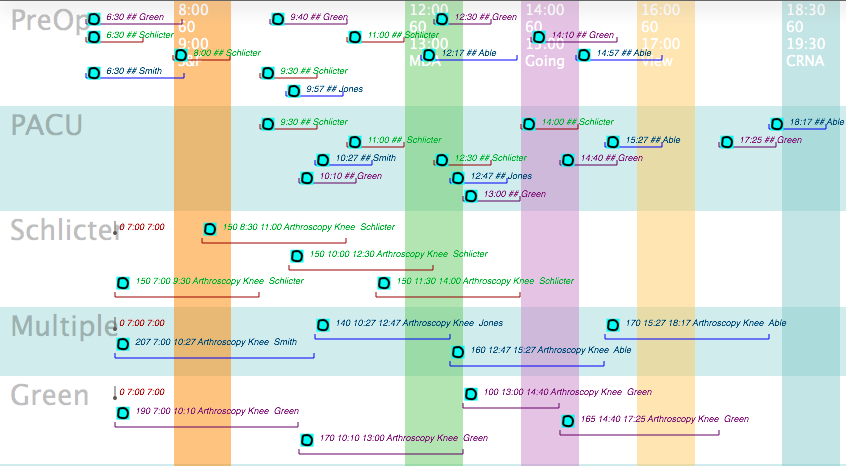
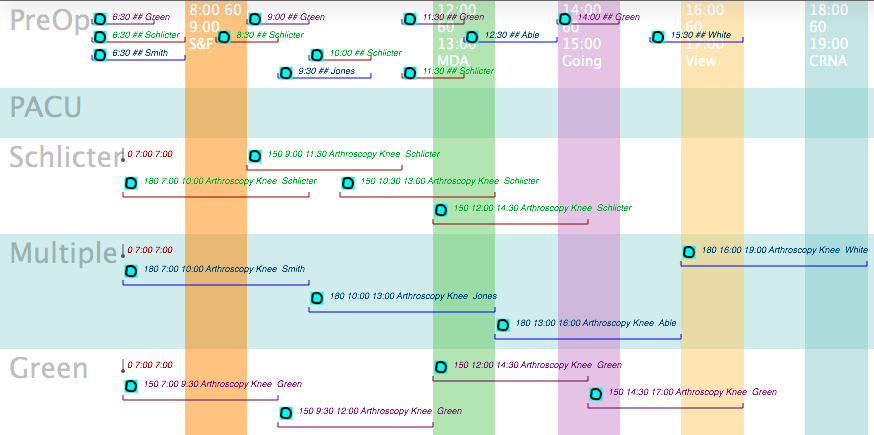
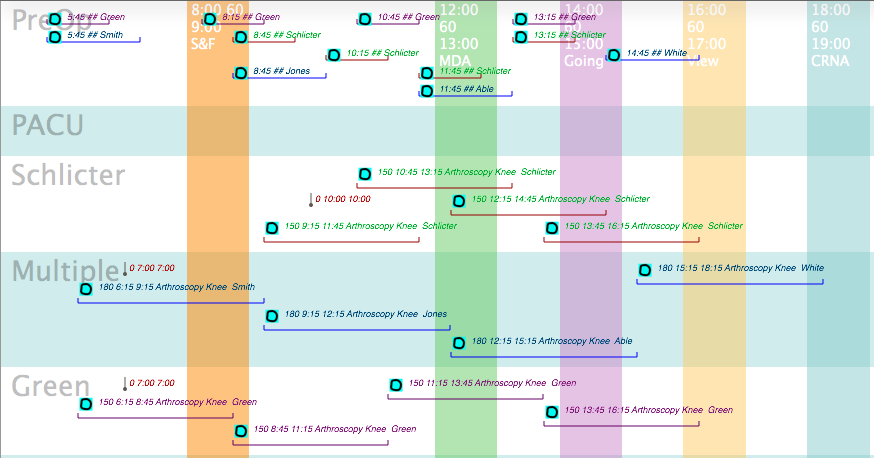
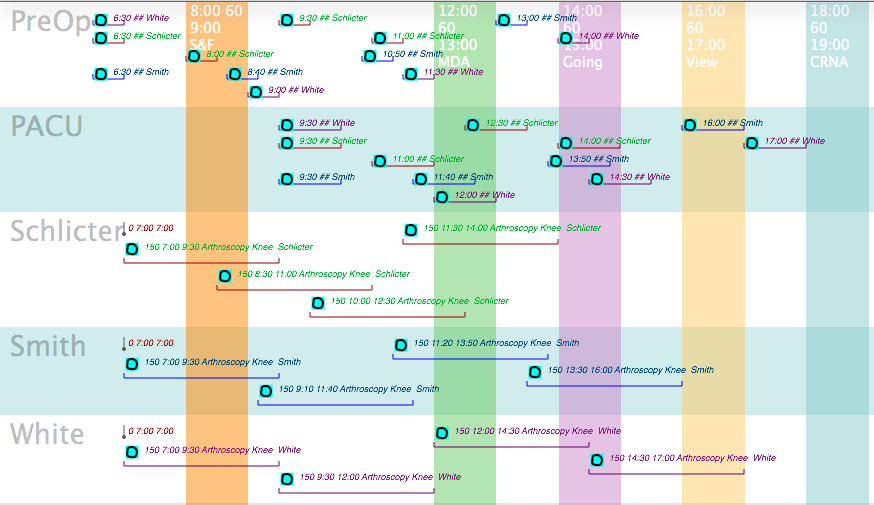
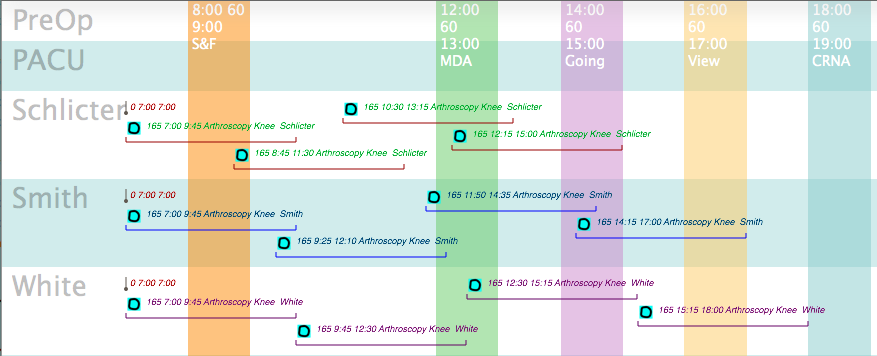
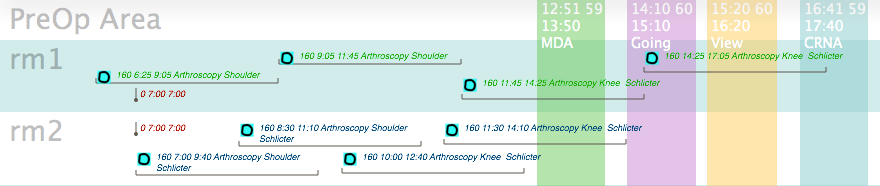
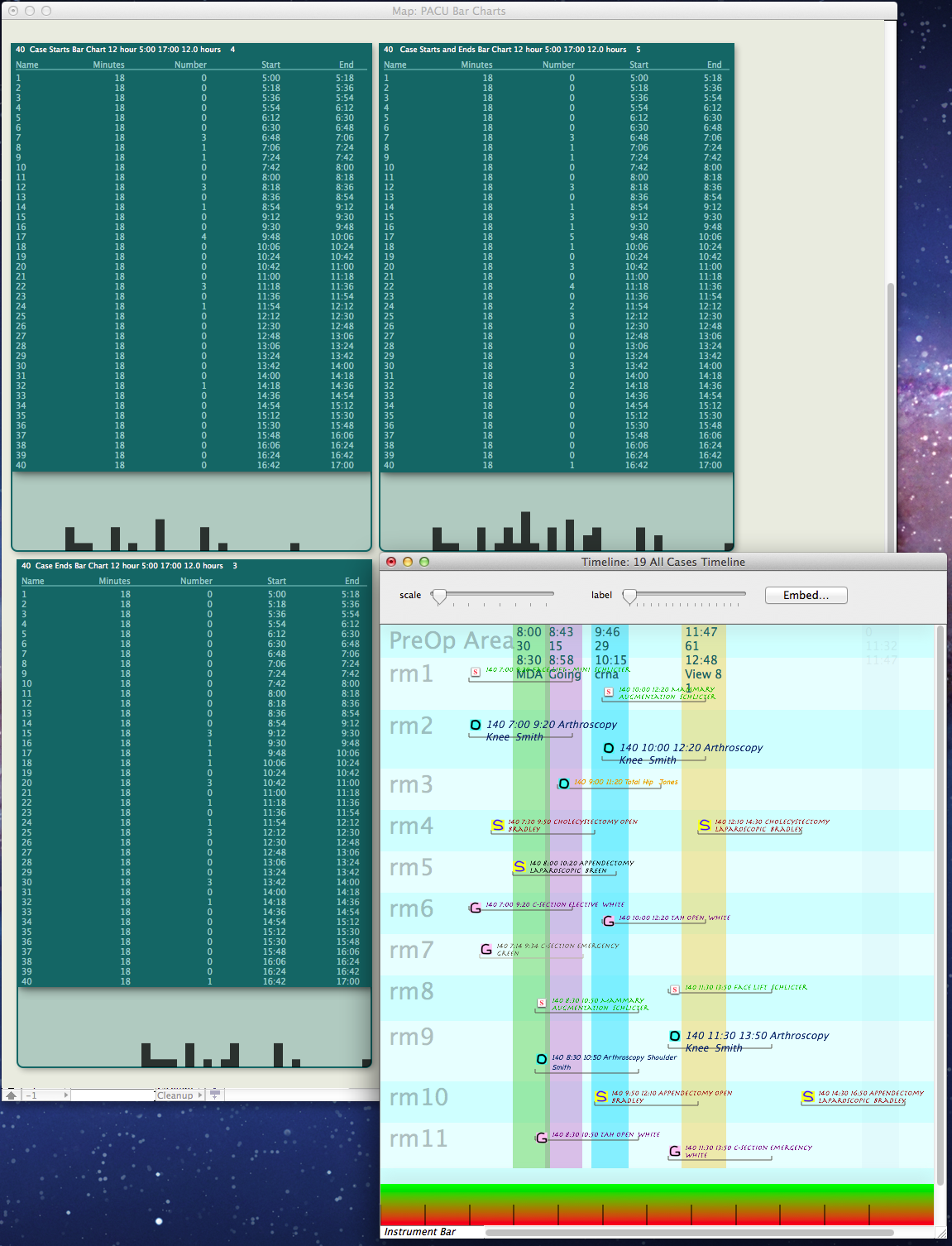
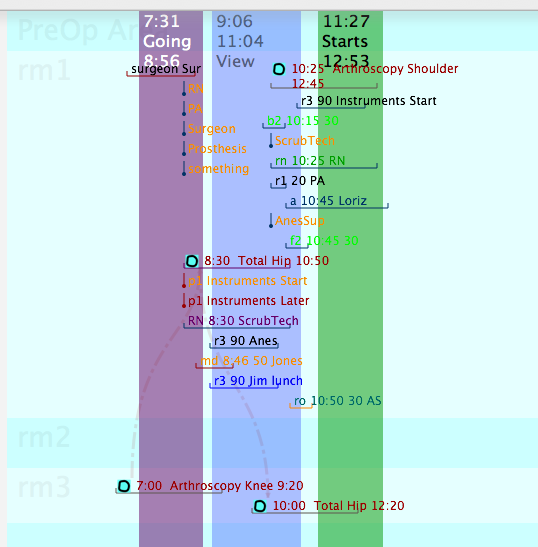
Do you know where your CRNAs are?


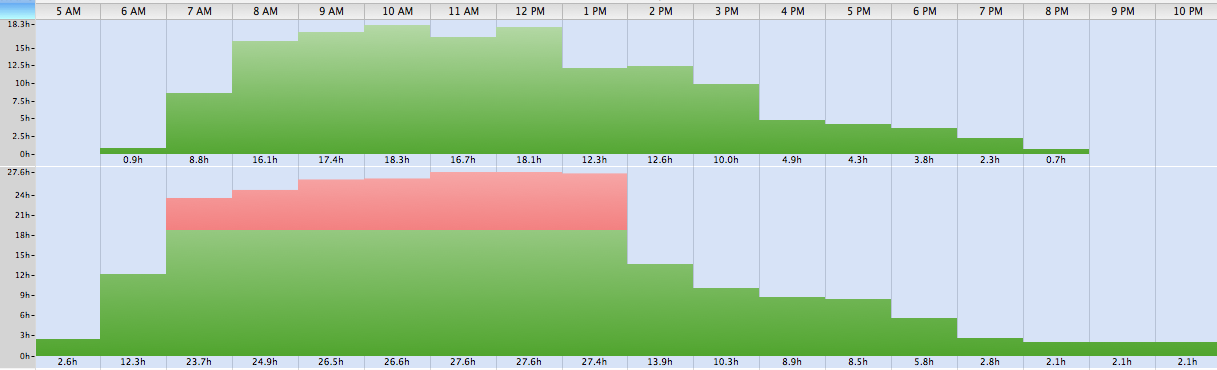
Excess CRNA Hours   $900,000 waste a year

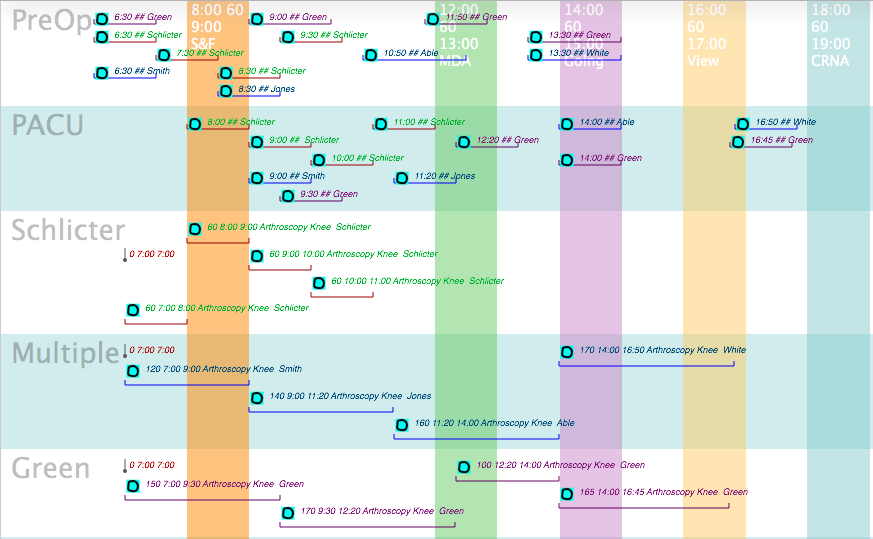
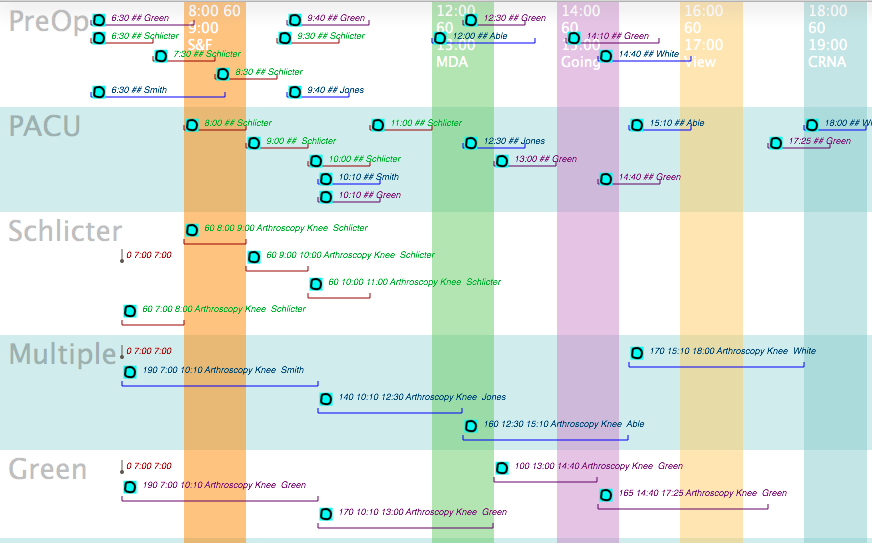
<click on graph to enlarge in separate window>  [Note that the scale for the upper and lower graphs are different]

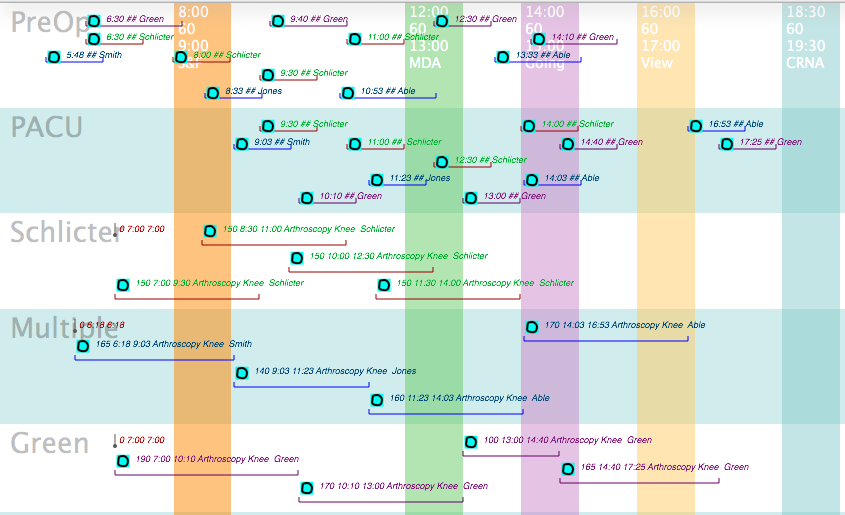
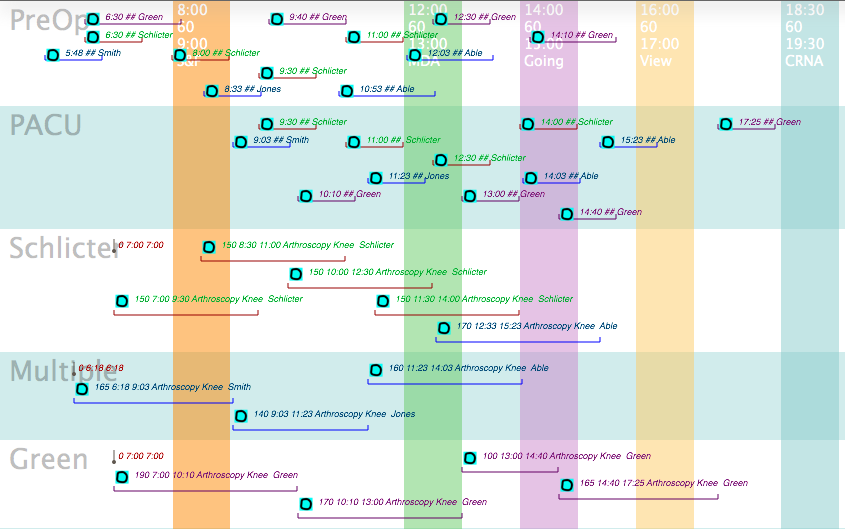
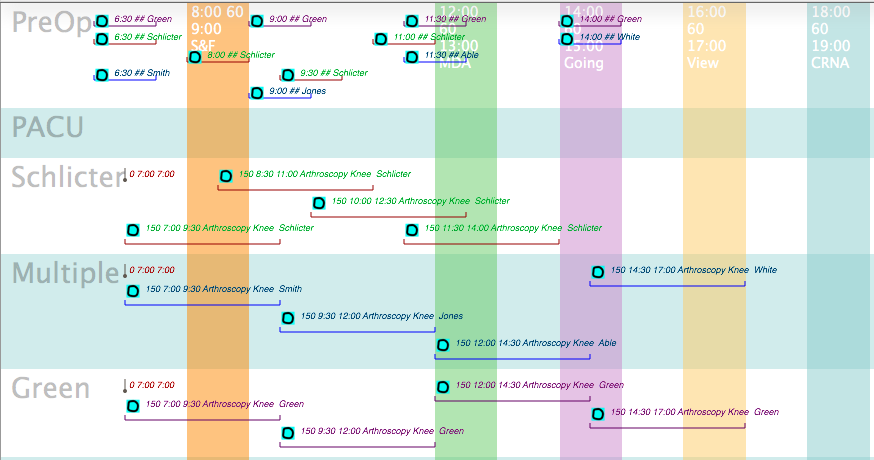
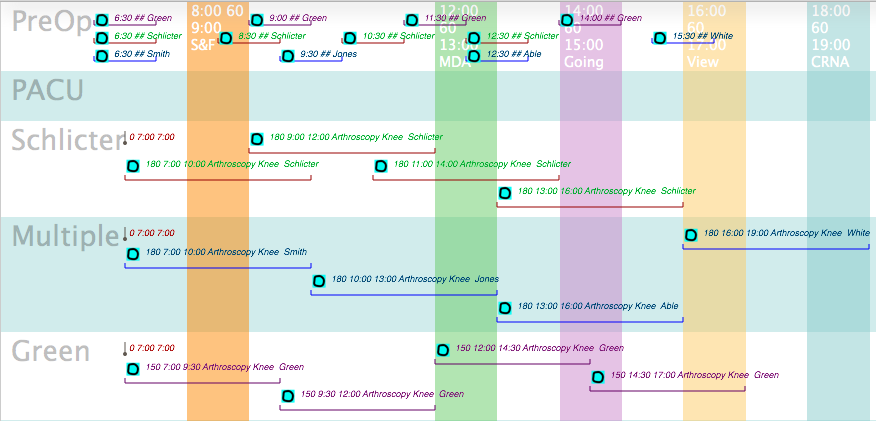
I mentioned in the prior post that my client had wanted an analysis of how well they were using their CRNAs.  By using the time sheets for the CRNAs, and the data from the anesthesia records, I came up with these two graphs.

The top graph shows times from the anesthesia records—the times that the CRNAs were doing cases (revenue for the anesthesia group).

The bottom graph shows the times the CRNAs were at the facility and being paid (expense for the anesthesia group).  The red part of the graph shows how many extra CRNAs present that were not needed during the peak hours.

(I suggest clicking on the chart which will enlarge it in another window so that you can more easily follow the description and analysis. Both graphs are scaled the same.  The actual hours used and hours available are at the bottom of each graph.)

Assuming the initial room preparation time by a CRNA of under an hour, there should be no more CRNAs present the hour before the first cases start than there are during the subsequent hour they are actually doing those cases.  There are 12.3 CRNAs available from 6 am to 7am, but only 8.8 CRNAs doing cases from 7 am to 8am which is [(12.3-8.8 =3.5)]; 3 CRNAs too many.  From 7 am to 8 am there are 23.7 CRNAs, but only 16.1 CRNAs doing cases from 8 am to 9 am [(23.7-16.1)=7.6]; 7 CRNAs too many.  The rest of the peak hours also show from 5 to 11 more CRNAs present than needed. From 2 pm to 4 pm there’s an appropriate amount of CRNAs present for the case load.  However, from 4 pm to 7 pm there are too many CRNAs.

Other important data is that the CRNAs are paid overtime after 40 hours of work in a week—there’s no overtime on a daily basis; the case scheduling is done by the nurses, not the anesthesiologists, and the anesthesiologists are guaranteed a minimum income which is just above what they would earn from the cases themselves.

While discussing the situation with my client, he said that a rough estimate of costs for 5 CRNAs a year would be close to $900,000. Looking at the graphs, even with the current system for scheduling cases and not adjusting anyone’s work schedule,  they could conservatively have 5 fewer CRNAs for the entire normal work day without making lack of CRNAs the constraint in the OR.  That’s $900,000 a year that if divided among a group of 25 anesthesiologists a year would be valued at $36,000 per anesthesiologist per year. If you then add the extra CRNAs that are  around from 4 pm to 7 pm [(8.9-4.9)+(8.5-4.3)+(5.8-3.8)=10.2]; you add an additional 10 hours of CRNAs not needed.

Depending on how conservative you want to be in your calculations, just with better scheduling they could hire 5 to 7 fewer CRNAs  and save between $36,000 to $42,400 per year for each of the 25 anesthesiologist.  If there were only 20 anesthesiologists, this would save up to $53,000 per year per anesthesiologist; this increase in income is in addition to the [25/20=1.25] 25 percent increased income due to dividing the revenue among fewer anesthesiologists.

Why don’t they schedule the CRNAs better? One reason is they lose track of their CRNAs—and they aren’t aware of the easy and inexpensive ways to tightly coordinate their activities with modern technology.  Another reason is hospital politics.

Where things get really exciting is when the anesthesiologists control the schedule.  This is possible when the anesthesiology group has an exclusive contract with the hospital, common in the southeastern US but not allowed in some other states. Even where exclusive contracts aren’t permitted, there is still a way to simulate the incentives and gains that can come with an exclusive contract.  More on that later…

Posted in anesthesiologist, scheduling | Tagged , , , , , | 1 Comment

Wasting surgeons’ time? One hospital– $27 Million opportunity Loss per Year from scheduling


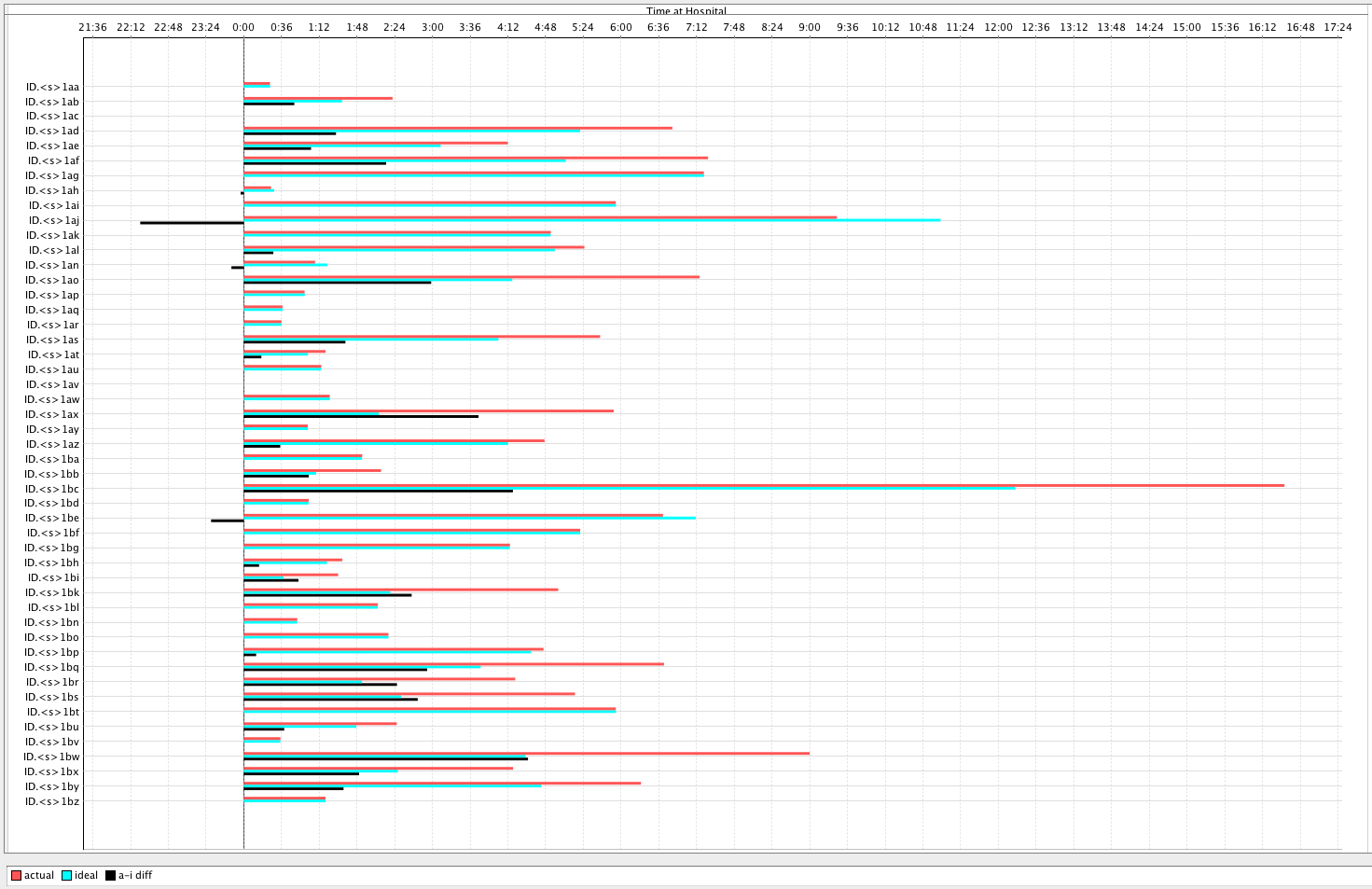
$2000/hr x 55 hours saved = $110,000 opportunity cost in one day …  Who’s in charge here?.

click here:  3 Graphs of Actual and Optimized Surgical Schedule « ORTimes – Healthcare Systems Engineering Analysis

The above chart was derived from data from a client who wanted to know if they were using their CRNAs efficiently. (we’ll show that another time). We decided to use the data to show information that would be of interest to a wider audience.

Beside each surgeon’s name is a red bar and a green bar. These bars represent the total time the surgeon had to be in the OR to finish his cases. The red bar is from ‘actual’ time recorded on the anesthesia records. The green ‘ideal’ bar is from a simulation using the actual durations, but scheduled differently. The black bar measures ‘actual’ – ‘real’.

You’ll notice that for two cases the green bars are longer than the red bars, but for all the rest the red bars are as long or longer than the green. In some cases they are over twice as long. This means most surgeons spent much longer than they needed to finish their case schedules. In fact, the total number of surgeons’ wasted hours is about 55.

In this case the OR was very busy, with most rooms being used. In the ‘ideal’ simulation, the OR did not use any extra rooms and did not stay open as long. I like analogies, and this scenario reminds me of packing a suitcase or the trunk of a car. The amount of space doesn’t change, but given the know how (and the right tools for scheduling) you can make a big difference.

The significance? If you were a surgeon, would you move your patients to a hospital where you could finish your cases in half the time? Would you do more surgery?

Below is the same chart but with only the ‘actual – ideal’ times showing. The black bars to the right of 0.00 indicated potential saved time. Those to the left of 0.00 indicate the surgeons’ whose time actually increased with the new schedule. Ways to avoid that can be discussed at another time.

update: Graphs of actual and optimized surgical schedule are on blog post dated January 20, 2010.

Time potentially saved by individual surgeons (actual – ideal)

Posted in anesthesiologist, CEO, healthcare reform, scheduling, surgeon | Tagged , , , , , , , , , , , , , , | 1 Comment

Take A Deep Breath — Tony B. Wilde


A

Posted in Uncategorized | Comments Off on Take A Deep Breath — Tony B. Wilde

Managerial Accounting Primer


Managerial Accounting Scope 20160319

Posted in Uncategorized | Comments Off on Managerial Accounting Primer

Root Causes of US Healthcare Design Conflicts


Single payer means single customer. If there is just one customer (no others exist) who no longer needs your services, or has an alternative to your services, then that customer, the single payer, can set the price just above the point where the provider is willing to quit that business.

With competing providers, the single payer will pick your services over other competing providers based on value versus price. Quality, availability, and other negotiable attributes are components of value. The single payer may want different mixes of value attributes for different reasons – and use multiple providers.

There is a lot of talk about single-payer healthcare. This would mean that providers of healthcare could have only one customer, implying the US government. Just as the term ‘Obamacare’ was used in lieu of Affordable Care Act, single-payer is misleading. Possible better terms would be ‘tax funded base healthcare’, ‘social safety healthcare’, ‘non-profit government sold healthcare’, ‘employer independent healthcare’, ’employer independent tax funded health care’, universal healthcare, or some other form depending on whether the healthcare is funded by taxes or purchased through the government with private money, who is actually covered, and whether other sources of healthcare are possible.

There can be a mix of tax-funded healthcare and non-profit-government-sold healthcare along with private health insurance and direct payment to healthcare providers as happens now. Which one has more value to an individual depends on that individual’s trade-offs of the parameters of value.

Price is always a component of value. Price risk (maximum amount potentially paid – deductible, or other portion of amount) can be a component of value. Hidden costs do not add to value, they subtract from value. Transparency of ALL potential prices is needed for rational decision making.

Just as overhead in a corporation can double the cost of a product, overhead can double the cost of healthcare. Health insurance companies (and equivalent players) can have large expensive bureaucracies whose goal is to deny payments to healthcare providers (thereby increasing the indirect costs of business for healthcare providers and themselves). The insurance companies will have shareholders who demand a competitive rate of return on their investments. The compensation of the decision makers of the health insurance companies (CEO) is dependent on the rate of return for those shareholders. The wasted cost of these massive time and effort  battles cause a large inefficiency in financial resources that would otherwise go directly to patient care.

The debate seems to be whether inefficiencies by the government would be greater than inefficiencies previously mentioned in the private sector. Other countries seem to prove that the government is more efficient. However, each government is different. It could be that the US government is much more inefficient than any other government and should not be involved in healthcare.

There’s also the question of accountability. A government whose bureaucracy is poorly held accountable for lack of skills and knowledge, incompetent, willing to be bought, or just malicious (sociopaths or psychopaths), will be inefficient in distribution of healthcare services and interfere with improvements in the system.

The US seems to protect its bureaucratic public servants. The recent problems with police all over the country, and the incarceration of four times as many people in the US as China (which has a larger population) or any other country is one example. The reputation of the IRS for complexity and hostility compared to other countries such as the Inland Revenue Department in New Zealand (or multiple others) is another example. The US has an enormous number of lawyers and accountants to deal with the government compared to other countries.

Are these the causes of fear of a universal healthcare system in the US? Is it a cultural problem that needs to be attacked at the cultural level?  What would help? Better education, better standard of living, better (fairer) judicial system, attacking corruption?

Are we asking the right ‘root’ questions?

Posted in Uncategorized | Comments Off on Root Causes of US Healthcare Design Conflicts

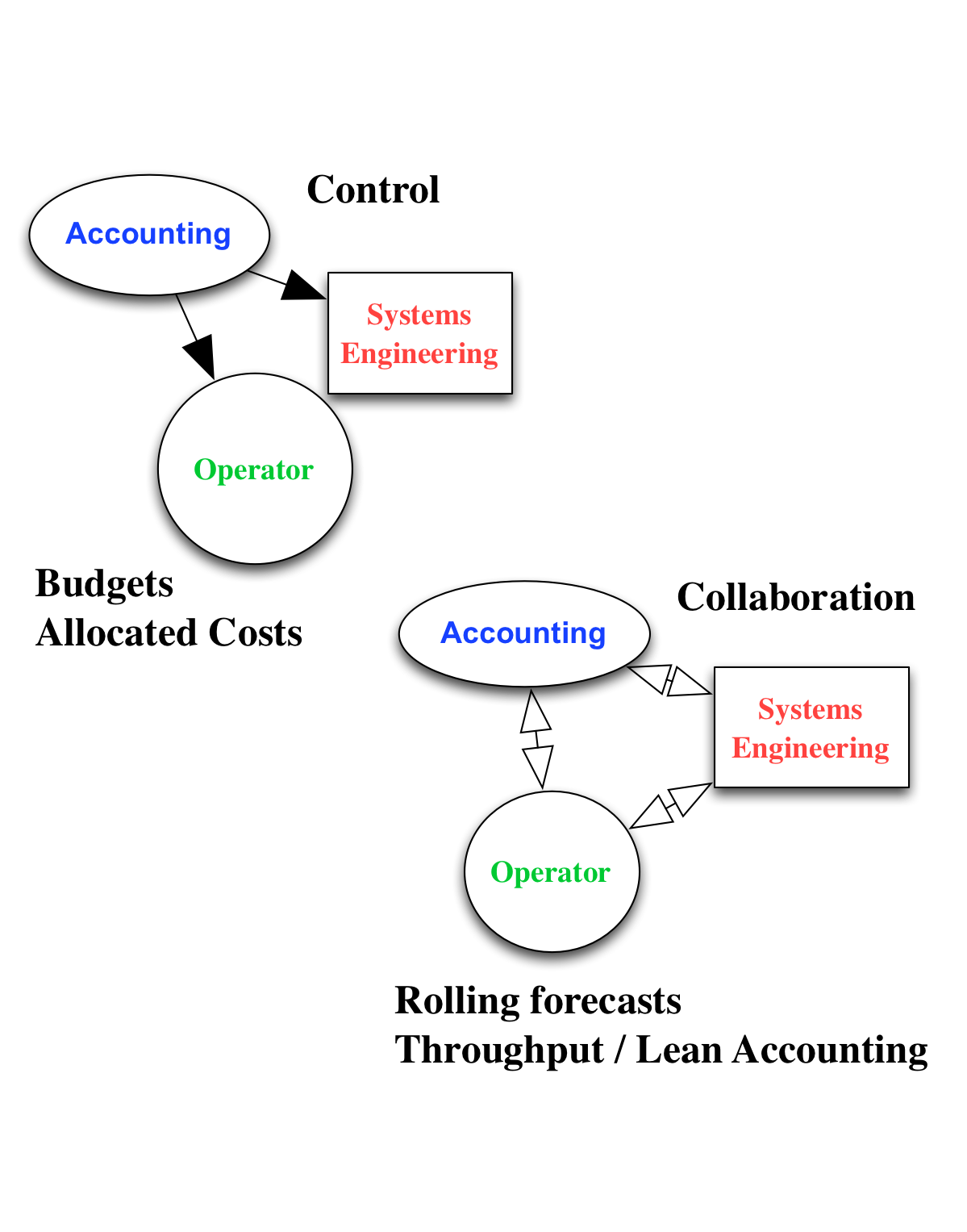
Is it all about Control?


Control and Collaboration

Posted in Uncategorized | Tagged , , , , | Leave a comment

MIT news: “flexibility in resources drastically improves wait times”


From MIT news (August 6, 2013)—    From theory to practice

“In work beginning with his master’s thesis, Xu has shown that having even a little flexibility in resources drastically improves wait times”:

I blogged about this in January 2010 relating it to ORs, but used the finance term ‘fungible’ to try to get the idea across. It was so obvious when actually doing it every day….that I forgot to alert MIT.

From ORTimes.ORG (January 27, 2010)—  From practice to theory – the fungible anesthetist

Expanding on the topic (July 14, 2010) —  the law of unintended consequences…staffing anesthesiologists

update 8/15/2013:  MIT news declined to publish my comments about prior research and articles. First  Aaron Swartz, now this … what’s up MIT, you were my favorite university.

Posted in anesthesiologist, OR concepts, scheduling, simulation | Tagged , , , | Leave a comment

Finance Leaders Bemoan Talent Shortage


http://www3.cfo.com/article/2013/4/training_finance-function-training-skills-talent-corporate-executive-board-kruti-bharucha?utm_source=taboola

Read the comments in the article.

Posted in Accounting, CEO, healthcare reform | Leave a comment

LinkedIn conversation…transparency discussion SCO (Surgery Center of Oklahoma)


OKLAHOMA CITY – An Oklahoma City surgery center is offering a new kind of price transparency, posting guaranteed all-inclusive surgery…

9 days ago

You, Robyn GrayTim Foley and 34 others like this

73 comments • Jump to most recent comments

Robert Bonds • Excellent piece and having worked for two of the hospital systems mentioned in the story that are both not for profits, they are extremely revenue oriented. What is of interest is the fact that the surgery center does not participate in any federal programs and that is why the surgery center can keep its costs to patients affordable. The cost accounting required by Medicare is a tremendous financial overhead for any healthcare to bear. What most healthcare consumers do not know is that Medicare/Medicaid reimbursement to surgery centers is 40-60% below what is paid to hospitals for the same outpatient surgery procedures. Surgery centers represent a very viable alternative for elective surgery.

8 days ago• Like1

Nick Yaqub, MD, MPHE, JD • Basic commerce idea that is extremely overdue in medical services. Consumers should support this and refuse to pay unpublished prices that are usually charged after the facts. This paradigm change will force hospital to concentrate on internal cost of their products.

8 days ago• Like3

Don Jarrell • Robert makes an excellent point which I’d like to extend. The notion that the cost of administrative/clerical overhead for CMS dealings is incremental, significant and does not contribute to either real operation or its essential economics is obvious. Similar creative response is growing in the face of ICD-10 implementation where costs for increased staff, increased training, new/enhanced software tools etc are coupled with probable increased costs in staff time to work denials, financial wrangling to accommodate more delayed reimbursement, more legal fees etc, etc.

As such, several providers with whom we’ve talked have discussed voluntary (“prophylactic”) down-coding, based on the fairly sound (IMO) theory that the decreased reimbursement across the board would be less than the costs of the enormous and continual fight with CMS over reimbursement dollars. This is not a political point but strictly a business/economic point.

8 days ago• Like1
Brian Gregory, MD, MBA

Brian Gregory, MD, MBA • I’m glad to see this transparent competition in pricing.

Unfortunately, as in many product/service purchases, significant quality will be ignored (or not seen) and people will choose based on price alone. Maybe I’m wrong…Thoughts?

@Don I think that downcoding might be a bad move in that the 3rd party payor may just use that as an excuse to claim that others are coding too high. It will also screw up any trends in disease or trauma analysis along with morbidity and mortality associated with those cases. Any thoughts on the significance of this, or possible alternative deals/discussions with the 3rd party payors?

Transparent price competition might encourage the use of concierge physicians (medical care) knowledgeable about the facilities and clinicians who can weigh and explain the expertise-risk-price trade-offs for the patient.

Medical tourism is already involved with these same problems and some have developed more sophisticated quality measurements than those used by JCAHO. It seems that some convergence is beginning (which usually means that we’re actually getting somewhere).

In any event, those of us who make the process more efficient/productive should see an increased interest in our products and capabilities.

8 days ago

Don Jarrell • Dr. Gregory, you’re absolutely right that as provider-shopping becomes more based on price transparency, some providers may over-torque the dynamics as previously seen in other markets tending toward commoditization. But, I’m sure we agree, there is a big difference in discovering the price/quality boundary in solar landscape lighting versus a CBAG.

The conflict between coding-for-research and coding-for-reimbursement is inherent, huge and not the doing of the providers or private payors (even if the latter learned to exploit it). Exercising such options for many may become more about survival than greed with the ultimate net effect being that, as you say, volunteer down-coders will be *pitted against* those who choose (and can afford) to spend a lot of money fighting denials on higher, (hypothetically correct) codes. (Just observing, as we have no dog in that fight.)

Finally, because of our business, we have an interesting view of what things HCOs *want* to measure. With a growing library of 1100+ expertly-defined “official” Performance Measures on the entire spectrum of clinical care performance, we are still adding (quite easily) additional measures that customers and prospects request. Even with a predominant focus on universal/eternal measures of outcomes and clinical practices, we still get a lot of requests for measures related strictly to performance against administrative or “program” mandates from regulators. Of course, everyone who runs any kind of HCO is familiar with such pressures that are not *really* about quality of care. Interestingly the conversations we have with international prospects make clear they appreciate our primary focus as a real *quality* related *management* tool for delivering best patient care efficiently.

8 days ago• Like1
Brian Gregory, MD, MBA

Brian Gregory, MD, MBA • Don, what I like about your system (if I’m interpreting correctly) is that you can quickly modify and tailor it for a specific type of medical care and facility. The research and practical benefits, for those who understand how and why to modify the measures, are enormous: a rapid simulation and learning platform in the right hands, and a way to ‘game’ the system in the wrong hands.

Powerful, and prescient– if Surgery Center of Oklahoma becomes the norm (which seems to be the case from the article). They’re engaging in medical tourism. The medical tourism systems I’ve heard about before are more rigid and would be expensive and slow to adapt or tailor for rapid competitive purposes, and it looks as the competition is increasing.

I’m also glad that SCO is empowering its employees knowledge and input—tough competition to beat!

8 days ago1
Brian Gregory, MD, MBA

Brian Gregory, MD, MBA • As an aside, 15 years ago I tried to get the hospital where I worked to do this. They (as well as some of the comments in the Oklahoma City hospital article) said they’d never do it and listed a plethora of reasons. Validation is sweet.

8 days ago2

Jeffrey Thompson • Don and Brian,

I really enjoyed reading your comments. To add to discussion, I think it will be essential for healthcare providers to truly understand and separate out which conditions/procedures can be either fully or partially commoditized and which conditions/patients are more complex. As Clayton Christensen discusses in the Innovator’s Prescription, a value added process can be empirically driven and paid on fee for episode (bundled payment) while the complex condition should still paid on fee for service.

I think we will find that we have more conditions that can be commoditized over time as we reduce the artificial variation in healthcare.. This can and is being done in pockets across the country but requires a well-designed and flexible delivery model combined with significant culture change at all levels.

(The views expressed are my own and do not reflect the views of my employer.)

7 days ago• Like
Brian Gregory, MD, MBA

Brian Gregory, MD, MBA • Jeffrey, you said:
“I think it will be essential for healthcare providers to truly understand and separate out which conditions/procedures can be either fully or partially commoditized and which conditions/patients are more complex.”

::grin:: That’s the fun part —nothing like a tough puzzle for a good team with some depth.

I know that the Mayo Clinic is quite good at the non-commoditized part, and ‘The Innovator’s Prescription’ [Don and friends turned me onto it earlier this year] would have categorized Mayo as a fee for service facility. If you are at liberty to say, how far has Mayo delved into commoditizing? I’ll leave that as a simple open ended question even though I have some very specific-detailed ones.

7 days ago

Jeffrey Thompson • Hi Brian,

There are many efforts across the institution looking at practice redesign and it definitely will be a journey for Mayo Clinic as well as other institutions as our country deals with healthcare reform. As for specifics, we are publishing multiple publications of our work in cardiac surgery which will be out there over the next year.

7 days ago• Like

Rick Baker • Our medical brokerage organization, has been triaging clients to Dr. Keith Smith’s facility in Oklahoma City for the last eight years. All of our clients who have had surgery at this facility, give it rave reviews.

Healthcare is the one industry, more than any other, where there is no relationship between the cost of the service and the quality of the service in most cases. We use an online hospital rating service to vet the hospitals to which we send our clients.It is fascinating to note that several world famous American hospitals will get a one star rating for spinal fusion, for example, whereas hospitals we routinely use, in nearby states, and which get no national publicity, get a five star rating.
Yet the hospitals we use, charge our clients a small fraction of what they would otherwise have paid at world famous hospitals.

7 days ago• Unlike2

Joanne Rohde • The State of Colorado is doing an excellent job on price transparency, posting charges and efficacy of the physicians. All the insurance companies have come to gether to force this transparency, and they have the added ability with the State’s help to publish the docs and hospitals data. I’d keep an eye on what’s happening there. It won’t be perfect at first, but great is the enemy of the good.

6 days ago• Like
Brian Gregory, MD, MBA

Brian Gregory, MD, MBA • Joanne: Are they posting charges and collections? Is there enough raw data to discover liens on people’s property? I know it’s early, but how about 1,2,3 year follow-ups? Inexpensive, but also unneeded tests, procedures, or referrals? A start is good….

My gist is that I don’t know what type of data Colorado is collecting . Putting data into the public arena is great, and I hope that it’s comprehensive enough that it can’t be gamed. There should be the possibility for people to recognize tradeoffs that might exist, also. Pros should be able to adequately and confidently analyze the data for those who can’t.

Florida (yeah, I know…Florida) had a simple system for listing malpractice suits that could be assessed by the public. From personal experience, and those of others, we saw bad information: wrong docs, no information on many dismissals or settlements, few details, impossible to correct. Lots of Catch 22’s and bad administration. Gamed by some less than ideal docs who knew how to triage their mistakes elsewhere.

What Colorado is doing is good for the general public. However, physicians and facilities wanting to decrease their costs by increases in efficiency and productivity (while decreasing risk) require different data and different outside information. That ‘private’ information will then help them score better on Colorado’s ‘public’ information ratings, which is feedback (but not solutions) for the processes.

Ideally, results and process are analyzed together. That would be difficult for the state to do, but easy for the physicians and facilities. That’s also why Colorado should be very careful about the data it collects—gaming the system.

6 days ago

Christopher Hawley • So if you click the link for the pricing in the article all the prices come with an asterisk that refers to a “Pricing Disclaimer”. If you click the disclaimer it takes you the disclaimer page that states:

“NOTE: If you are scheduled for surgery at our facility and we are filing insurance for you, the prices listed on this website do not apply to you.”

The pricing disclaimer also goes on to point out that any hardware or implants are not included in the quoted price. Overnight stays are additional charges. Expenses or fees resulting from complication are also not included.

When you really look at what they are doing it isn’t anything really different than hospitals with regards to transparency. Self-pay patients are still paying different then insured patients and the prices are nothing more than quotes.

6 days ago• Like
Brian Gregory, MD, MBA

Brian Gregory, MD, MBA • When buying a car, you can get upgrades, change the tires, etc….But you know the price before you sign on the line. If I understand correctly, you can get the final inclusive price for SCO before you sign on line; or if the hardware has to be changed after the operation starts, you can have knowledge of how much that change will be and also the maximum potential price.

When going to most hospitals…it’s a big surprise for the patient at the end of the day.

When going through most insurers…it’s a surprise for the doctors and facilities at the end of the day. I’m not surprised that they don’t quote for third party payors.

6 days ago

Greg Grambor • As a layman, to me this is all so superficial. If I am going to have surgery, I seek the most competent doctor I can find, and hang the cost! And I am very far from being a wealthy person. Even if I have to take a loan to pay a horrendous co-pay, I would do it. When anyone in my family needs a procedure, the research machine goes into high gear, and the responsible adults in the family start making a blizzard of phone calls seeking referrals to the most highly regarded expert in that type of surgery. You have a duty to yourself and those who depend on you to make sure the person cutting you open is the most skilled you can locate. Let the money take care of itself over time. Just a view from the other side of the scalpel………….

6 days ago• Like

Christopher Hawley • Buying a car is the purchasing a finished product, of course you can be given a final price. A better analogy would be going to the mechanic. He can give you an estimate based on his initial assessment of the problem, but until he gets in there and sees what’s actually wrong and fixes it he can’t give you a final price. And just like at a hospital the bill can be a big surprise at the end of the day.

This surgery center is using a business model like Jiffy Lube. Jiffy Lube provides standard pricing for the low level maintenance services: oil change, air filters, fluid changes, etc. However they aren’t going to replace your mechanic or provide standard pricing for any sort of complicated repairs. This business model works because the services can be standardized with regards to cost. It’s a good business model for what they do, but their services are limited and Jiffy Lube cannot replace your mechanic.

When going through insurers it’s a surprise for doctors and facilities? While reimbursement rates differ from insurer to insurer the actual reimbursement rate it’s never a surprise.

6 days ago• Like

Robert Bonds • There was one comment regarding the quality of the surgeons which is very common in the surgery center world. Having been a surgery center administrator years ago I had to deal with this comment. Those surgeons who have privileges at the surgery center have to be credentialed before doing any procedures, just the same as the hospital. Many if not all surgeons who operate at a surgery center are also those who are on staff at the local hospitals, ergo there is no difference in the physician. The scope of care provided at a surgery center is regulated by each state to ensure the safety of the patients, so that surgeons are not performing cases which are beyond the capabilities of the center.

As to the comment about this business model, while I have not investigated what the Surgery Center of Oklahoma has posted on their website vis-a-vis pricing; I am sure there is some sort of disclaimer to take into account a complication that arises during the procedure. Why does Jiffy Lube do more oil changes and other minor car maintenance than the local car dealer or independent mechanic; quite simple they are extremely efficient and proficient. Ergo this also applies to services provided by a surgery center, which based on information from FASA, the surgery center trade organization and personal experience, the efficiency of the surgery center is far superior to the outpatient surgery department of the local hospital. Let’s not forget that the “outpatient surgery department” of the hospital is not truly a separate department with its own set of operating rooms. In reality all that exists is a separate reception/waiting area and possibly a separate pre-op area. Those patients coming through the hospital “outpatient surgery department” are having their procedures in the same operating rooms that those patients that were admitted directly into the hospital. It is typical for those hospital surgeries to be complicated, delaying those elective surgeries coming through the “outpatient surgery department.”

At the end of the day, in my opinion, elective surgery patients can be better served by having their procedure done at a freestanding surgery center where efficiency is priority and where the insurers do not take a beating at the hands of the hospital.

6 days ago• Like
Brian Gregory, MD, MBA

Brian Gregory, MD, MBA • Christopher and Robert,
Having been personally involved in 20+ years of surgeries as an anesthesiologist, I can guarantee you that there can be a tremendous difference among board certified surgeons both in time it takes to perform a surgery and the quality of the surgery.

Some surgeons would not be asked to be part of an efficient free-standing surgery center due to the operational cost (overhead) of their slowness and complication rate, potential lawsuits, and frictional personalities. Ask anyone who actually works in a hospital OR. I could say the same about some anesthesiologists, CRNAs, and nurses not making the cut. The integration as a team is important, too.

As for third-party payors, the cost for collecting from specific payors who deny claims or drag their feet have caused some friends (surgeons, OB-Gyns) to quit accepting those patients having their policies. Again…not conjecture but routine that every surgeon’s collection ‘people’ have to deal with.

Anesthesiologists (particularly when and where multiple groups or individuals would work with same surgeons in the same hospitals) would try to surreptitiously see who was the primary payor for a patient before having a ‘busy’ excuse for not being able to do a specific case the next day.

Hospital administrators know this because part of the contract with an anesthesia group often depends on a guaranteed minimum for the independent anesthesia group due to a ‘bad’ insurance mix with regards to paying for anesthesia.

Ask any plastic surgeon whether they’d take cash over insurance.

As for the arcane accounting practices of many hospitals versus free-standing surgery centers…Well, that’s a major cause of the mis-pricing of surgery. It’s amazing that inappropriate accounting concepts and systems can make an otherwise viable in-house outpatient surgery center not competitive.

So…
* Difference in surgeons

* Difference in anesthesia

* Difference in nurses

* Difference in payors

* Difference in accounting and complexity

That’s before I have to think hard about it and get into problems with referral patterns or non-necessary consults, non- necessary tests, incredibly inefficient scheduling of surgeons cases during a specific day…

This may be why there’s such effort by hospitals to prohibit free standing surgery centers (often funded and run by surgeons and anesthesiologists) by legislation.

Those with more knowledge, experience, and funds at stake who actually play in the game usually end up competing better.

6 days ago2

Rick Baker • The Surgery Center of Oklahoma,whose pricing strategy started this whole conversation, is a physician owned facility. Only the brightest, most capable, and most efficient surgeons are invited to join their group. And certainly, no surgeons with any malpractice issues, would get an invitation.

Based on the positive outcomes which all of our clients have had with their surgeries at this facility over the last 10 years, I would have no hesitation in scheduling surgery for any of my own family, at this center.

6 days ago• Like2

Ralph Weber AEP, CFP, CLU, ChFC, GBA, REBC • Keith Smith and his Oklahoma Surgery Center has single handedly started which no amount of legislation could ever do…He has begun to restore a free market in medical care. The PPOs with their opacity operate like a cartel and prevent competition, so the only way to reduce costs is to step outside of that model.
The Oklahoma Surgery Center is one of our best facilities on MediBid.com, and they have stood by their quoted pricing even when minor complications arose.
More and more employers are embracing competitive models, as we design health plans which encourage that

5 days ago• Like1

Jonas P Littman • Does anyone know if such down-pricing and transparency has had the effect of Insurance Companies asking to renegotiate their negotiated rates lower? I am trying to get my local hospital to change its entire charge-master, but one argument is that it would open them up to such re-negotiation.

5 days ago• Like1
Brian Gregory, MD, MBA

Brian Gregory, MD, MBA • Jonas: ::grin:: There’s a limit as to how many cases OSC can do in a day…so far. However, the pressure is on. If not careful, the insurance companies will price themselves out of the market as a middleman. Their options will be value added services, more legislation, or integration with these efficient places.

Ascension Healthcare (a hospital behemoth) is taking the later route by investing in the 2 billion dollar cardiovascular hospital on Grand Cayman that is being spearheaded by the best known cardiovascular surgeon from India (sorry, forgot his name). It’s a guess as to how Ascension is going to take advantage of this. In any event, short sell your CV surgery units now while there’s still time! 🙂

5 days ago

Alen T. • I looked at several of their prices and are very close to 80/20 reimbursement plans.

5 days ago• Like

Jonas P Littman • But 80/20 of what? I am seeing the situation where an uninsured person (or someone with insurance but where the procedure isn’t covered) gets charged the “charge-master” price which is ofter a very very significant multiple of the typical negotiated rate. So a $10,000 surgery can have a charge master of $50,000. This is why I want to get them to change this truly fundamental pricing number across the board.

5 days ago• Like1
Brian Gregory, MD, MBA

Brian Gregory, MD, MBA • (hopefully someone can better explain or correct the following)

Jonas: If I understand you correctly, you’re asking why the hospital charges the maximum amount for non-covered items?

Apparently, it’s a bizarre numbers game between the hospitals and 3rd party payors.

Third party payors (government or private) tend to take an average, quartile, minimum or some other statistically calculated amount from all the charges for that category of care (how they group care activities into categories is sometimes a mystery unto itself). That calculated amount (within their accepted categorization) is what they will pay without going through a very expensive collection effort by the healthcare provider. The categorization can also depend on where the care was given.

I suppose 3rd party payors could also take a statistical calculation of the amount actually paid out (without taking into account the cost of collection by the provider) and come up with a price for specific care that way. As usual, people seem to accept statistical reasons for doing things whether that actually makes sense or not, so any type of calculation might be invented.

So… The hospitals will therefore charge an ‘unrealistic’ maximum so that they keep that statistical calculation high (whatever the statistical calculation is).

Sometimes the hospitals say that they have to ‘overcharge’ on some items because they aren’t paid enough for other items. A lot of normal people have trouble believing this argument based on common sense. A lot of people in non-hospital finance and non-hospital management have trouble believing this (loss leader?) argument based on economic, finance, and management theories and experience in other, competitive industries (payment inefficiencies inhibiting appropriate charging for specific services and focus for improvement or alternative care).

i.e.,
* The hospitals are more accustomed to making money by charging more (like the government collecting taxes) than by becoming more efficient or productive (like the computer industry and some others), they’re under financial pressure, and…

* there are no usury or other laws effectively prohibiting many of these high charges whether the charges were known by the patient or came as a surprise later.

Which leads to the demand for transparency, competition, and/or universal healthcare… which leads to SCO being formed, medical tourism on the uprise, the beginning of serious efforts in efficiency and productivity, etc.

5 days ago

Ralph Weber AEP, CFP, CLU, ChFC, GBA, REBC • Jonas,
Changing chargemaster might do that, but there are better ways

5 days ago• Like

Ralph Weber AEP, CFP, CLU, ChFC, GBA, REBC • Brian, Third party payers also have a built in “hidden fee”. If you google “Blue Cross Hidden fees case” you will see what I mean. That’s why they like the chargemaster, so they can re-price the procedure to “allowable”, but then reimburse the facility at a rate even lower than that.

5 days ago• Like
Brian Gregory, MD, MBA

Brian Gregory, MD, MBA • Ralph, How does that play out in court?

(reminds me of the time I was charged for napkins and pats of butter in a restaurant in Italy)

5 days ago

Richard Beery, MBA • Another thing to take into consideration is that, for in-patient care, the advent of the DRG reimbursement mode spelled the death knell for cost related accounting for hospitals. It used to be, pre-DRG, that the various departments (radiology, lab, respiratory etc.) were termed “revenue centers” since the hospital was paid on a “time and materials” type basis. Since DRG the only revenue center is the coding department of Medical Records and there is no way of assessing the reimbursement amount which should go to covering the cost of physical therapy treatments following a knee replacement.

5 days ago• Like

Jonas P Littman • Interesting comments all. thanks.
I need to do some more reading. The weird thing on the very specific issue of charging the full charge-master rate to the uninsured is that this appears to be a very small part of the bottom line when I look at the Hospital’s last tax return (2011). So it is hard to imagine that even if every charge-master price was 10x the average negotiated rate, that it would move the meter much in the somewhat obtuse calculation you mention (Brian) that the insurer’s make.

There is no doubt some of this is just a historic artifact and since it almost only impacts a small un-empowered population there is little incentive to change it. In fact most people I’ve spoken with don;t even understand that this is an issue. The reaction is “it doesn’t matter. THOSE people just don’t pay.” And in fact collection rates are low. But a) maybe they would pay the $1000 an insurance co would negotiate but not the $10,000 they are being billed. And b) the debt and credit issue will haunt them for years. So there are many people out there who desperately want to pay but simple can’t afford the outrageous amount they are asking. “Usury” is a good analogy.

Ralph I am very interested in another easy to implement way to go after this than changing the charge-master.

5 days ago• Like

Richard Beery, MBA • Jonas – You are quite correct that the Charge Master has little to do with overall reimbursement. And, charging the full price to those least able to pay makes no sense at all. When I was working in a hospital, way back when, it was a common practice to mark up products and services 300 to 500 percent of the cost on the Charge Master. I have no knowledge as to whether or not that still holds true, but I would guess that it does, if not more.

5 days ago• Like

Ralph Weber AEP, CFP, CLU, ChFC, GBA, REBC • Jonas there was a precedence set in Florida about charge master and the uninsured. Also repricers, ppos and medical debt collectors benefit from high chargemaster rates

5 days ago• Like

Jennifer Misajet • So much to read here-
I just had to give a nod and smile to Brian’s description of anesthesia wanting to know the payor before the procedure. In my past we fondly called that the “wallet biopsy” and the on-call person got defaulted what was assumed to be low pay or no pay work on that day (-:
We could spend hours on the chargemaster/item master alone-
first it can be a mess with duplicates of the same item (sometimes with different prices) which makes any kind of analytics more difficult.
second- when the annual increase is calculated- you have to go back and take a look at the cost of particularly low dollar items comparing charge to purchase price- that work does not routinely happen with lower ticket items. Even if you use some type of matrix based on type of item and dollar range, across the board increases need close scrutiny. The price the hospital is paying for the item is frequently not current in the system- so anything based on cost can also actually be charged at less than what you are paying for it (true). Don’t forget all those other thousands of supplies that are in the item master but are not “chargeable” so have a zero $ value in the chargemaster.
We do know that people “choose” to be uninsured when accessing healthcare services…
I will stop there on that subject.
Last but certainly not least- one thing no one has mentioned that contributes significantly to the cost of medical care anywhere – Salaries and benefits. This can vary greatly based on geographic region, skill mix etc. but can’t be ignored. Free-standing surgery centers have gotten closer to acute care in wage and benefits and frequently use bonus pay and other incentives as part of the total compensation.
Interesting times

4 days ago• Like

Gerald Rogan • When I practiced primary care, I advised a private pay patient to pick the cheapest surgery center and I would find a surgeon to operate. I gave him the CPT code for his operation.
One of my uninsured friends negotiated an all inclusive cash hospital fee for his wife’s delivery at Medi-Cal rates.
Another friend made so much money owning 10 surgery centers with his surgeon partners that he retired at age 38.
As a self-pay patient in 2012, I visited a specialty doc at his office located in an office building near the hospital. Two months later the university hospital charged me $329 for use of his office for one hour. The existence of the facility fee and its amount was not disclosed in advance. The hospital refused to waive its non-compliant bill, so I was forced to pay it and file a complaint with the State of California department of licensing and certification field office. The investigator found the hospital system was not compliant with current California law and required a corrective action plan. Now I must follow-up to determine whether the hospital is compliant so I know whether to file another complaint. What goes around comes around!

4 days ago• Like

Prakash Singh • I think this is good news for all to improve transparency and I hope other hospitals also follow the trend.

4 days ago• Like1
Brian Gregory, MD, MBA

Brian Gregory, MD, MBA • Does anyone else recognize the irony that this discussion thread is about price transparency for the CUSTOMER, but price (cost of operations) transparency for the SELLER is a major problem, too (reference to Jennifer’s comment)? It’s difficult to have competition leading to improvements if both sides are guessing.

I’d like to know how Surgery Center of Oklahoma handles their accounting system (theory, computer program, and practice implementation). I assume they have a positive cash flow, but even that would need to take into account the owners’ net from professional fees and the surgicenter together. And, who knows what the requirements of the passive investors (if they exist) are?

4 days ago

Jonas P Littman • Brian, that is true. But it is true in any complex business that figuring out the cost of one action depends on the allocation of the cost of a variety of support functions. How much of food services should go into a patient’s bill for getting stitches in the ER? At least I assume that is what you are talking about.

Jennifer. I am interested to hear more about “We do know that people “choose” to be uninsured when accessing healthcare services.” I know some people choose to not pay for health insurance. but do you mean they will pretend to be uninsured when accessing services?

4 days ago• Like

Christopher Hawley • I just don’t see how this surgery center is being actually”transparent with pricing”. The prices listed are only applicable to uninsured patients, and there is a potential for a multitude of additional costs not listed in that price. Did any of you notice their preferred payment method is cash and there are additional charges for any other forms of payment?

This is probably a much more effective marketing tool for them than functional business model. How many uninsured patients do you know with cash available to afford one of these procedures? I’m sure they get the occasional patient from Canada or California, but I bet the majority of their patients are still insured patients. With their advertised pricing then can now make claims like; “an ankle arthroscopy at OU Medical Center will be $23,934 while it’s only $3,740 here.” There are lots of insured patients who will hear this and choose the Surgery Center because they think they are being cost conscious consumers. Except neither of those prices are actually applicable to an insured patient. Both places have negotiated reimbursement rates, which neither are disclosing. The insured patient has now gone there thinking the prices are lower, when in fact the insurance negotiated reimbursement could potential be higher at the Surgery Center.

4 days ago• Like
Brian Gregory, MD, MBA

Brian Gregory, MD, MBA • Jonas, I was referring to the problem that Jennifer had with simple direct costing due to ‘simple’ problems with updating the cost sheets.

At OSC it should be easier to keep up with the direct costs, and there’s much less indirect cost. That’s a major advantage free standing surgery centers have since they will not as likely misapply as much costs (and subsequent strategy changes, purchases, etc) compared to a hospital with a lot more overhead.

When large established companies attempt disruptive innovation, it’s usually recommended they create an entirely separated division that does not deal in any way with the existing structure—-not culture, and not accounting. The culture piece is more obvious, the accounting piece is not so obvious but involves bad strategy from misapplication of decisions based on overhead from the rest of the company to the new venture. [Certain accounting systems can more easily handle the problem without separating the new venture.]

When dealing with non-direct costs, you’re getting into a big debate on whether to use throughput accounting, marginal accounting, TDABC, standard costing, etc. That’s a massive debate unto itself and the choice can make or break a facility.

4 days ago

Jonas P Littman • Brian – Sorry to be dense: does “cost sheets” = charge-master?

Christopher – As guess as a subset of your point, why won’t the insurance companies come back to re-negotiate basis these published prices? My understanding is that most contracts between ins.co’s and hospitals have some sort of most favorite nation clause that they can’t sell the service at a price below their negotiated rate.

4 days ago• Like
Brian Gregory, MD, MBA

Brian Gregory, MD, MBA • Jonas – No, they’re not the same– item master would be closer. Jennifer touched on this in her comment. When dealing with some accounting systems (like TDABC), you’d be involved with other units as well.

4 days ago

Stephen Jackson • Transparency is great.
On rates insurance companies should get lower rates as they are driving business.

4 days ago• Like

Ralph Weber AEP, CFP, CLU, ChFC, GBA, REBC • Christopher
I’m pretty sure they don’t have contact with insurance company

4 days ago• Like

Christopher Hawley • Ralph, they have a “Pricing Disclaimer”http://www.surgerycenterok.com/pricing-disclaimer/ that clearly states:

NOTE: If you are scheduled for surgery at our facility and we are filing insurance for you, the prices listed on this website do not apply to you.

4 days ago• Like

Jonas P Littman • Thanks for clarifying that Christopher. But are the negotiated rates with insurers lower (as is the norm)? If they are higher, how does that work as I have seen some of these “most favored nation” clauses in contracts that do not allow the hospital I looked at to charge less than they do to the ins co?

4 days ago• Like

Christopher Hawley • Jonas, I’m not trying to say their insured rates are necessarily higher than their advertised pricing. They don’t advertise their insured rates and which is why I question their level of actual transparency. They advertise dramatically lower “prices” than the hospitals, but without knowing their insurance reimbursement rates we don’t know if they are actually cheaper.

4 days ago• Like1

Tracy Bevington • I am a Canadian citizen living in Canada experiencing the fall of the Canadian health care sytem. I have through my business helped many Canadians seek and receive help from The US health care system. More importantly than the today issues of each health care system is the economic outlook for the future of both countries. It is my opinion and that of several colleauges on both sides of the border that health care benefits will be the sole concern of the individual. In other words we will all be responsible to pay for our own healthcare. Similar to buying any other commodity;who has the best products/services for the best prices. This has already begun to affect Canadians and it could be in the relatively near future fo the US as well.
So, back to the question; it is my thought that todays decision to advertise health care services and prices may be the way both countries decide where to go for their health care needs, especially surgeries.
…. My humble opinion…….

3 days ago• Like
Brian Gregory, MD, MBA

Brian Gregory, MD, MBA • Tracy,
The point remains that transparency (and the ability to act on it) is a requirement whether healthcare is considered infrastructure provided by the government or a commodity purchased individually or in groups.

One could debate in which form (and at what rate) it would be easier to force transparency and change. Also, I doubt that a government by itself would come up with destructive changes (individual companies find it very difficult within themselves) that tend to create some of the most significant improvements.

On the other hand, it would be beneficial for those risking their own finances, time, and futures in other potential industries to have a fall back healthcare system. Many creative people will risk a standard of life, but not their own lives or those of their children in the pursuit of wealth, fame, etc.. Healthcare worries take up a lot of energy that could be going elsewhere.

A mixed system (with transparency) could permit both. There are existing countries that seem to strike a balance. Canada is having political problems with its attempt to mimic the US in some industries. It might not be the best instructional example of failed social healthcare.

3 days ago
Brian Gregory, MD, MBA

Brian Gregory, MD, MBA • Transparency….The US government has not been doing well with that. It’s surprising and scary ‘they’ are not cognizant of the ramifications of ‘their’ actions when the citizenry consider letting the government get involved in other industries (like healthcare).

If they are aware… hmmm, that’s even more scary. Ignorance, malice, greed, or power? I’d prefer a situation where any of those could be recognized and dealt with. Transparency would help.

3 days ago

Tracy Bevington • Well Doctor Gregory, we really could debate the weaknesses and strenghts of our governments involvements passed, present and future in health care. Our socialistic appraoch has certainly become antiquated, how ever it apperas that many healthcare providers in the US are very unhappy with the rates of pay for insured health care users and that is having tremendous negative impact on the econmomical sustainace of the US system as we know it. As for Canada imitating the US in many areas I think your president’s decision to insured health care is poretty close to Canad’s and it is failing.

However, I must agree that in the pursuit of a proper business model, and as I had said earlier that the future looks like health care shoppingll be the new approach, certainly transparency would help.
I also believe that mixed approach could help Canada and the US, as the US could use the cash paymnets from Canadian’s in need, Canada could appreciate the technology advancenent the US has in the health care industry over Canada (approx. 15 years worth), we still wait for surgeries weeks and months and eve years, talk about “DO NO HARM” just the waiting can kill you.

Thank you Doctor, this is interesting.

3 days ago• Like
Brian Gregory, MD, MBA

Brian Gregory, MD, MBA • ::grin:: So we agree transparency is good for whoever ‘they’ are.

3 days ago

Tracy Bevington • Yes Doc! Even more, it should be mandated.

3 days ago• Like

Gerald Rogan • An functional marketplace requires that buyers and sellers know the price and the nature of the item or service transacted. What we have now is an institutionalized failure to communicate.

3 days ago• Like

Jonas P Littman • It is the ability to have transparency which can be tricky. For a personal example – I used to go to a certain well respected out-of-network doctor for my annual skin/melanoma check. $400 (friend of doctor rate – seriously). Over time I decided it was too expensive for me. So I tried an in-network dermatologist whom my physician recommended. $80.

However, the out-of-net doc would spend 30-45 minutes with a large magnifier going over every remotely accessible inch of my body. The in-network doc came into the examining room, looked at my for about 5 minutes (not an exaggeration) and asked if I noticed any changes recently – then sent me away.

What sort of transparency would give me the ability to make the choice between doctors without prior knowledge of the difference? They are both well regarded. And even having made the comparison now, which doctor should I go to next year (assuming money means something)?

3 days ago• Like
Brian Gregory, MD, MBA

Brian Gregory, MD, MBA • Jonas- Perfect transparency? Good question.

Yep, you’d have the ability to decide your own tradeoffs—your own utility functions as complicated as you want to make them. Can you handle it?

Need help with locating and analyzing all the possible combinations? You’ve just created an industry—medical tourism on steroids, and I bet there’d even be a medical consumer’s report and medical travel agents who could quote you the complication rates, readmit rates, room with a view rates… and opinions on all of them.

Suppose ‘Stage 1 – Transparency’ is accomplished.
What now? What’s ‘Stage 2’?
What are the possibilities?
How has the game changed?

Time to sit back and enjoy the input. 🙂

3 days ago

Gerald Rogan • “Fool me once, shame on you. Fool me twice, shame on me”

3 days ago• Like

Debra Wilson • Silos and computers! Where have our human factors gone? We send emails to the office next door. Forget there are other subsystems within the megacosmos not just the world revolving within our own small sphere. We have built walls and barriers within our systems which prevents communication… the real face to face interaction.

2 days ago• Like

Jennifer Misajet • There are so many responses I had to scroll back and read to catch up. The dialog generated from this article has been for lack of a better word “healthy”
For the colleague asking about people “choosing” not to be insured- what I mean specifically is people who have coverage and choose not to provide that information when obtaining service. This is not unusual, I have seen it when people have lifetime caps, having procedures they don’t want part of their insurance record.
@ Jonas- for your dermatology example I had a couple of thoughts, first this seems to be significant in your health history and as such you as the patient would let this network doc know that you are used to a much more thorough exam. It is also a specialty where telehealth has made great advances and the computer is a most useful diagnostic and treatment tool.
As I keep reading about transparency and “healthcare shopping”- I am struck by the notion that people want to purchase healthcare at “cost” or wholesale. Healthcare needs to operate at least at “break-even” to continue to provide anything
When one purchases car repair you get a breakdown of parts/labor to do one job for one person. When legal, accounting type services are purchased you get a bill for what is essentially “labor”.
In healthcare, outside of the professional fees, the bill includes the cost of the “parts” with the labor built into that cost as well as the cost to maintain the support infrastructure. In the Oklahoma model, the infrastructure cost is significantly less than in a multi-service acute care setting. Even medicare understands this and reimburses differently for ambulatory surgery.

2 days ago• Like

John B. • This news will shake up the inpatient and outpatient surgery sectors of the Healthcare industry.
Most US patients really don’t know about the tremendously cost-saving surgery done overseas. Boob jobs are much cheaper in Colombia, done by good surgeons. Indian cardiovascular surgeons, who are tops, doing coronary bypass at one fifth the cost.
But most are hesitant to go overseas. This news may change things.
Watch for updates on http://www.InternetMedicine.com

1 day ago• Like1

Jeffrey Thompson • The biggger threat is when surgeons such as Dr. Devi Shetty from India bring care model to regions such as Caymen Islands that are closer to the United States. Models like his will eventually disrupt healthcare in the United States.

Agree with Jennifer’s comment below

“In healthcare, outside of the professional fees, the bill includes the cost of the “parts” with the labor built into that cost as well as the cost to maintain the support infrastructure. In the Oklahoma model, the infrastructure cost is significantly less than in a multi-service acute care setting. Even medicare understands this and reimburses differently for ambulatory surgery.”

Healthcare providers will need to separate complex care from value added care or intermediate care. Tke key to provided the highest value is the ability to develop reliable delivery models sepated out based on complexity of care while still having an integrated approach for delivering care in the most appropriate setting. (Best outcome with lowest cost)

We have ways to go in healthcare, but discussions like this thread are a step in the right direction.

The views expressed are my own and do not reflect the views of my employer.

1 day ago• Like1

Keith Smith • Rick Baker just pointed out to me all of the comments in this group. Just like other social media sites, it is easy to tell who finds our approach refreshing and those who are threatened by it. This pricing is having a deflationary effect on pricing here in OKC and many patients far from here are using our pricing to leverage a reasonable deal from their local medical market. Tough news for these poor mouthing hospitals that are building everywhere and buying out physician practices, exposed for charging many multiples what we have listed online, all the while claiming to not make a profit.

1 day ago• Like

Jonas P Littman • Jennifer: Not a personal issue. Just one of my personal experiences in how challenging it can be to try being a savvy shopper in health care.
I do agree on your other point that healthcare needs to be at a minimum a break even business. And there is no doubt that minimizing the administrative aspects of the business and changing tort law could do much to lower the overall cost of healthcare while not negatively impacting physicians and other providers.

1 day ago• Like

John B. • The Cayman Islands? Yes, that is a significant turn of events, as far as going overseas.
Leave it to the Caymans, which, as everyone knows, is a tax-haven for the people with extra loot, to be the Caribbean country to open these clinics.
Can you blame the patients? After all, they are customers of a business, save emergencies. Why wouldn’t they go to a sunny Caribbean Island, if they were assured of the competency of the doctor. And, as most doctors know, Indians are known for having some fantastic surgeons, many of whom occupy top spots in the best surgical hospitals in the country, and I bet there are few at Mayo Clinic.

1 day ago• Like

Rick Baker • Periodically, our company gets contacted by hospitals in the Caribbean, seeking to have us triage our clients to their facilities. A recent contact was from a cardiac facility in Barbados. At present, we send our clients to cardiac specialty hospitals in Oklahoma and Arizona. When we explained to the hospital in the Barbados, what pricing we are getting from the hospitals in the US, they replied that they could not touch the prices we are already getting.They did not contact us again.

So my question is, why would anybody go to the Barbados or the Caymans for cardiac surgery which costs more than the patient would pay within the US ?

1 day ago• Like1

Jeffrey Thompson • Obviously, they wouldn’t go to the Caribbean for surgery which costs more than a patient would pay in the US. From my limited research on Dr. Devi Shetty, he is looking to offer heart surgery for less than providers in the US.

Here is a link on his vision for the health city. There are additional embedded links which provide more detail.

http://www.evolutionshift.com/blog/2013/05/06/health-city-and-dr-devi-shetty/

The views expressed are my own and do not reflect the views of my employer.

1 day ago• Like

Rick Baker • What Dr. Shetty will discover,is that he and his facility will need to charge enough to recover :
-their fixed costs(nurses, non-medical staff, electricity, telephone etc.)
-their variable costs(surgeon, anesthesia, surgical supplies etc)
-profit
US based hospitals do not have to collect their fixed costs from medical tourists, because these costs are already being paid by patients from their immediate catchment area.
Hospitals in such locations as Barbados and the Caymans, do not have sufficient numbers of resident patients in their local area, to cover their fixed costs. Hence they must recover them from medical tourists.
This is why I am dubious that Dr. Shetty will be able to attract medical tourists from the US.I wish him luck, however..

1 day ago• Like

Tracy Bevington • Jeff, knowing health care shopping as I do, I would not cancel out the fact of travelling far away for economical choices for health care options to purchase.
As examples mnay people pay and have been for some time to go to Portugal for back surgeries, Itakly fo MS counselling and treatments, Mexico for Cancer treatments, Vancouver-Canada for joint replacement surgeries.
Many people fly from all over the world to centres in the US for minimally invasive spine surgery.

1 day ago• Like

Rick Baker • Tracy, anyone traveling to Vancouver, Canada, for joint replacement surgery, will be sorely disappointedupon their arrival. Firstly, Canadian surgeons are not insured to operate on non-residents of Canada. Equally important, joint replacement surgery must take place in an in- inpatient setting, While there are private outpatient surgical facilities in Vancouver, there are no private hospitals in all of Canada, including Vancouver.

We send our Canadian clients seeking joint replacements to any of four hospitals in our US network, where we have negotiated deeply discounted pricing. Our clients who are resident in Vancouver, commonly go to Phoenix for their joint replacement procedures.

1 day ago• Like

Scott Bork • Rick: You are correct, Vancouver is not a destination for joint surgery by the very nature of the Canadian system which it certainly has not received accolades for it’s health care. Medical tourism is largely based on cost with overseas hospitals deeply discounting compared to US rates. Most is due to the much higher cost of the physician services and operations. We explored a clinic in Central America where our physician cost was about $1200/mo! Also, almost every hospital offering international services to travelers are doing just as the Oklahoma hospital is doing–they openly share their costs up front. Regardless of their cost-accounting system, how they arrived at their pricing, or whether their contractual arrangements are different, the point is they offer a cash price and they market it! Excellent way to show what it costs for a certain procedure. I recently payed $2K for a CT scan. I could have shopped and gotten the scan for about $350. I don’t care how they do the accounting or how they get the price, I just want the best deal and Oklahoma is resorting to a great market plan, and will surely be successful. Hopefully it should also lower costs in the area as well as any free market approach will do. Excellent approach versus government regulation and control. Need far more of it.

13 hours ago• Like

Jonas P Littman • Rick – would a Canadian get any reimbursement for the US-done procedure?

9 hours ago• Like

Rick Baker • we once received a referral from a British Columbian vascular surgeon who had a patient with a life-threatening arterial blockage. We sent her to Washington state for an emergency stenting. Upon her return to BC, she was unable to obtain any refund from the Ministry of Health
the province of Alberta is the only jurisdiction in Canada which helps out with any refund for out of country surgery. They typically refund about 15% of the total cost..

Ralph Weber AEP, CFP, CLU, ChFC, GBA, REBC • @John B,
Overseas facilities generally market their prices against US Chargemaster prices. They count on people actually believing that the uninsured actually pay $50,000 for a knee replacement, or that Blue Cross actually pays $29,000. The fact is that a knee replacement in most parts of the US goes for between $10,000 and $19,000, and hip replacements are a little more. Most overseas facilities are about the same price, except a few of them that come in at about $7,000 for a knee, and $7,500 for a hip.
The key to medical tourism, whether domestic, or international is shopping the procedure every time, and having many choices. Our healthcare system has proven time and time again that pre-negotiated pricing does not work, it simply increases costs

2 hours ago• Like 

Posted in Accounting, Ambulatory Surgical Center, scheduling | Tagged , , , , , | Leave a comment

Why OR staffing and scheduling is different than ER staffing and scheduling…


The OR case load has a very high daily variability of patient arrivals similar to an ER.

However, unlike an ER patient’s arrival that normally may monopolize a single (or shared) ER nurse and room until the next caretaker (physician, etc) arrives, each OR case requires the simultaneous availability of multiple skilled people (circulator, scrub, anesthesia, surgeon, etc) who must be there at a specific time or else they will interfere with the on-sight and off-sight schedules of the following case’s personnel (usually surgeon and anesthesiologist with their clinics, office hours, or other ORs).

note: An active trauma based ER will require a different scheduling system than the typical ER in order to coordinate the multiple people involved with a single patient (or patients) which makes it a hybrid of OR and typical ER.

Since there is such an economic hit to so many people (surgeons, anesthesiologists, and hospital indirectly through physician clinic staffing) if there is a delay in the cases, there needs to be a surplus of those people who are assigned only to the OR (nurses, scrubs techs, etc). These people assigned only to the OR are not the constraint, therefore they need to be buffered — which means extra people.

There are three ways to tactically minimize the cost of that OR buffer and have as little effect as possible on other areas outside the OR:

1) Have those surplus ‘inside OR’ people perform other chores when they are not busy
2) Optimize the throughput of those ‘visiting OR people’ when they arrive so they spend the least amount of total time in the OR
3) Decrease the total startup and cleanup times of specific OR cases.

Number ‘1’ will be determined by the unique nature of the particular OR.

Number ‘2’ will require an OR scheduling program that adapts and optimizes changing constraints.

Number ‘3’ will require decreasing non-contiguous case loads (ex: decrease ’emergency’ cases which require people not at the hospital to come in) by changing staffing times or making it possible and preferable to do those ’emergency’ cases at a different time.

There can be a calculated balance for the ‘buffers’ after stating the objectives and tradeoffs with regard to financial preferences and legal requirements so that they are transparent and understood by all parties. The finance, risk management, and legal departments should be involved as well as the OR managers.

Your regular staff scheduling program should be able to handle scheduling the ‘buffered’ personnel. How you optimize the use of those ‘buffered’ personnel cannot be handled by your regular staff scheduling program.

To clarify:

Most facilities are trying to solve two different types of problems with one type of software.

Stabilize the system through information and policy so that you can take as much variability as possible out of the workflow. You may need some more conceptual background that helps you do this. Some software will help with those concepts and implementation.

After that, other software needs to be based on throughput concepts that permit you to adapt to the variability that arises minute by minute in order to optimize what’s left over. This, too, requires a bit of background and specialized software.

Your practical, effective result is the combination of the two. With a simpler OR you can take out a larger percentage of the variability (stabilize the system). That’s why free standing surgicenters can cost much less to operate than the surgery center within a larger facility. However, with the right throughput scheduling concepts (along with throughput accounting concepts) a major facility should be capable of adapting to, and taking advantage of, the remaining variability in order to compete successfully with a free standing surgicenter.

I once presented to an OR team tasked with finding new scheduling software–they had seriously considered using meeting room software. There are scheduling professionals who save multi-national corporations billions of dollars every year. They achieve that by using software that aids in optimizing the use of certain concepts. Professional schedulers will tweak the software instead of being tweaked by the software.

Posted in OR concepts, scheduling, simulation | Tagged , , , , | Leave a comment

Can engineers and physicians mix…from LinkedIn conversation


Can engineers and physicians mix?

When doing and hearing about healthcare performance improvement it seems much is dependent on doctors and engineers collaborating. Yet this is difficult. Sometimes impossible when implementing. Are they too different to succeed?

7 days ago

30 comments • Jump to most recent comments

Wayne Fischer • [Hello, David! 🙂 ]

I’ve worked as an engineer in industry for 28 years and now in healthcare for 13. My work has taken me into just about every area of both. I have found no significant differences working with professionals in either domain. Most people are relatively easy and straightforward to work with; some are exceptions (for various reasons and with various idiosyncrasies), but I can’t say MDs, as a group, are much different from PhDs in industry. 🙂

7 days ago• Unlike2
Brian Gregory, MD, MBA

Brian Gregory, MD, MBA • Not a problem.

6 days ago

David Belson • The reason I wrote this is a very large healthcare organization asked why doctors seem to be a roadblock in sustaining change and systems redesign. They felt that the approach of engineers is quite different from doctors and full implementation of engineered improvements is often a problem.
Not sure I’d hold up PhDs as a good example – and I am one.
After over 40 years in industry, last 12 exclusively in healthcare I believe that doctors present a real challenge. Their approach is quite different. Doctors diagnose and engineers design.
Not sure how to answer the question as to how to maximize the effectiveness of the combination.

6 days ago• Like
Brian Gregory, MD, MBA

Brian Gregory, MD, MBA • “Doctors diagnose and engineers design.”
Um… You’re kidding, aren’t you? Stereotyping? You are aware that many physicians are also engineers, PhDs, etc.? Diagnosis is also integral to good engineering.

I suspect that the problem lies in what’s in it for the stakeholders. An engineer gets paid to change the system. Change can cost time and money for some physicians. Who’s paying the engineer to change what for whom?

Bureaucrats love bureaucracy. Lawyers love going to court. Surgeons love cutting on people. Citizens, defendants, and patients aren’t as fond of those events.

[Pardon my stereotyping for that last sentence, but the not totally accurate stereotyping was a quick way to emphasize the point—and in this case helps, not hinders, the thought process.]

6 days ago1
Brian Gregory, MD, MBA

Brian Gregory, MD, MBA • There’s also a lot of ‘systems engineering’ that physicians design, create, and employ throughout healthcare with their procedures. (spoiler alert: the human body is a complicated system, too). It’s just not the type of systems engineering that you’re familiar with.

6 days ago

Wayne Fischer • Brian beat me to the punch – I agree with all he wrote.

I also heard from others early on in healthcare that physicians (and especially surgeons) were “hard to work with.” I never found that to be the case. I think Brian’s got it right: finding out what the physicians’ need to do their work better, faster, cheaper, easier… 🙂

6 days ago• Like

David Belson • Sure, sometimes MDs are part of management engineering. Some are great to collaborate with. I just published a paper with one.
Question is how to assure physician support and involvement? This is not always the case. What creates MD-Engineering success?

Medical schools don’t often include training in systems redesign or such things as Lean. I have been working with a medical school but they find it difficult to include it in their busy and expensive curriculum.

6 days ago• Like
Brian Gregory, MD, MBA

Brian Gregory, MD, MBA • David, I will agree with you some specialties need to broaden their focus. 17 years ago, whilst as KFSH&RC, I was chatting with an visiting anesthesia attending (professor) from some name-brand school that they needed to include game theory in training for anesthesia. He didn’t know what I meant.

I tried to explain in terms of risk management, constraints, efficiency, drug dose and fluid challenges during a case, and playing chess—he still didn’t understand even after I gave some examples from routine cases and a couple of trauma cases. Clueless still– his eyes crossed with boredom from listening to me. The topic was also a non-starter at a couple of M&Ms.

But, I’ve had some good conversations with non-teaching anesthesiologists, pulmonologists, a nephrologist, some cardiologists, a pediatric surgeon, some OB-Gyns, an ER doc, and a couple of others about the same topic. What does that mean? To me it means that some people and specialty programs are a lot better than others.

Systems engineers are not a homogenous bunch either. If either physician or engineer is out to lunch, there’s not much synergy.

But—As Wayne said…”finding out what the physicians’ need to do their work better, faster, cheaper, easier”…is very important and often overlooked while the engineers try to force implementation of something that adds no value (and sometimes decreases value) to physicians.

Med school is not the right place for training in lean management. Residency programs would benefit more from game theory, risk management, constraint theory, sequencing analysis, and a bit more statistics and probability focused on their specialty. Lean is common sense after all those.

6 days ago

Wayne Fischer • From what I read, and have heard, more medical schools are including aspects of Quality Improvement in their curriculum. IHI has instituted their Open School Quality Improvement Practicum, and there are plenty of other resources (on-line and elsewhere) for docs to (self)learn QI.

When working with docs I don’t mention the catch-phrases (Lean, Six Sigma, Theory of Constraints, etc.) but rather engage them in a dialogue from which I try to learn what it is that they need…in their context…their world, then propose an approach I think will work, explaining as I go (when needed) what and why the different methods / data are that we’ll use.

But generally, isn’t your main question of “how to assure physician support and involvement” answered by the tried and proven concepts / principles / methods of change management? [Well, they’ve worked for me…]

6 days ago• Like
Brian Gregory, MD, MBA

Brian Gregory, MD, MBA • Always a pleasure, Wayne. 🙂

6 days ago

Arie Versluis • Wayne and Brian did give already some very good comments – I had not expected otherwise.
In my experience as an industrial engineer (with a strong behavorial science background) I never had any problem working with the medical profession, not even in University hospitals :-). My approach is to show doctors – and others – that I understand their profession and its organizational issues that come with that and by talking with them (not to them) I can let them develop a feeling for my profession. From that point on we can cooperate as professionals in improving the service to the patient.

The discussions about doctors against engineers is mainly found in hospitals where the engineers (often supported or pushed by management) think that they are the only ones who know how to design good processes and a good organization. And then try to impose that on the professionals and other staff.

4 days ago• Like1

David Belson • Thanks for the comments. We were seeking ideas to improve the collaboration. I am
sure there are many success stories.

There are differences between their training and viewpoints. Doctors often focus on the individual and relating to the individual’s problems. Engineeres, I believe, are more systems oriented and rely less on relating to individuals.

As Arie said; imposing engineering designs on doctors is doomed.

3 days ago• Like

Richard Skiff • This is a very interesting discussion. One thing that helps when approaching a problem (something that is different than what it should be) is to mutually define the problem, and to focus on how that problem can be solved – from the perspective of value to the customer. This also requires a discussion as to who the customer really is. In some cases it is the patient, others the physician, others the “system;” and often there are multiple customers. Once we have a mutual understanding (hopefully agreement), then working on countermeasures to the problem becomes a collaborative, rather than a confrontational, endeavor.

3 days ago• Like3
Brian Gregory, MD, MBA

Brian Gregory, MD, MBA • David, I believe that you have a preconceived notion that you won’t relinquish.

3 days ago

David Belson • Richard: Good point. I’d pose the problem as – how to you improve (or assure) a productive relationship between doctors and engineers, particularly sustaining change?

Brian: This was not my idea, was asked this by a very large healthcare system; a “customer” who invests a great deal in systems reengineering but feels doctors do not always support the designs in the long term.

3 days ago• Like

Madhan Kris Srinivasan • Richard and David: Great discussion points! As a systems engineer and physician, my take is to work back from a common goal. Many times in healthcare, we are so consumed with the immediate problem that we lose sight of our end goal, which is usually good patient outcomes. In my experience with medicine and risk management, I utilize this basic concept to make even the most complex processes simple. It has and still is working for me.

Brian: You raise many good points, but one that I will argue is that lean management should not be taught in medical school. This is where the foundation of every physician is built and if we do not instill some insight into such thinking at this stage, the future is uncertain. Systems thinking can benefit a student even in their daily activities while trying to complete multiple given tasks. I agree that game theory and predictive modeling too over the top, but the basic concepts should be ingrained at an early stage.

Group: Systems thinking needs to integrate with the physicians behaviors while not affecting our autonomy in decision making. If this happens, then engineers are viewed as no better than payers who are controlling decisions whether they are in the best interest of a patient. So the goal of all engineers should be to integrate their thought processes where it fits into that of any physician. My suggestion would be to have systems engineers shadow physicians for a given time and get a true sense of the behaviors, stressors, and optimal practices currently being used but not shared.

3 days ago• Like1
Brian Gregory, MD, MBA

Brian Gregory, MD, MBA • The point of my recommending teaching systems engineering skills in residency is that the benefits of the techniques will be obvious and appreciated each day. The residents will accept it as readily as the learned clinical techniques for a patient. Residency (not med school) is when you begin to see the business side of medicine. It will also increase the throughput in each specialty (which is often a problem with residency programs) in the hospital. The focus, feedback, and social pressure just isn’t there in med school (IMHO).

I’ve worked with groups of neurosurgeons who trained at different facilities. One group was from Tennessee, and you could tell that their training included ‘lean’, contraints, strategy, and teamwork. The other group was more of a circus act.

I’ve also noticed considerable difference in new anesthesia group members. Some hit the ground running, others seem to be road kill for the first year or two. You can tell who has had some systems training (whether it was formal or informal).

3 days ago

1

Robert Gordon • I wrote a long note about the different place and perception of “physicians” and “engineers” in healthcare. But the length was all cleverness and learning. Cut.

Forget the labels. People with the ability to see systems and an interest in re-designing processes, whatever their titles can make valuable contributions. People called “doctors” (can) know process and “engineers” (can) know healthcare.

I have met conceited, arrogant, jerks bearing each of those titles. The people who were the opposite of that (open, participative, gents) were the way they were by character or personality, not by undergraduate degree.

The way this thread was introduced (however well intentioned) risks exacerbating any lingering status worries and making progress more difficult rather than less.

3 days ago• Like1
Brian Gregory, MD, MBA

Brian Gregory, MD, MBA • “Brian: This was not my idea, was asked this by a very large healthcare system; a “customer” who invests a great deal in systems reengineering but feels doctors do not always support the designs in the long term.”

David,
Taking a cue from Robert’s comment, if you’re interested in helping your ‘very large healthcare system customer’, I’d recommend suggesting they hire some physician-engineers with a good theoretical background and practical experience to act as translators and evaluators of those systems. They’ll be more apt to find the ‘systems engineers’ on the medical staff and bring them on board. They’ll be more able to help clarify the needs and tailor those systems directly and indirectly by putting the right people together with the official systems engineers. Find and give the embedded natural process talent some power.

Heads of departments aren’t necessarily the ones with the background, savvy, and inclination to change things. There are probably other docs who have been thwarted in bringing change by the current political and hierarchical structure within the facility. Make it possible to bypass that structure.

2 days ago2

Arie Versluis • Often when I read discussions like this one I have a feeling that one of the implicit assumptions is that there must be a best solution for organizational and process issues. Solutions which, when found. can be applied in the whole organization.
I have learned from my experience – I learn from my mistakes 🙂 – that these implicit assumptions are the cause of a lot of frictions. And what is the best solution today maybe completely obsolete tomorrow because the healthcare world is very dynamic and has strong stochastic characteristics.
@David: I have found that collaboration can be realised very well by implementing multidisciplinairy teams and give them on the operational level the authority and responsibility to design and implement their best processes (with a little bit of engineering help). The structure and activities of these units are based on applying ‘minimal specification’ for the design, instead or the traditional maximizing of specifications for better control. By allowing decision making on the operational level flexibity of those units is very high. And yes, it can lead to situations where to comparable units choose different solutions. And I think that is great! Those units can even learn from each other.

2 days ago• Unlike2

Lynne Sisak • David and Brian – I agree with you both almost fully! I am not a physician nor an engineer but usually the person who brings these two parties together. Both respond well to data – I’m talking real data here. What I have seen is that physicians tend to see the black and white of things while engineers see the grey in between. The other characteristic that I see is that physicians (and yes, I am generalizing) tend to make decisions quickly where as engineers need to ‘think’ about it for a bit before making decisions. If the goal is clearly stated at the beginning and both parties can articulate the goal to each other – puts everyone on the same page – and a third party (the role I play) collects and presents the data to open up the dialogue – works like the charm. I respect and truly enjoy working with both – but they are very different.

2 days ago• Like
Brian Gregory, MD, MBA

Brian Gregory, MD, MBA • Lynne,
Your talking to an anesthesiologist here. We work in shades of gray:

Never trust a single monitor or piece of equipment, all patients react somewhat differently to drugs, batches of drugs have been known to fail, type of anesthesia can depend on the surgeon as much as the patient, trial and test are sometimes the only way to know what will work. It’s a fuzzy world and we feel our way through it. Gotta have a backup for everything. But you still need to know the theory to work your way through the fog.

2 days ago
Brian Gregory, MD, MBA

Brian Gregory, MD, MBA • Did I mention that sometimes the theories conflict?

2 days ago1

Lynne Sisak • Brian – I agree with the process for decision-making … yes, you take all of the variables and make a decision – I don’t consider that exactly “grey”. What I am referring to usually occurs after that. So once a decision is made – it’s fairly final from an MD point of view. To the engineer it is never final. And just so we are clear …. I’m not suggesting that MDs can’t change their minds and make a different decision later, it’s just that to the engineer, the decision was never truly final in the first place. Just my observations …. been in the business since 1979.

1 day ago• Like

Craig Dreikosen • I have gotten along wonderfully with our Physicians. Contrary to some of the comments in this post I feel Engineers and Physicians actually think, act, and are trained in very SIMILAR ways. Engineers are problems solvers…they look for solutions or at least a partial solution to everything. Physicians do the same with the most complex organism (system) that we know, the human body. In my mind you can actually lump the two of us into very similar pools and I find the synergies are amazing.

1 day ago• Like1
Brian Gregory, MD, MBA

Brian Gregory, MD, MBA • Lynn,
Hmmm…’fuzzy, fog, trial, test, conflicting theories’— Those don’t sound like inflexible decision adjectives to me. If you’re using “grey” to mean that you don’t really know what you’re doing or what you should be doing, are you applying that adjective to engineers? Lack of detailed feedback can make it difficult.

I’m confused…been in the business since 1978.

1 day ago
Brian Gregory, MD, MBA

Brian Gregory, MD, MBA • Lynne, you said: “I am not a physician nor an engineer but usually the person who brings these two parties together.”

How do you do that? Bring the two parties together? Do you have an analytical mind and detailed information or resources of another sort (financial analysis, financial backer, legal, rules and regulations, contacts) that those two parties need to work synergistically? Are those two parties within the same facility or across the country? Are you more like an angel or a dating service? Is this necessary extra component of the physician-engineer mix unique to your facility, company, or situation?

What’s your value added?

16 hours ago

Douglas Zech • All,

Very interesting exchange, for which I thank all the contributors.

I have had similar experiences to the one David puts forth in the question. The first reaction for many is “Docs and Engineers can’t play nice together” but I think that’s too simplistic. My take is a “5 whys?” exercise is needed to figure out where the issue really lies. I’ve found external physician groups often have much different goals than the hospital, so they’re not really working towards the same endpoint as the hospital engineers. (I don’t have much experience with employed Physician groups, so maybe it’s not an issue in those hospitals). These goals have lead to conflict at the process level between the Physicians and the Process Engineers. These are separate issues which evolve at the Sr. Management level, but the Engineers and Physicians are left to battle it out far removed from the ivory towers. It seems I’m often working with a Physician who’s playing Baseball, while I’m standing there holding a football!

I’m going to try to be nicer to those darned Physicians going forward!

8 hours ago• Unlike1

Lynne Sisak • @ Brian – yes – except for the dating service part. And typically within the same organization.
@ Graig – If Physician and Engineers were the same then we wouldn’t have one or the other. I am not favouring one over the other – I’m just saying they don’t think or problem solve the same way – generally speaking of course. If they did, then all Engineers would have gone to Medical School and all Physicians would have gone into Engineering. But they didn’t.

1 hour ago• Like
Brian Gregory, MD, MBA

Brian Gregory, MD, MBA • ::grin:: Thanks, Lynne. I marvel at your logic.

15 minutes ago 

Posted in CEO, experts, healthcare reform, Uncategorized | Tagged , , , | Leave a comment

Value Added rationale….Lean Six Sigma group from Linkedin


How do determine which steps are non-value added and which add?

I specialize in precision cleaning prior to final assembly, an operation traditionally described as “non-value added.” The operation is obviously critical to the final product quality, yet it seems to be treated as “insurance” (e.g. you have to have it.) What am I missing here?

1 day ago

George Henderson likes this

5 comments

Wayne Fischer • Might ask the “customers” of your precision cleaning what it is worth to them – not necessarily in terms of money but perhaps in terms of time saved when comparing final assembly times with and without precision cleaning.

If those times (or some other quality characteristic) are not significantly different, then look to your external customers’ experience using your products that included the precision cleaning step versus those not. I’m guessing those customers won’t even accept products that exclude the precision cleaning. Investigate whether they can estimate a value for precision cleaning.

14 hours ago• Like

Srividhya Ganesh • Interesting question… I would say that to classify anything as “Value” it must satisfy the 3C’s, so I like Wayne’s comment on “Asking the customer” to see if he values it, because the process does “Change the thing” and could be done “Correct the first time” If precision cleaning an important part of the process and you dont get “Pre-cleaned” parts without the extra cost, then it does become a part of the transformation process so I would tend to classify the activity as “Value added”

14 hours ago• Like
Brian Gregory, MD, MBA

Brian Gregory, MD, MBA • Mike,
Is your question whether ‘value’ is defined as increasing your net income potential… or increasing functionality for the purchaser? Want, or need?

According to Wikipedia: “In economics, the sum of the unit profit, the unit depreciation cost, and the unit labor cost is the unit value added.”

By this definition, if you can sell it for more by putting on a sticker that says ‘lemon freshened’, then it is value added. This also means that passing a law prohibiting competition is also a value added action.

Maybe there needs to be a further nomenclature to differentiate ‘functional value added’ from ‘revenue value added’. Even then, you could further divide the ‘revenue value added’ into causes from sales, depreciation, and costs. Going further, costs could be confusing by referring to fixed asset allocation value added versus direct cost value added.

This also doesn’t rule out the unusual situation in which increasing functional value actually decreases the sales value. I’m comparing PCs and Apple. You end up with value added for one customer, but a decrease in value for another.

13 hours ago

1

Brian Gregory, MD, MBA

Brian Gregory, MD, MBA • To look at your precision cleaning another way, if there were no effect on sales you still need to calculate the contribution of the following factors in calculating net income value added:

1. decrease in failure of part with cost of rework or scrap

2. increase in variable costs of precision cleaning

3. increase in total throughput time of constraint in the production line due to precision cleaning

11 hours ago1

Mike Peach • Brian, Thank you. The operation is critical to part reliability, demonstrated by a major drop in rejects at assembly/test (approx 5,000 ppm to <200 ppm; all rejects are scrap) when I upgraded the equipment/process several years ago. Although the only way to demonstrate the process improvement was the source of improvement would be to revert to the earlier process (I did offer ;-)) NOBODY wanted to go back.

I’ve been working on a few projects recently were I know the best approach Intuitively, but have had difficulty explaining my reasoning to others (mostly explaining chemistry to mechanical engineers who thought college was the last time they needed to think about the subject.) I think your approach will get the point across with enough clarity that my team members can be an active part of the decisions and planning.

Again, thank you for the guidance.

38 minutes ago• Like
Posted in Uncategorized | Tagged , , | Leave a comment

TA vs GAAP (from a LinkedIn conversation)


Similar benefits for TA also apply to Lean Accounting and Marginal Costing.–me

From Tony Rizzo:

“Constraints-Accounting, that to which you refer as TA, is useful when one’s questions are designed to enable one to MAKE more money. The corresponding calculations are entirely consistent with the laws of physics; they yield measurements that are indispensable for making relatively near-term (operational) decisions consistently optimally.
GAAP accounting and transfer-pricing techniques that are acceptable to tax-authorities are useful when one’s questions are designed to enable one to KEEP more money, well AFTER having made that money. The corresponding calculations have no basis in the laws of physics. They are, instead, legislated by politicians whose questions are designed to enable them to TAKE more money, from all those who make money. These calculations yield measurements that grossly confound one’s view of reality, particularly when answers are needed, which enable one to MAKE more money.

Both sets of calculations are necessary, because the two sets satisfy distinctly different needs, neither of which can be ignored for very long. The former set satisfies the need for information that is consistent with physical reality. The latter set satisfies the need to avoid incarceration.

Cordially,
Tony Rizzo
tony.rizzo@pdinstitute.com”

Posted in Accounting, Uncategorized | Tagged , , | Leave a comment

What is the cost of a minute of intra-unit patient transport time….from LinkedIn conversation


What is the cost of a minute of intra-unit patient transport time?

The cost of a minute of time in patient transport is a questions we get asked quite often by acute care leaders. Is anyone aware of a study or analysis of costs of patient time by minutes?

The context of the question is an attempt to quantify the hidden cost of searching for full O2 tanks to transport patients.

I am grateful for any thoughts or ideas on this item.

8 days ago

You, Peter Van de Kerkhove, MHACatelyn S. and 1 other like this

24 comments • Jump to most recent comments

Brian Gregory, MD, MBA

Brian Gregory, MD, MBA • Depends on who’s waiting for it. Add up the opportunity costs for ALL those who that extra bit of time effects. Also, time cost is not continuous, it has quantum (stair-step) increases; sometimes an hours doesn’t matter, but sometimes a few seconds does–with an extra 5 seconds you can miss a train or a plane. Ask the patient who needs the oxygen…an extra 15 seconds could mean life or death.

If you frequently have to wait, rearrange dependent events (buffers, alternate pathways, sequencing, parallel activities, slow/quiet times, break the event into smaller sections, etc) so that the waiting time has little effect on other things.

8 days ago1
Brian Gregory, MD, MBA

Brian Gregory, MD, MBA • You might also consider giving the ‘job’ of moving the patient to the department (floor nurses, transport department, whomever…) who can better schedule and integrate the act of moving with their other chores.

8 days ago1

Brendan McSheffrey • Thank you for the comments Dr. Gregory. I think your comments are spot on. The time durring a critical life safety event is incalculably high. Like the time cost in response to a growing fire, time is invaluable.

That said, there is a labor and billing cost to patient transport. It happens often where emergency department or transport team members will be ready to move a patient (either in an emergency or non-threatening situation) and will have to stall the process to find a full supplemental tank to use in the transport process. This process can be quick (2-5 minutes) or take as much as an hour to find a tank if storage locations are not at full par value.

The question that has been poised to us is, what is the actual cost of having the patient wait and the staff “hunt and gather” O2? One way it has been asked is “what is the cost of a patient minute?”

8 days ago• Like
Brian Gregory, MD, MBA

Brian Gregory, MD, MBA • Cost questions rarely have single answers. It’s possible to give answers on how to improve the situation with recognition of externalities and holistic effects. A single dollar per minute answer might be comforting, and create a fiction for billing purposes, but it won’t help you improve things.

8 days ago1

Brendan McSheffrey • Again, Dr. Gregory, I agree whole heartedly. There is rarely (if ever) a single root cause answer in any complex system. Agreed, patient transport is a very complex system with lots of root causes in considering costs.

We as a manufacturing company embraced lean thinking a very long time ago to address the complex questions of quality, a core tenet is to seek all root causes in complete system. In lean there is a term called Takt time ( or cycle time ) used to measure the time a part spends in the process. In using Takt time approach we can estimate the time cost of inventory. While not a perfect analogy, perhaps someone knows of a parallel in patient time.

Outside of the clinical, do you think it is fair to think of patient transport time having base-line? i.e. labor costs of the transporter? Inventory consumed durring transport?

Thank you for the thoughtful responses

7 days ago• Like
Brian Gregory, MD, MBA

Brian Gregory, MD, MBA • The baseline transport time (defined either in context or under ideal conditions) is useful. You can even benchmark it and use it with other information to decide whether you need to transport a patient for a process, or move the process to a grouping of patients based on their diagnoses.

So, yes, a ‘baseline’ transport time is useful if you’re defining ‘cost’ in units of time: “the cost of a minute of intra-unit patient transport time” vs ‘the cost in minutes of intra-unit transport time’.

Maybe I’m not understanding you. Elaborate more with an example so that I have a better sense of where you’re coming from. I tend to learn a lot from these discussions once I get the framework.

Also, first names please, Brendan.
Thanks, Brian

7 days ago

Brendan McSheffrey • A bit more detail. Our firm produces systems for remote monitoring of safety equipment, fire extinguishers, crash carts, AEDs and medical O2 tanks. The purpose of our technologies is to make people safer by keeping safety assets ready when you need them.

In the case of medical O2 monitoring we help respiratory (or central supply) have digital transparency into O2 tank inventories by providing pressure and location status over RTLS systems. Whether the in storage locations (ED storage, transport storage, Cath lab etc.) or on gurneys, crash carts and other equipment. This allows tank managers to quickly identify low pressure tanks, where full tanks are needed and reduce tank inventories on the floor.

As we have deployed O2 tracking, the most passionate response we get is not due to the reduction in tank leases but rather the improvement in patient flow. Simply having full O2 tanks at the ready in the emergency department and the empty tanks removed from gurneys has proven to have a very strong benefit. We know that the simple fact of having tanks at the ready reduces waste in transport time, one ED we work with estimates more than 5 minutes per patient. Our customers are asking us to help quantify this positive result.

Thus the question, what does a minute of patient transport cost?

Ultimately our technology is about improving patient outcomes, but costs drive adoption and we have been surprised at the lack of readily available cost analysis in this area.

Thank you again for taking the thoughtful responses. It is greatly appreciated.

7 days ago• Like
Brian Gregory, MD, MBA

Brian Gregory, MD, MBA • Ahhh…
Yes, I’ve been the recipient of many an empty O2 tank on a gurney before transporting a patient. In fact, protocol dictates that you check the tank pressure and delivery mechanism before taking off down the hall with the patient. There’s also the problem of empty backup O2 tanks on anesthesia machines and anywhere else sedation is given.

I like your RTLS ability, and wasn’t aware that you had the means of monitoring the pressure within the tanks. But, I’d still do a manual check before using one on a patient 🙂

In the case of an empty tank in the OR, you have the cost an OR crew for the next case being delayed however long it takes to find a full tank. That’s quite expensive.

7 days ago
Brian Gregory, MD, MBA

Brian Gregory, MD, MBA • Plus you have the opportunity cost for the anesthesiologist and surgeon who could make a significant amount of money if they can do another case before the 4pm cut-off time for having the next patient in the room.

Similar opportunity costs could apply to radiologist seeing another patient for the day, the overtime costs of the staff for the delay…etc.

Only if no one other process is waiting for the patient could you come up with a base cost for the time delay.

7 days ago
Brian Gregory, MD, MBA

Brian Gregory, MD, MBA • “Only if no one other process is waiting on the patient could you come up with a base cost for the time delay.”

In an odd way, that means the base cost is zero unless you’re paying the person hunting for the O2 tank by the minute (no guaranteed 8 hour day…piecemeal work).

::grin:: My wife and close friends are PhDs who teach finance. This is typical fun dinner conversation.

7 days ago

Peter Van de Kerkhove, MHA • The issue of “fictionalized value” is not only spot-on as being problematic for defining the cost of delays in patient flows, but it may in fact be the root cause for the lack of an industry standard model for controlling hospital inpatient Transport logistics!
In my experience, the “cost” of waste due to delays with inpatient logistics is best approached from 2 directions: A) identifying the opportunity cost as it can be related to clinical billing and B) as a labor differential cost, when clinical staff have to perform non-clinical transports. I have a SixSigma study as proof that a systematic reduction in Patient Transport delays will correspond directly to an increase in billable procedures (i.e. CT procedures). However, that will only be true when the demand for a clinical procedure is greater than the supply, and the efficiency can tap that pent up demand. That addresses option A. To address the B option, I would like to refer back to Dr. Gregory’s comment: “You might also consider giving the ‘job’ of moving the patient to the department (floor nurses, transport department, whomever…) who can better schedule and integrate the act of moving with their other chores.”. There are 2 great elements to this suggestion.
First, there is still a cost to transferring Patient Transport work, so at what point does that transfer, from lower paid transporters, to high paid clinical staff like Floor Nurses, become an issue? Second, as a promoter of consolidating Patient Transports under a central Transport Department, as Dr. Gregory pointed out, they “can better schedule and integrate the act of moving with their other chores”. I would now like to add one more dimension that will address Brendan’s original interest in putting a value on delays in patient flow. There is an opportunity that exists in a Central Transporter model, to define an ROI for solving delays due to equipment availability, like O2. The approach is to utilize Central Transporter’s time in the form of a “down-time” task. When Transporters can fill and stock O2 tanks as a deferrable or “down-time task”, which will create value on 2 levels. First, it will justify your ability to maintain the Transporter resources needed to respond to peak times for on-demand Patient Transport services, and second, “idle time” can be used productively to reduce workflow delays due to a lack of par level equipment. Not only for filled Oxygen tanks, but for also having an ample supply of wheelchairs and ED stretchers as well.
Managing this “pooled Transporter resource” requires appropriate technology to be effective. Technology can allow the use of standardized intelligent dispatching logic (automated decision support), that will not only help optimize performance, but also increase the transparency and accountability over the process. The technology should provide the data needed to labor optimize the staffing levels, to maximize utilization and productivity. Naturally, there is also an underlying assumption that the appropriate management competencies exist to manage the staff and the technology in order to achieve those goals.

7 days ago• Unlike2

Peter Van de Kerkhove, MHA • Brendan, in the context of quantifying the hidden cost of searching for full O2 tanks to transport patients, it’s not the cost of the patient’s time that is driving accountable care as much as the cost of the clinical care providers, whose time is wasted in the process of delivering high quality care. Lean processes improvements tend to focus on the clinical time lost to delays, like finding a full O2 tank.
From the Pareto perspective, the bulk of the delays to clinical workflows seem to be caused by the “patient’s availability”, which can tie more directly to either a lack of a patient care schedule or the non-clinical support staff needed to move patients or stock equipment. That’s not to say that equipment delays are mostly negligible. In certain departments or situations, they can be serious factor, particularly as they relate to a patient’s safety. Unfortunately, the value of safety is best quantified by the risk from not having equipment, like portable oxygen, and the liability associated with that risk.

7 days ago• Unlike2

Peter Van de Kerkhove, MHA • From a metrics calculation approach, knowing the cost per 1 minute of patient transport might make sense, but to use it effectively, you would need to multiply that by the # of transports that are effected by an Oxygen delay. I’ve worked with literally hundreds of hospitals on central Patient Transport service delay issues, including big names like Johns Hopkins, Cleveland Clinic, Henry Ford and Mass General, and I have personally reviewed detailed trip delay data on over 40% of them. Trip delays due to empty O2 tanks has been reported less than 2%, housewide, even when we include delays due to O2 not mentioned in the trip requirements and a Transporter has to go retrieve a tank.
Hospital administration doesn’t typically buy into “soft savings” for a minute of time is saved, unless you can prove there is a direct Labor Cost reduction that will result, and someone is willing to guarantee that reduction in their budget.
Given your background in Safety, a more likely candidate for defining value is to provide a “guarantee” your technology can offer, that you are willing to backup.
Here is one that you might be able to take to the bank: Can you guarantee that your technology will never allow a tank to go below 40% full (or whatever # they want), without notifying at least 3 different types or levels of alerts/alarms? This would provide your clients with a fail-safe that their patients would ever be on an Oxygen Tank that ran out of air, without a reasonable opportunity to be notified to prevent it. If your system prevents even just One Million $ lawsuit, it should pay for over 2 decades of your technology’s cost. Take out a Lloyd’s Policy and back up your contract with a Million Dollar money back guarantee. Now that’s what I’m talking about.

7 days ago• Unlike2
Brian Gregory, MD, MBA

Brian Gregory, MD, MBA • Nicely put, Peter.

Also, you said:
“Can you guarantee that your technology will never allow a tank to go below 40% full (or whatever # they want), without notifying at least 3 different types or levels of alerts/alarms?”

I’d recommend the ability to monitor the rate of flow (decrease in volume) from a central station. A few reasons:

1) Some tank valves leak due to the fault of the tank, and some from improper connections. Either way, the flow will be noticed, cause determined, and repaired.

2)Back up check for rates of flow for patients in various locations.

3)In the case of a rare system wide oxygen failure (I’ve seen this three times while construction was carried out in a hospital) priority and be given to those emergency tanks that are running out the quickest. This jibes with number 4…

4) Some older anesthesia machines (and possibly ICU ventilators) use the reserve O2 tank pressure as a means of powering the patient’s ventilator when the wall O2 is cut off. This cuts time capacity of the tank from 2+ hours down to 15 or 20 minutes.

7 days ago1
Brian Gregory, MD, MBA

Brian Gregory, MD, MBA • Peter, you said:

“Trip delays due to empty O2 tanks has been reported less than 2%, housewide, even when we include delays due to O2 not mentioned in the trip requirements and a Transporter has to go retrieve a tank.”

This could be due to diligent nursing/clinical personnel who spend significant time making sure that everything works well. The reason there wasn’t a delay is that the nurse already checked and discarded the first tank or two that wasn’t full and made sure a good one was ready. As usual, the less experienced the clinical personnel, the more chance of something going wrong due to not correcting the problem before it ever occurs; this includes not beginning to move the patient until all is ready.

There still is the time saved (if there’s a shortage of time due to shortage of nurses, etc) by quickly being able to find and verify a ‘good’ O2 tank that can be positioned on the gurney ahead of time.

7 days ago1
Brian Gregory, MD, MBA

Brian Gregory, MD, MBA • Peter, you commented:
“Second, as a promoter of consolidating Patient Transports under a central Transport Department, as Dr. Gregory pointed out, they “can better schedule and integrate the act of moving with their other chores”. I would now like to add one more dimension that will address Brendan’s original interest in putting a value on delays in patient flow. There is an opportunity that exists in a Central Transporter model, to define an ROI for solving delays due to equipment availability, like O2.”

A corollary comment:
This jibes with the idea of using accounting TDABC as a means of ‘benchmarking’ (time data plus more) processes and subprocesses across department silos so that comparisons can be made into the methods, efficiencies, cost, and risk of accomplishing the same task (subprocess or process). The better technique can then be adapted everywhere if applicable, or the task can be outsourced to the more efficient department. TDABC, however, needs to be combined with Throughput Accounting (more applicable to silos and hierarchical departments) so as to not lose site of the local department constraints and goals.

7 days ago1

Peter Van de Kerkhove, MHA • Brian, now you are talking my language. I was doing TD-ABC before I knew about the term. My first deep dive into ABC was to allocate Nursing time by DRG by developing a a TD-ABC based model for Nurse Staffing, utilizing a Patient Acuity assessment model, and developing task based standards for all direct and indirect nursing activities. Talk about heavy lifting. By 1984 we could accurately allocate nursing labor resources by DRG, just as that Public Law was being written.
However, to stay on point with this discussion, I have developed both a software system and a manual data collection process that captures the Transport activities, process and sub-processes. Relative to the use of Oxygen, the “system” basically isolated “equipment delays” by type and aggregated them into “sets” that were then applied as a “standard delay” based on the unique combination of equipment requirements of every patient transport.
The “manual survey process” I developed was a technique for hospitals to conduct their own house-wide 24 hour Transport Activity Survey (TAS)that followed the six steps for TD-ABC, providing fact based data across all silos, for Patient Transport activities. That process is usually performed for one of 2 reasons: 1) hospitals want fact based decisions and not depend on anecdotal information; or 2) they want to baseline the activities for the current de-centralized model, and use the data to determine the appropriate scope and standards for a centralized model. Everyone is aware that the sample size was not statistically significant, but this survey method capitalizes on the Pareto rule by validating both the benchmark estimate, as well as the “common sense” intelligence, therefore no one has ever forced us to continue the the manual data collection process in order to meet sample requirements, knowing technology will soon be deployed, and will save the 80% effort needed for the last 20% of confidence.
I’ve also utilized the TD-ABC method to provide benchmark staffing levels of centralized transport services, whether they were centralized already, or not. The 24 hr TAS is just used to validate the benchmark estimate.

6 days ago• Like
Brian Gregory, MD, MBA

Brian Gregory, MD, MBA • Yes! I thought this might be a good thread!

6 days ago

Brendan McSheffrey • Thank you both very much for the feedback, I think this discussion is bigger and more important than just the original O2 tank question we are trying to answer. In talking with Brian, it is clear there are many challenges to improving patient transport and technology is just one part of the solution.

One hospital we are working with has used the tools of a Centrak RTLS system and LEAN process engineering to reduce the average patient transport time from 70+ minutes down to less than 30, perhaps I can get them to share their experience here.

6 days ago• Like
Brian Gregory, MD, MBA

Brian Gregory, MD, MBA • Dissecting their lean process implementation and method of using RTLS would be informative. As you implied, improving transport time involves technology, theory, and experience that can also be used elsewhere. I’d like to hear about their implementation experience and any insights they gained from it.

6 days ago1

John D’Alesandro • With all due respect the cost of the transfer is zero. Read the Goal by Eli Goldratt

5 days ago• Like
Brian Gregory, MD, MBA

Brian Gregory, MD, MBA • John, you said:
“With all due respect the cost of the transfer is zero. Read the Goal by Eli Goldratt”

That is in agreement with what was already said:

“In an odd way, that means the base cost is zero unless you’re paying the person hunting for the O2 tank by the minute (no guaranteed 8 hour day…piecemeal work).”

but without the caveats. The Goal is a nice intro book…read it 23 years ago during my MBA.

5 days ago
Brian Gregory, MD, MBA

Brian Gregory, MD, MBA • Even then, the Goal presupposes one agent. The direct cost to the hospital might be zero, but the costs to other agents (anesthesiologists, surgeon, radiologist,…) could be significant.

That’s one of the problems with hospitals. The least cost (even zero) design (their constraint) for them can be a very expensive for others. That’s one reason hospitals target specific specialties (frequently surgeons) who can be considered their effective customers (often to the detriment of anesthesiologists) and eat direct costs because of the indirect revenue generation (marketing for surgeon as customer) by catering to them. This sometimes causes local anesthesia shortages (groups leave) or less optimal care (less experienced groups come in) due to that preferential treatment.

That’s why hospitals occasionally try to buy practices so that their direct costs from ‘marketing’ to various medical specialties goes down. [ok…that may not be entirely correct, but it’d take a small book to explain well].

That’s also why so many (pretty much all) OR case scheduling systems fail…they don’t know how to handle the multiple agency problem. The same would probably apply to ERs.

4 days ago
Brian Gregory, MD, MBA

Brian Gregory, MD, MBA • That’s also why…many facilities don’t realize their projected net income boost once they buy physician practices. To optimize their net income they need to alter their ‘goal’ and hence the constraints—which means altering the practice time schedules (time of day, duration, and possible case mix) of physicians. The facilities are either not aware of this necessity or the physicians were not aware of this eventuality, and implementation fails.

This really needs a thread of its own…so I’m going to stop here.

4 days ago

Posted in Accounting, healthcare reform, scheduling, Uncategorized | Tagged , , , , , , , , , , , | Leave a comment

TA (throughput accounting) and TDABC (time driven activity based costing)….the fabric, the ‘warp and woof’ of healthcare accounting?


also see: throughput accounting…a natural for hospitals? Linkedin thread

also see: throughput accounting (TA) vs activity based costing (ABC)

also see: FTE vs cost accounting… when PUNs equal CUEs

also see: When you’re lost, use a map…

also see: Graphic Simulation Interactions of Constraint Theory and Lean

also see: Getting Dr. Able out of the OR before 4pm…

From LinkedIn conversation : Why aren’t more hospitals adopting full-blown cost accounting systems? | LinkedIn

Why aren’t more hospitals adopting full-blown cost accounting systems?

Only about one third of hospitals have full-blown cost accounting systems. In the current issue of HFMA’s Strategic Financial Planning (http://bit.ly/12rMZmU) Gregory M. Adams, FHFMA, president, consulting services, Panacea Healthcare Solutions, Inc., provides this explanation:

“As a CFO, I need information that is accurate enough to support management decisions, that allows me to drive prices off of costs, but I don’t want to build a cost accounting system that takes more time and effort to maintain than the value of the information I get out of it,” said Adams. “The answer for Holy Name Hospital, and for many other hospitals, is a hybrid: the RVU (relative value unit) costing methodology.”

Please share your views on this topic.

12 days ago

45 comments

Colin Lay • I cannot access the article for reasons beyond my immediate control.

However, I suspect that most hospitals that avoid developing a “full blown cost accounting system” have a very limited view of what it can be useful for.

The Institute of Medicine (amongst others) have stated that about 30% of care delivered to patients is pure waste, and is physically and financially harmful to patients. The push-back has started and will force hospitals to identify and eradicate wasteful care. If 30% of the charges represent waste, how much does that represent in real cost of service, and how much does it cut from the bottom line, if the insurers start denying payment for unwarranted services (even more than currently)?

Which specific services are actually waste for any group of patients, and how many groups of patients does the hospital need to track? Which hospital departments will be hit most, and by how many dollars?

Driving “prices off of costs” reflects the current expectation that any service delivered should be charged and reimbursed. That fee for service practice will be de-emphasized more and more over the next few years.

Why does a hospital need real cost accounting (or ABC or TDABC)? Because it provides a strong platform for the analysis of the impact of stricter control of best practice treatment protocols, and best practice production of services for delivery to patients.

There are many ways to become more efficient and effective. Enterprise Analytics will identify what is working well, and what is not. It will identify the bottom line impact, showing total dollars gained or lost by specific department and service, and by specific patient type, and clinical group.

Brian Gregory, MD, MBA

Brian Gregory, MD, MBA • Sounds a bit like benchmarking 🙂

If they’d just look at TDABC or ABC in a way that uses the units of costs ‘$’ as an ordinal or ratio measure and not ‘just’ for deciding the financial viability of a project…then they’d have an entirely new level of analysis and relevance open to them. Don’t try to fit a measure into an inappropriate category…one of the rules of systems engineering!

12 days ago

Robert Lewis CPA, MBA, FHFMA • First of all I don’t really know the definition of a “Full Blown Cost Accounting System for Healthcare” but I will allow a few thoughts anyway. Most CFOs that have survived for any length of time have a fairly reliable method to determine if revenues exceed variable costs, by service line. Drilling down further; most have adopted some form of 80/20 approach to analyzing cost, meaning that they may focus efforts on high dollar/volume areas such as surgery, or ER. That is not to say that what was adequate in the past will be viable in the future.

I never met a CFO that would not love to have accurate procedure code level costing at their disposal. But getting there is both very capital and extremely labor intensive. Additionally there is no generally accepted accounting principals for cost accounting, leaving the development of costing methods and philosophies to each implementation. Granted, Activity Based Costing has theoretical promise but requires green eye shades and a stopwatch, making it quite a cultural challenge. A cost accounting system that does not separate fixed and variable costs as well as direct and indirect costs, at the reporting level; is worse than useless. Developing these is much more difficult than you can imagine if you haven’t tried to do it. And. if the user does not know what is included in a cost figure, any decisions made relying on the data will be highly at risk. Also, the system must be kept up to date with fresh costing and statistical data. In the end a lot of costs wind up being developed by various statistical measures for expediency. Pragmatic CFOs will assess were these efforts hit “diminishing returns” and where it fits in there strategic and tactical plans. This is my guess as to why there are not more Full Blown cost accounting systems.

12 days ago• Like2
Brian Gregory, MD, MBA

Brian Gregory, MD, MBA • Hi Robert…it’s good to have an experienced CFO practitioner to keep the conversation grounded. So I’m going to take advantage of that…

Correct me if I’m wrong or if you have a different way of looking at it:

What a CFO usually wants is some measure(s) that tell him(her) whether an activity (process) is financially solvent (profitable), usually in a quantitative matter so that the activities can be ranked in order of profitability. The most profitable ones are supported, the least profitable (or negative) aren’t.

Notice that I said process and not cost of an item. The total cost of the process (ABC) is more important than the cost of a single item. Confounding the analysis is that a particular single item that is in more than one process can have dramatically different effects on the cost of different processes. Often that different process cost is related to an effect the item has on the time it takes to complete the process (TDABC).

To make things more complicated, most processes are composed of sub-processes (start an IV before starting anesthesia or giving medications). And some of those processes could have substitute processes (therefor not needed) in the scope of a larger process.

So, trying to figure out the cost (opportunity cost?) of an item within a subprocess of a larger process is some science, some art, and some nonsense.

But…
What if the CFO had time data (how long it took and how often the process was performed) for these processes (and sub-processes) within different contexts (departments) in a hospital? Some departments might be able to accomplish the same process (or a substitute process) in a considerably shorter time than a different department. A substitute measure of time and frequency of use could be a cost allocation (that’s what cost accounting is, isn’t it?)

The CFO would end up having a valuable database for benchmarking processes. Not only that, he’d be able to walk down the hall and see if the most efficient technique of implementing that process (or substitute process) in one department could be used in other departments that weren’t as efficient with the process.

We did this years ago with the use of anesthesia for pediatric radiation therapy at KFSH&RC and published a paper on it, but the focus was on safety and results of the radiation therapy….not cost. As for the productivity results, we cut the time for each radiation treatment so much that what used to take 8 or 9 hours a day ended up taking 75 or 80 minutes total. At least 4 personnel from radiation therapy (and equipment) were freed up to perform other treatments. A CFO with data on costs of ‘sedation/anesthesia’ would have seen this much sooner. As it was, my friend (the radiation oncologist) had by chance asked at dinner if I thought we could help speed things up — an inefficient chance occurrence. The CFO would now be part of the clinical community.

Here’s the paper:
“Evaluation of the safety and efficacy of repeated sedations for the radiotherapy of young children with cancer:  A prospective study of 1033 consecutive sedations,” (with G. Seiler et al), International Journal of Radiation Oncology, Biology, Physics, 49(3), 2001.

12 days ago

Colin Lay • Brian – when, if ever, did the CFO become part of the analysis of the radiation therapy situation?

My point in asking the question is that financial and clinical people have to develop great understanding of each other’s domains in order to exploit the kinds of efficiencies that you showed in this example. (Oh yes, why, or why not, cost accounting?)

I vividly remember sitting in a room at the HFMA ANI in Seattle a few years ago where the presenters were talking about how they were organizing their Cardiovascular Service Line. One of the presenters casually mentioned “Triple A” (AAA). I stood up during Q&A and asked how many people in the audience knew what AAA meant. There were about 100 to 200 people in the room, and I did not see any hands go up. I was saddened, but not shocked, by the lack of even recognition of the term.

During my teaching career I counseled our MHA students to make themselves as knowledgeable as possible about the real business of healthcare. I believe it is not about chasing dollars, but about helping people stay well, or recover from some illness, or at least be as comfortable as possible in living with an illness. The students should stretch themselves regardless of their previous background in the delivery of healthcare (some were doctors, many were nurses, but many had no previous exposure to hands-on patient care).

Of course responsibility flows in both directions. Yesterday, Medscape carried another story about patients not understanding either the benefits or risks of the CT scan they had just had. That comes after a short-lived upset about the prevalence of patients undergoing 2 CT scans on the same day. (NY Times June 17, 2011 “Hospitals Performed Needless Double CT Scans, Records Show”) The problem? A chest CT scan gives a radiation dose equivalent to 350 chest X-rays. Radiation causes cancer. (Newer CT technology may reduce that figure, but not down to 1, and not in most hospitals.)

Where does the finance department get involved in these kinds of decisions? What is the responsibility of doctors?

12 days ago• Like
Brian Gregory, MD, MBA

Brian Gregory, MD, MBA • Colin, times are changing.

Last Friday at the SHS2013 meeting in New Orleans I moderated the follow session:

“Evaluating The Financial Viability of Particular Operative Procedures Using TDABC Lawrence Rosenberg, McGill University”

Many (all?) of the people were associated with Jewish Hospital in Montreal. Lawrence Rosenberg is a surgeon, Phil Troy is an industrial engineer and computer wonk, the speaker for the presentation (Sam) is in a joint MD/MBA program. They’re taking the interaction of finance, industrial engineer, and clinicians seriously in order to adapt to decreasing funding of healthcare in Canada.

I thought that only 3 or 4 people would be in the audience. By the end of the session, there were about 40 people. I don’t know if any were CFOs.

12 days ago

Dan Baccus • I think it is important to keep in mind that for years hospitals have not fully operated as businesses. I have worked for institutions where all of the c-level executives and managers were clinicians with no real business experience or training to prepare them for their positions. It was not unusual for health care providers to promote clinicians to business positions who could not perform the duties of the positions.

I do think some health care facilities, especially hospitals, are coming to the realization that they need accountants, financial analysts, etc., to perform business specific tasks. Slowly but surely the hospitals will stop giving business specific jobs to current employees just because they have worked at the hospital for years. It is quite possible health care facilities will start hiring CPAs, CMA, and MBAs.

12 days ago• Like3
Brian Gregory, MD, MBA

Brian Gregory, MD, MBA • “Brian – when, if ever, did the CFO become part of the analysis of the radiation therapy situation? ”

In the situation I described, the time was cut from over 8 hours to 75 minutes. That’s a large change in resources, cash flow, potential revenue, etc. We dramatically decreased costs and help the financial status of the hospital…yet the CFO was totally unaware and probably took credit for the bottom line boost. There were plenty of CPAs, CMAs, and MBAs around who had nothing to do with it;…. just a couple of savvy docs who understood the clinical process.

12 days ago
Brian Gregory, MD, MBA

Brian Gregory, MD, MBA • To get back to the original question quandary:

“As a CFO, I need information that is accurate enough to support management decisions, that allows me to drive prices off of costs, but I don’t want to build a cost accounting system that takes more time and effort to maintain than the value of the information I get out of it,” said Adams. “The answer for Holy Name Hospital, and for many other hospitals, is a hybrid: the RVU (relative value unit) costing methodology.”

Is the major cost and effort related to collecting raw data (time, and original bills for materials?) or is it due to trying to divide up those elements into portions that are relegated in a discretionary manner to processes (and re-relegated over and over in an attempt to improve costing)?

If discretionary relegation is used, is the relegation added piecemeal before the processes occur (with possible errors of actual use), or is it done quickly afterwards by computer with the aid of a database that shows everything that was actually used for a process and with access to bulk costs of materials, human resources, etc. which can then be used in a simulation fashion to play with discretionary relegation until something makes sense…and which may also show shifts in processes when that relegation ceases to make sense.

Does anyone calculate lost opportunity costs? Is that more important than adding up the relegated costs? Is the point to improve cash flow, or keep a somewhat fictional account of costs? Relational value (ordinal) is easier to see than absolute value (I can tell you which car is going faster as it heads for the finish line even though I can’t tell you its speed.)

Tough question, Anna.

11 days ago1

Robert Lewis CPA, MBA, FHFMA • Hello Brian
My assessment was in response to the original question “Why aren’t more hospitals adopting full-blown cost accounting systems?” I agree with you that processes should be continually analyzed, from an operational standpoint, asking the hard questions, to insure that best and most efficacious process practices are in place to the greatest extent possible, specially using an 80/20 approach. But that is a different idea, I believe, than a full blown cost accounting system that will at some point reach diminishing returns for the effort.. It would quickly become a massive bureaucracy, if done in a “full blown” manner. Ad hoc cost analysis in support of focused process analysis, I believe, is move useful at this stage of available IT solutions and internal analytical capability. There are simply too many moving parts and process variations in most facilities currently to implement an accurate and effective “full blown cost accounting system”. There are exceptions to this assertion of course, and in the future it may evolve to a different level.

10 days ago• Like
Brian Gregory, MD, MBA

Brian Gregory, MD, MBA • Hi Robert,

OK…bear with me…tell me if I’m out to lunch…

Would it help alleviate the massive bureaucracy if you kept track of processes (for comparison between departments and locations) at a level that’s only detailed enough to show that one location is being more efficient or productive with that process than another?

If you could leave the details of the process to be sorted out to those clinically involved, other departments would probably be able to quickly see if there’s an advantage to emulating the implementation of a specific (or substitute) process that show’s up best by your preliminary data. (An example would be the use of a particular brand of IV catheter that takes less time to insert that currently is used only by radiology.)

The data entered by the IV starter would be the person starting the iv, brand, and duration of IV starting. The rest of the data you’d already have. If you wanted to record use of a machine…You’d have time (start and finish) of machine use which would also give you the frequency of use, person using the machine, purpose, and patient data. Most of that’s already done. Use this data between departments and silos to see if someone has a much better way of accomplishing a process goal.

Whatever the cost from tallying all the processes for a particular DRG code, you can begin improving (by comparison of implementations of similar processes or goals in different departments) costs. The clinicians can make the decision about the myriad minute details of difference between the implementations and if it’s possible…they just need a lead to where there might be a better way. [You’d also discover those who are spending a fortune when it’s not necessary.]

So, you’re using cost data augmented by other already collected clinically relevant data, and you’re using the experience of clinical personnel to avoid having to collect a lot of other data (but just having them take a look at how others are doing it).

Well…. I’ve never tried this. What are the potential problems?

10 days ago
Brian Gregory, MD, MBA

Brian Gregory, MD, MBA • The same thought process would apply for capital asset purchasing and utilization assessment of personnel (FTE) and equipment before cash outlays.

10 days ago

Anthony Wunsh • If I may be so bold as to step into this conversation with some thoughts and insights.

The culture within costing, pricing and profitability in a hospital and in fact in Health Care in the USA is dictated by third party influence. Nothing I am aware of is looked at in the context of how much time, cost and inventory is required to determine what to charge, why to charge it or how it fits in context to the bottom line.

It is determined by what the insurer (government or private payer) will pay. And for generations this has been the case, thus creating even an internal environment where the typical costing and accountability towards cost factors has been either ignored, forgotten or irrelevant.

And this is a real challenge in an environment that is seeing that third party forcing more of the risk onto the patient directly (higher co-pay, co-insurance and deductible dollars), reducing reimbursement and demanding more transparency in pricing from both legal entities and the end user (patients).

And of course we all recognize that in health care it is not as simple as determining what is profitable or not in determining what can and what must be provided. But it can be a factor which if deployed helps with both bottom line and cost of services.

While complex, it is also simplistic, all processes, items sold, staffing needs, facility requirements, equipment purchases, marketing, and all other business required needs should be accessed based on factual data and analysis which drives better decisions.

But as long as third parties set price, supply, demand, reimbursement, consumption levels and most other factors, getting to a fully functional accounting system that resembles other industry standards is at best a challenge, at worst impossible.

10 days ago• Like2
Brian Gregory, MD, MBA

Brian Gregory, MD, MBA • Anthony,
To me it sounds as though there’s currently a great opportunity to take advantage of insurers miscalculation of costs….if you have the enterprise data that we’ve been discussing.

10 days ago
Brian Gregory, MD, MBA

Brian Gregory, MD, MBA • The more I think about it…You’re a genius, Anthony!

If you could collect the enterprise data as I discussed, you’d have enough information to evaluate capacity utilization, marginal costing, opportunity costing, and better valuation of real options. If every other facility is using the standard (somewhat arbitrary) cost accounting, you’d have great arbitrage potential for procedure selection in the hospital. You’d bill using the ‘normal and standard’ costs, but do only the cases where those ‘normal and standard’ overstate your actual costs.

Of course, capital utilization and marginal costing are facility dependent (sounds like constraint theory and throughput accounting, doesn’t it?) so that each hospital might prefer a different mix. Maybe there are a couple of savvy facilities out there now which don’t really want the confusing mess to be fixed—they’re taking advantage of the extra potential gains.

The ability to improve the processes from the data would be icing on the cake–leading to even better returns.

10 days ago

Anthony Wunsh • Thank you for the compliment Brian. I have given this a great deal of thought and work with a great many of facilites and physicians to change this culture from within.

Some food for thought, the status quo can not survive. We are costing ourselves out of existence.

And this is evident in the record number of hospitals that filed for bankruptcy protection or closed their doors in the last two years, the record number of docs retiring, selling or closing up shop as well.

And there is evidence that supports if you take the third party out of the equation, all participants realize financial benefits, patient and provider of care.

Thus why one in six practices is now a direct pay, concierge or hybrid model.

On the physician side at least, these model allow the facility to charge as much as 50% to 70% less for the procedure, visit and follow up as opposed to using the insurance pricing and actually make more money.

I am a big advocate that the transaction both financial and care delivery need to again be only between patient and care provider, I can substantiate that 40% of all cost of care is a direct result of the third party influence on how we get paid, what we charge, how much we are paid and the administrative burden these processes add to the actual cost of care.

And if you really want a little more detail on this here is a big picture review

450 bilion in patient balance went uncollected in 2011
300 billion in payer reimbursement went uncollected in 2011
It cost 385 billion to collect what we did a whopping 15% of all revenue just to get paid.

And if we were operating as a true business model, these numbers would not possibly be tolerated or even exist.

So give the industry back 1.1 trillion in either hard cost or lost revenue and what do you have, an industry that allows 40% of what they charge to be dicated by the third party influence.

10 days ago• Like1

Derrick Van Mell, MBA, MA • Boeing knows what a 747 costs to build down to a nickel–there’s no reason a hospital can’t have a comprehensive cost accounting system. Nor should it be satisfied with workarounds. Working the details is essential not only to control costs, but to improve quality: it’s an invaluable perspective into care delivery. 99% of what happens in a hospital every day is enormously routine. “It’s too hard” would not be accepted in any other industry. Healthcare should not try to invent it’s own way (and own terminology–again), but copy manufacturing’s proven, successful approach.

9 days ago• Like2

Robert Lewis CPA, MBA, FHFMA • All of you have great ideas and you are well positioned to advocate for them with your clients. I would be very interested in reading about your efforts and successes.

9 days ago• Like

Colin Lay • I agree with Anthony, up to a point.

I don’t need a 3rd party payer to buy my car for me. I don’t have to buy a policy for that.

But I do buy insurance against the expenses due to accidents. I simply do not know what might happen or how bad it would be, if I had an accident. I expect that in some cases an insurer might refuse to pay for damage either to me or to someone else. There could conceivably be hundreds of thousands that might be assessed against me, if I happened to be at fault, and even if I were not at fault. How would I pay? That is why I buy liability coverage for about $2 million. I hope never to need it.

With medical care it is a different story. I might never be sick until the day I die, or I might get some disease that requires a long series of treatments with huge expenses.

For my transportation needs, if I can’t afford to buy and run a car, then I ride the bus or I stay at home, or I walk.

With cancer I either “buy” the treatment, or I wait in fear and trembling for something bad to happen. Can I say I can afford anything up to, say, $5,000, but beyond that I cannot go to hospital? Even at 50 to 70% off a procedure I might not be able to afford it. Many other people in my town might never have to face that decision, but what about me when I do? (In fact I did face that decision with Prostate Cancer. I chose a local surgeon rather than a Robotic Surgery hospital a few hundred miles away, 8 years ago. I could not afford the $70,000 self-pay price tag. I see my surgeon for another annual update in 10 days. I expect to be around for at least another 10 years, but then one never knows.)

How many real patients can afford to pay for their medical care all by themselves, with no insurance? A broken leg or arm, maybe. But how about a massive injury with broken leg, pelvis, ribs, internal injuries, and a hospital that says let me see your money first. Even Warren Buffet might be in trouble in an emergency, unless he has someone with him who has power of attorney to write the check.

I don’t think that living in the modern world without insurance is very pleasant. Not even with it, if there are massive deductibles, co-payments and coverage caps.

By the way, how much of those billions of dollars (450 + 300 = 750) consisted of inflated charges, which bore no relationship to the real cost of the provision of the services? What about the 30% of unwarranted services that don’t actually help the patients?

9 days ago• Like
Brian Gregory, MD, MBA

Brian Gregory, MD, MBA • To get back to the topic, “Why aren’t more hospitals adopting full-blown cost accounting systems?”…

Colin, you taught MHAs for (3?) decades. And you also developed and implemented a ‘full-blown cost accounting system’. Are you prohibited by NDAs from telling us how that went? Have any graphs? What did you do with it? Try anything we’ve suggested here? It’d be nice to hear from someone with the background and actual experience to tell us the good, the bad, and the ugly of the system.

9 days ago

Anthony Wunsh • Colin, rather than disagree with you I actually agree, insurance is a protection against against unforeseen catastrophic events that have the potential to financially ruin me.

However health insurance is far different than what it was and what it should be. It is maintenance insurance.

Imagine using your example of the automobile. Now assume you buy the car, but before hand the insurance company tells you what kind of car, where to buy it, how many dealers can sell it in your area, what price you must pay for it and where you can drive it and when.

And that is just the purchase of the car, now lets assume every time you need gas, the gas station attendant must first file a claim with the insurance company, then get paid some 45 days later if approved, and if your deductible is not met, then the gas station will bill you your balance.

Now imagine this gas station had to hire people to file these claims, use a special language to identify which gas you bought, how much and if the owner of the station really felt that you needed that gas.

Then imagine every time you needed an oil change, wipers changed, brakes and tires and any other service, this same process had to take place.

What do you think the cost of these goods and services would be inflated by.

And this is exactly what health care is in the US.

And to Brian’s point of getting back to the point, I believe this is the point, this is the only business that does not stop and look at the cost factors involved in the pricing and purchase of the goods sold.

And like it or not, health care providers are in business, are they not, the product they happen to sell is health care, but the same basic principals of business should be applied, if they were, the cost of care would be greatly reduced and from a moral perspective if cost is reduced access to care is increased, is it not.

If one would sit down and determine what it costs me to open a practice, dispense my product (care) and what makes sense for a price point and what can be eliminated, the third party costs are the major expense dwarfing all others and in fact all others combined in most cases.

And the lack of looking at our vertical through a business eye glass not only costs us far too much money to dispense care, but it also costs our customers (patients) far too much to purchase and receive care.

So a hypothetical to imagine, if the cost of care was reduced by 40%, would we pass this savings on to the patients, and if we did would the demand and need for insurance diminish?

Hospitals in particular, spend millions if not billions of dollars trying to reduce paper cost, or reduce procedure time, or reduce labor costs and facility costs and in most cases make little to no progress in the actual cost of operating the hospital, when the largest cost, the manner we get paid is left to other people to make these decisions.

And what are these decisions doing to hospitals and health care in general

Payer payments are continually being reduced, patient responsibility is continually increasing, mandates are placed upon the industry that increase cost yet do nothing to improve the delivery of care, yet increase the cost to the consumer and the cost to operate.

And the third party also allows the consumer, the patient to over consume and consume the most expensive care with no concern for cost.

It is a real challenge in the accounting and operational costs of care, that if looked at as stated above through the eyes of a business perspective is just plain dumb. Name one other industry that could or would allow this third party influence and survive.

9 days ago• Like

Anthony Wunsh • Sorry group I just read again Colin’s response again and the last paragraph caught my attention.

“By the way, how much of those billions of dollars (450 + 300 = 750) consisted of inflated charges, which bore no relationship to the real cost of the provision of the services? What about the 30% of unwarranted services that don’t actually help the patients?”

I often marvel at how we so think we disagree on issues but in reality we agree, just how they are perceived or the causation is different.

To this question, in my opinion, it again is directly on point. Absorbing 1.1 trillion in losses or expenses, forces the industry to charge those who do pay, 1.1 trillion more. Again liken it to a retail store which adds the cost of shoplifting to all products sold which are actually paid for.

And this is exactly what managing cost versus price, or cost of goods sold, or cost to operate, or fixed costs versus variables, or managing time value of money, or all the other processes a business does by routine outside of health care would help to identify and resolve.

Again, can you name another business vertical that could survive this third party influence. It is just non existent.

So if the charges are inflated due to the cost of getting paid and other influences, then that 40% increase in charges is a result. And if that 40% increase in charges results in 49.3% of patient balances to go uncollected and 20% of payer balances to go uncollected, and adds 15% in administrative costs, it perpetuates adding the 40% inflated charges and the cycle never ends. I is just flat unsustainable.

Again there are highly intelligent folks contributing to this thread, and many reading but not contributing.

And the basic tenant is if we actually break down the cost versus charges, and look at hospital and health care in general from a purely financial aspect as a business, we could radically correct the cost factors, assuming of course we are willing and able to fight the special interests. But to stay the course. The topic is why aren’t more hospitals adopting full blown accounting systems to better manage revenue and expenses.

And the sad truth is most even with the information are either not reacting to it in a logical manner or powerless to make the changes necessary to enhance the outcome financially.

And the typical argument against this perspective, “health care is different” just does not hold up under scrutiny. It can and should be looked at from the financial aspect and the bottom line, so that the provider of care can then pass these changes on to the consumers (patients).

My mantra is we have a cost of care issue in the US, not a quality of care issue. And thus as costs increase, access to care decreases, regardless of what legislation is passed to stop it.

And as Brian aptly pointed out using tools to evaluate capacity utilization, marginal costing, opportunity costing, and better valuation of real options.

Add into this the cost of third party influence.

And I do want to state I have solutions, I am not just a bringer of bad news.

Simple things like making the patient responsible for claim filing and pre-cert, would make them more aware, would put immense pressure on the payer to deal with their own customer and would relieve some of the cost burden on the provider. Or perhaps having the payer pay 100% to the provider and then have them collect the deductible dollars and co-insurance back from their own customer, they have the only leverage to say if you don’t pay, we cancel your policy.

I don’t think the gravity of this cost factor is understood. Again 1.1 trillion dollars is lost to health care, put another way added to the cost of health care, as a result of the system in place.

What impact would not losing this, or not having to charge this have on the cost of operation and the cost of care? And this is the heart of the issue.

9 days ago• Like

Alford Hardy • “The board report absorbed me totally into the moment. My mind flashed through scenarios and possible outcomes as I charted my way toward addressing the error. The report was off only by … well … tens of millions of dollars.” – Covering Your Assets by Exposing The Butt-Ugly Truth

The excerpt above leads to the question, How can you know what things cost when standard reporting has holes in it?

Derrick Van Mell nailed it. There is no reason we cannot know how much healthcare cost down to the individual patient. Also, notice that he said same approach, not transplanting systems.

The “too hard” seem to be a leadership decision to get it done and then a profession manager and the technical expertise to implement.

Enterprise solution for my area asset management,: Establishing data quality in everyday practices takes 6 months to a year – not hard. Costs and utilization of key assets and the impact on revenue, 2 to 3 months afterwards.

8 days ago• Unlike1
Brian Gregory, MD, MBA

Brian Gregory, MD, MBA • I believe the current interest in TDABC is an attempt to address the greater influence that time has on typical costing in healthcare than in manufacturing. There’s a huge scheduling component that needs some concepts from systems engineering, plus a couple of finance concepts that need to be addressed. If you accept the fact that typical costing is a fiction, then simplify it to get useful comparative costs across processes, your results won’t be any more wrong in the absolute sense, but you’ll have a more valid relative ranking of cost and value.

8 days ago1
Brian Gregory, MD, MBA

Brian Gregory, MD, MBA • Think of it as an ‘opportunity’ costing system. It needs to suggest the reallocation of scarce resources…and even dumping ballast. Isn’t that the goal of an enterprise costing system?

8 days ago1
Brian Gregory, MD, MBA

Brian Gregory, MD, MBA • Combining Anna’s original question: “Why aren’t more hospitals adopting full-blown cost accounting systems?”
“As a CFO, I need information that is accurate enough to support management decisions, that allows me to drive prices off of costs, but I don’t want to build a cost accounting system that takes more time and effort to maintain than the value of the information I get out of it,” said Adams. “The answer for Holy Name Hospital, and for many other hospitals, is a hybrid: the RVU (relative value unit) costing methodology.”

And Robert’s statement: “specially using an 80/20 approach. But that is a different idea, I believe, than a full blown cost accounting system that will at some point reach diminishing returns for the effort.. It would quickly become a massive bureaucracy, if done in a “full blown” manner. Ad hoc cost analysis in support of focused process analysis, I believe, is move useful at this stage of available IT solutions and internal analytical capability.”

A simpler costing system that keeps track of marginal/consumable resources linked to the use of fixed assets and the times that each person is involved in a process and subprocess along with a database of similar and substitute processes would permit ranking of potential for Robert’s 80/20. Graphic visualization of the data along with input (and buy in) from clinicians would quickly focus on those changes that are possible and probable.

The decisions for capital purchases are based on forecasting and quickly become sunk costs. Once purchased, fixed assets should be used as strategically and tactically beneficial as possible (requires clinical knowledge to do that) and can’t be managed without consideration of scheduling and synergistic considerations on the micro level (can’t do that with accounting data). Analysis of the benefits of the original purchase (and possible future purchases) need to be the result of the benefits from that strategic and tactical use.

The brunt of the work of the CFO should be from that analysis…not from trying to figure out a better allocation of fixed costs and major process to every micro-process (better to assess the benefit of a global micro-process to major processes). The decision should be whether to dump a major process/strategy/asset because of its holistic effect. Systems/Industrial engineers and clinicians have the potential to change the net returns from implemented processes (as the example I gave from pediatric radiation). The crucial jobs of accountants is to recognize those holistic financial benefits. Get better engineers and savvy clinicians to improve the process; get a better CFO who can analyze and rank system financial results from the engineers and clinicians efforts.

An RFID (or equivalent) system like Alford’s makes it possible to quickly linked fixed and consumable/marginal expenses to time (TDABC). Colin’s accounting system cross-references/slices/dices and that data to give those rankings and substitue processes that I referred to. The capability is already there.

IMHO…the reason that more facilities aren’t using full-blown cost accounting systems (engineering) is due to outdated, time intensive cost accounting methods that don’t give useful managerial data, and hence the benefits don’t materialize. Industrial/systems engineering has made incredible progress (with the help of Deming, Goldratt, and others). Where’s the equivalent push of lean, six-sigma, kanban, and throughput in the healthcare accounting field? Better accounting methods have been used in academia and other industries for years. The focus on cost plus billing has killed healthcare accounting innovation.

7 days ago1
Brian Gregory, MD, MBA

Brian Gregory, MD, MBA • …and in the process harmed healthcare systems engineering and clinical innovation. Isn’t that why there’ve been changes in reimbursement schemes?

7 days ago
Brian Gregory, MD, MBA

Brian Gregory, MD, MBA • As examples:
Accounting can be used to assess the total result of each the following scheduling techniques, but would miss the benefits if used solely for the individual OR cases:
===
https://ortimes.org/wp-content/uploads/2013/03/shs2013-clarifying-or-turnover-time-concept-graph.pdf
===
neither could accounting for individual cases see these technique benefits:
===
https://ortimes.org/wp-content/uploads/2013/03/shs2013-clarifying-or-on-time-starts.pdf

7 days ago

Alford Hardy • @ Dr. Gregory

I saw the publication on your profile and downloaded it earlier this morning. As an asset manager, my concerns center around whether the equipment and applications in the OR actually have value to the physicians, nurses, technicians, and staff using them. If the assets have value, how are they best managed from a life cycle standpoint (acquisition, utilization, maintenance, disposition). Capturing and analyzing the appropriate data is part of that life-cycle.

If you send me a linkedin email with your regular email address, I can send you one slide that, I think, reinforces your points about cost accounting in a novel way and points to a solution as well.

7 days ago• Like
Brian Gregory, MD, MBA

Brian Gregory, MD, MBA • Al,
The right/wrong and working/not working equipment has a huge time effect with repercussions throughout the rest of the OR, preop, postop, and other areas. The cost in risk and personnel time can be significant.

brian@ortimes.org

7 days ago1
Brian Gregory, MD, MBA

Brian Gregory, MD, MBA • The point is that the design of any full-blown cost accounting system should include the ability to create positive feedback loops with engineering and clinicians.

This assumes that there is not an adversarial relationship among the different groups…which could be exacerbated by insurance, independent financial concerns,etc. Taken a step further, this adversarial relationship helps explain the high cost of healthcare in the US compared to some other countries.

7 days ago

Alford Hardy • “Feedback loops…” Absolutely!

http://www.amazon.com/Covering-Assets-Exposing-Butt-Ugly-ebook/dp/B007OM83GU

The problems listed in this thread is captured in the Chapter 1 title, Naughty Piece of Paper.

6 days ago• Like
Brian Gregory, MD, MBA

Brian Gregory, MD, MBA • Ha! I just remembered a discussion on LinkedIn from a year ago dealing with accounting techniques for hospitals. I copied it to my weblog:

https://ortimes.org/2012/04/05/throughput-accounting-a-natural-for-hospitals-linkedin-thread/

6 days ago

Todd Kemp • Dear All I am a bit late to this conversation

I agree that we cannot continue on these minimalistic averaging costing methods. The amount of waste in healthcare is huge.

This does mean change and Change is the only word really stopping this happening. If clinicians do not want it, ”It will fail”. This will get worse as staff continue to fight fires rather than implementing a longer term view of a planned managed solution. Many systems are implemented by using current employed staff without adding or backfilling their FTE causing good people to become stressed and both the future and current processes get neglected. PLEASE give internal resources the funds to really make a difference under new project initiatives.

So back to the point ………………..
The ability to provide ABC within a healthcare environment is made difficult due to the many business modules, departments, layers and disparate systems utilized. By providing a web based layered interoperable technology between / across these systems (Financial, Clinical and Materials) allowing transactional data to the decision maker at the point of use is the key to both data capture, production management and resource/asset enhanced utilization across the healthcare continuum.

NXTLean™ is defined as a “method” of optimising all resources as a service based upon integrated communication between disparate systems and providing accurate transactional data to the point of use, for real time decision making capability.

This type of solution provides the tool set that can be leveraged by LEAN initiatives to provide sustainable production, quality outcomes and improvements. Without this most Lean initiatives will not be sustainable over time.

The outcome of a web based, layered interoperable system that implments the NXTLean method is the ability to get your hands on real time transactional data. This data set will allow all the ABC across the system not only for say perioperative services but the complete communication and systems architecture of the facilities multi-level and disparate systems.

Next time you hear a CIO or CFO say I would love to have or know – then Think NXTLean as the method of providing cross boundary access to information at the point of use that will allow global reporting against.

Many thanks

Todd Kemp SurgiDat.com

6 days ago• Like
Brian Gregory, MD, MBA

Brian Gregory, MD, MBA • Define ‘full-blown cost accounting system’.

Is a system that ignores important information related to costs that would significantly alter the processes of the company a ‘full-blown cost accounting system’? Or is it better called an ‘enterprise bookkeeping system’?

Here’s another blog from over a year ago detailing a common serious mistake that would be overlooked by an enterprise costing system if it did not take into consideration time and scheduling. TDABC(at least) should be used. Hiring, firing, and misallocation of personnel would be involved. Risk would be involved.
===
https://ortimes.org/2011/09/08/fte-vs-cost-accounting/

6 days ago

Jim Smith • Today’s challenge, dare I jump in where I probably have absolutely no business being.

Sorry to do this, but I’ve read the entire thread and I’ve been wondering for years where to get the answer for the following. For nearly 20 years I have been offering Fortune 500 CEO’s a unique expense reduction process that is based entirely on anonymous employee suggestions that are processed through a CEO sponsored system that creates a barrier to political or cultural interference. The process takes only ten weeks and actually improves morale. We’ve performed it for utilities, insurance, manufacturing, banking, even a internet company. For one utility who after a year long project accomplished only a $25 million reduction, our ten week CEO sponsored process generated a sustainable $300 million SG&A reduction, a $200 million reduction in already approved capital and $45 million one-time inventory reduction. All this in a heavily unionized company and all through employee suggestions shielded from politics and culture. Similar results were accomplished for every single client, albeit small numbers.

This process is highly structured, there are rules for officers and rules for employees and once it gets started and management actually takes action, it’s hard to stop the input. It is 100% based on human nature.

Why would this approach not work in hospitals, which probably have more intelligent employees than most businesses?

To give you an idea of our faith in the process, there are no invoices for labor or expenses during the 10 weeks and our ultimate fee is customer chosen. Having said that, our margins are off any reasonable scale because of the results, which have always exceeded 10% of operating expenses.

Is it a complete waste of time marketing to hospitals? Why? Is there something so unique about hospitals that human nature would not act?

Brian, what do you think?

6 days ago• Like

Stuart Singer • Jim,

I don’t mean you any disrespect but your approach is a scaled down version of Lean which several hospitals have used very successfully to improve quality and efficiency and reduce costs.

The difference in the two approaches appears to be that Lean is staff level driven, with support from Lean experts, while your approach suggests that problem solving and innovation originate from the C-Suite. I’m not suggesting that lower level staff are not included in your approach but, since you didn’t mention staff participation, it appears that their contribution ends with the submission of ideas and does not include driving and contributing to development and implementation of solutions.

6 days ago• Like
Brian Gregory, MD, MBA

Brian Gregory, MD, MBA • Jim,
There are quite a few people reading these comments who transferred into healthcare from elsewhere. They’d have some insightful answers to your question.

6 days ago
Brian Gregory, MD, MBA

Brian Gregory, MD, MBA • “Eventually, medical tourism (system competition) will resolve this as long as there are barriers to that competition. Hopefully, I’ll live long enough to see it.”

correction:
‘Eventually, medical tourism (system competition) will resolve this as long as there are
NOT barriers to that competition. Hopefully, I’ll live long enough to see it.’

5 days ago
Brian Gregory, MD, MBA

Brian Gregory, MD, MBA • Hi Alford,
Just finished reading your book. Can’t say much about the title, and the beginning was a little slow, but the last half was quite informative. Reading between the lines was also fun. Wish I could have seen your presentation at HIMSS11.

I see why you’re interested in this conversation thread, and I can see some further modifications and uses of RTLS that jive quite well with my scheduling work. Lots more potential. Seems naturally a part of any enterprise costing system.

5 days ago
Brian Gregory, MD, MBA

Brian Gregory, MD, MBA • ” “The answer for Holy Name Hospital, and for many other hospitals, is a hybrid: the RVU (relative value unit) costing methodology.”

Can anyone tell me how RVU could work? I see too many reasons that it wouldn’t. Maybe I’m missing a particular, unique value that it might have.

5 days ago

Paul A. Markham, MBA, Ph.D. • Why aren’t they is a good question. I think all that needs to be added is …yet! There is no doubt fiscal super efficiency is required as cost heavy chronic diseases enter the healthcare environment in ever greater baby boomer numbers. Great topic.

5 days ago• Like
Brian Gregory, MD, MBA

Brian Gregory, MD, MBA • Let’s see…

Alford’s RTLS saves significant costs by utilizing existing assets more efficiently. (frees up cash flow; does not judge the ‘goodness’ of treatment; could be used to correlate time with use, and evaluate utilization with procedures)

Todd’s system collects data linking processes and materials. (can be used to decrease the use of scarce assets that Alford’s RTLS helps locate, thus further freeing up cash flow; can be analyzed for best process implementation for a particular DRG). Can collect and forward time and use data to to help judge relevance and goodness of various process techniques.

Colin’s system integrates all that data, exposes unnecessary procedures for a DRG (diagnosis and treatment), correlates it with other information to see the ramifications throughout the system of any choices made for materials (feedback to Alford) and processes (feedback to Todd). Judges everything. Would be good for fixed payment per person or DRG. Frees up cash flow to hospital and society at large.

Nice feedback potential…would get better with age.

Or, you could use some standard, non-process and event specific method of grossly allocating the cost of fixed assets and personnel to everything within a silo which gives you….hmmm, give me a moment, I’m thinking……

GIGO. Maybe that’s why many hospital don’t see the value of a full blown hospital accounting system.

3 days ago
Brian Gregory, MD, MBA

Brian Gregory, MD, MBA • One last link to an OR scheduling example to show that you really do need to talk to clinicians when evaluating cost and revenue:

https://ortimes.org/2010/01/21/graph-of-crna-usage-for-optimized-surgeon-schedule/

2 days ago1
Brian Gregory, MD, MBA

Brian Gregory, MD, MBA • The warp and woof of healthcare accounting?
Throughput accounting(TA) and Time driven activity based costing (TDABC)

TDABC is extremely useful for enterprises –comparing [benchmarking] information for similar processes (subprocesses) across silos with the added perk (since it’s all in-house) of being able to compare the minutiae of the differences.

TA (throughput accounting) is useful within a clinical process (silo) made of multiple subprocesses. Each higher process level (hierarchical and based on contraints) is led by global strategies/goals (from top to bottom) and demands clinical and systems engineering inputs and design. Continuous reassessment as strategies change keeps the information flowing up and down the hierarchical chain.

TDABC — CFO gets leads for possible subprocess improvements for engineers and clinicians.

Throughput Accounting — Silos (clinicians and engineers) get strategies/goals from CEO & CFO and find best way to put subprocesses together to implement their part. Hierarchical with feedback up and down the line.

Feedback?

3 minutes ago

Posted in Accounting, board of directors, CEO, healthcare reform | Tagged , , , , , , | 4 Comments

Synergy of TDABC and Throughput Accounting…


SHS2013 poster presentation #107  “SHS2013 Clarifying OR Turnover Time Concept Graph

also see:  TA(throughput accounting) and TDABC (time driven activity based costing)…the fabric, the ‘warp and woof’ of healthcare accounting

Poster #107 graphically hints how TDABC and Throughput Accounting, when used and interpreted appropriately, clarify the categorization and use of  benchmarks, emphasize the focus of Lean, and  permit a holistic valuation of processes in context.

Posted in Accounting, concept graph | 1 Comment

big-data, gut-feelings, intuition


The argument comparing the usefulness of big data vs intuition needs some clarification of definitions and thought experiments.

A thought experiment:

“One picture is worth a thousand words”. Let’s suppose that the word is a an entry into a field (tuple).  A thousand words would be a large number of fields to describe each object.  As for the picture, I’m assuming that the saying originally started with a gray scale image.

Now, if the above statement is true, then a ‘color’ photo would give even more information. To continue in order of increasing information:

1. 1000 words

2. grey scale photo

3. color photo

4.  color video recording

5. 3D color video hologram

6. 3D color video hologram with olfactory input (may clarify a sound or action)

7. # 6 above with a secondary database of the history of everyone in the photo, every piece of equipment available, and all hearsay concerning such

8. #7 above with understanding of subtle body language of people in the picture—something like a ‘tell’ in poker

9. #8 above with a background in multiple disciplines

10. #9 above with the ability to ask terse, insightful questions of others gaining important information from them

Number 10 would qualify as a basis for gut-feeling or intuition.

But, how about the gambler who has a ‘gut-feeling’ that the next role of the dice will be 7?  That gut-feeling would certainly not be called intuition.

So, intuition would have access to much more data that may not need a rigorous mathematical analysis to clarify a situation.  However, quantitative analysis concerning parts of the data that is used in the intuition would be very helpful as has previously been stated by others.

Another thought experiment:

Let’s take an person who already knows how the world works and selectively integrates data to support prior beliefs (hard not to do).  The intuition, in this case, is not using all the available data…any small piece of data that might significantly change the analysis. A database (hopefully) does not discard data, even though it selectively acquires it (which may or may not be worse).

How about a person with Asperger’s at a cocktail party. An autistic person at a comedy show?  Lots of data is not absorbed. A list of people attending the party might be just as good as a report from the Asperger’s attendee; and a list of jokes from the comedy show might be just as entertaining to the autistic person.

Posted in Uncategorized | Leave a comment

Getting Dr. Able out of the OR before 4pm…


narration for SHS1013 poster presentations

supports  #161 SHS2013 Clarifying OR On Time Starts

supports #107SHS2013 Clarifying OR Turnover Time Concept Graph

supports #113Resolving Resistance to OR scheduling changes; Implementing a Multi-faceted Model

also see The effects of late surgeons on other surgeons, overtime, Pre-Op, PACU, and patient waiting… | ORTimes

A progression of techniques…

Dr. Able has two cases following two surgeons in the room ‘Multiple’.  He has to be finished by 16:00 to take call; if not, the hospital says that he will have to get a partner to cover call.

Baseline…Room setup of first case in room ‘Multiple’ begins at 7am with Dr. Smith.  Dr. Able finishes at 18:17

Graph 1

SHS2013 baseline

Surgeon starts at 7am for 95% surgical start at 7am…  Dr. Smith has wanted a 95% guarantee of a 7am surgical start.  Unfortunately for him, the OR will not let the nurses clock in before 6:00.  By the time the nurses have changed into scrubs and arrived at the room, it’s 06:18.  Dr. Smith keeps records of his start times, and has calculated that for a 95% chance of being ready to cut, he should show up at 07:25 [67 minutes later] which he does. Dr Jones starts 43 minutes earlier than in Graph 1. Dr. Able finishes at 17:35.

Graph 2

SHS2013 early

Surgeon starts earlier than 7am because the room and patient are usually ready earlier for a 95% surgical start at 7am… Dr. Smith sees the gantt chart and realizes how much sooner he can usually finish if he arrives earlier. He buys a faster car and arrives at the hospital before the time the room and patient are ready, 50% of the time being before 06:43 [42 minutes (67-25) earlier than before].  With the saved time, the nurses and anesthetist start Dr. Jones’ case 42 minutes earlier than in Graph 2. Dr. Able finishes at 16:53

Graph 3

SHS2013 early on-time

Dr. Able flips his last room into one of the two rooms which Dr. Schlicter had been using… Dr. Able finishes [90 minutes earlier than in Graph 3] at 15:23… and does not need to get a partner.

Graph 4

SHS2013 flip-room

Comment on Graph 2

You may have noticed that in Graph 2 the OR crew perceives Dr. Smith as arriving 17 minutes late for his 7am start for half of his cases. Dr. Smith, however, perceives that the OR nurses are incompetent since they occasionally make him wait  if he shows up before 7:20.  With the nurses’ inability to clock in before 6am, and Dr. Smith not showing up by 7am, the OR crew probably feels angry and disrespected by complaints from the surgeon to administration about the late starts.

Posted in Ambulatory Surgical Center, anesthesiologist, ASC, board of directors, concept graph, Uncategorized | Tagged , , , , , , , | 1 Comment

OR Policy Comparative Results and PreOP Congestion


See also:

SHS2013 Resolving Resistance to OR Scheduling

SHS2013 Clarifying OR Turnover Time Concept Graph

SHS2013 Clarifying OR On Time Starts

Many PreOp holding areas have a large variance in their usage.  To keep PreOp from being a constraint (bottleneck) for surgery (surgeons complain about waiting for patients to arrive) many are quite large, or they can expand into the PACU during maximum utilization.

We’ll start where I left off on my last post (room starts are at 7am) but with a few changes: The white horizontal bar labeled ‘Schlicter’ is for Dr. Schliter who is the constraint in his 2 rooms (flipping). The horizontal bar beneath that is labeled ‘Multiple’ because there will be four different surgeons (Smith, Jones, Able, White) following each other in only one room but doing the same type of case. The last horizontal bar is for Dr. Green who follows himself in only one room and never has delays (no changes until the last graph where his cut time is 7am). I’m using a more realistic scenario for PreOp times for each case since some of the focus will be on the significant influence on PreOp crowding from non-planned-for late starts throughout the day. As you’ll see, the effects of a late surgeon ripple through the OR and beyond.  You’ll need 3 PreOp nurses at least until noon for the Baseline day.

Baseline   <click on graph to enlarge)

PreOp Con Baseline

The next graph shows the effect of prolonging the surgical time in each case by 30 minutes (no changes for Dr. Green who is used as a reference). As you can see, you would need 3 PreOp slots (1 nurse per slot) only for starting the first cases of the day;  2 slots after that, and at least one PreOp nurse for an additional hour until 16:30.  There’s an OR downside with the extra hour of overtime in the ‘Multiple’ room. The room downtimes between Schlicter’s cases  –1st and 3rd– and  –2nd and 4th– are both an hour, but short procedures can be placed in those 1 hour periods with the concomitant use of two more slots for those cases in PreOp (not shown).

PreOp Con Surg+30

The following graph goes back to baseline, then adds a 30 minute delay to each of the 4 cases in the ‘Multiple’ room to show the effect if each surgeon is 30 minutes late.  Schlicter is 30 minutes late for the first case, but since he’s flipping rooms he’s always present and doesn’t delay his following cases. No changes for Dr. Green who is still used as a reference.

Notice that Schlicter finishes at 14:30, but the Multiple room doesn’t finish until 19:00. There’s an advantage to flipping rooms with the same surgeon…they’re present, not late for the following cases.

Also notice the extra 30 minute duration of the Multiple room patients. Due to the surgeons’ late arrivals the room is ready, but the patient is still held in PreOp. With more rooms going, more overlapping of PreOp patients will be likely.

PreOpCon late+30

The graph below shows results from  surgeons’ choices for  cut times, with some surgeons arriving late, together for comparison.

Green has his scheduled cut time at 07:00, is never late, and finishes by 16:15.  Schlicter has his scheduled cut time at 10:00 am, is never late, and also finishes by 16:15. Multiple has a scheduled cut time at 07:00, but every surgeon in that room arrives late by 30 minutes; the room is finished at 18:15, 2 hours later than the other two rooms.

The PreOp area needs 2 slots most of the time, but a third one for  about 15 minutes from 08:45 until 09:00.  This is due to spreading the case load through a longer time period.  If the PACU nurses can also cover PreOp, then only two full-time PreOp nurses would be needed.  There is no concomitant increase in downtime for Schlicter’s rooms, and it is unlikely that an additional procedure can be placed in the 30 minute room downtime periods.

PreOp Con Surg+30 Surg Start all

There is great potential for synergy in OR scheduling between concepts and computerized information with simulation capability.

The above graphs show several concepts: room starts, surgeon starts, early starts, late-day starts, surgeon-caused delays, flip-rooms, follow rooms, surgeon turnover time (sTOT), room turnover time (rTOT), and PreOp congestion.

Policy considerations need to strike a balance among money, time, risk management, clinical personnel, patients, power struggles, marketing, the present and the future.  Depending on your background, the above graphs will help clarify the interplay between these forces.

The actual results for a schedule will vary depending on the facility, personnel, and cases.  I’ve discussed only a few of the relationships in these graphs. Comparing start-times and end-times (in and between the graphs) for all the cases will give you more insight to determine policy and adapt to a changing schedule throughout the day.

See you at SHS2013 in New Orleans.

Copyright 2012 Brian D Gregory, MD, MBA  www.hsea.biz

Posted in Ambulatory Surgical Center, anesthesiologist, ASC, board of directors, CEO, concept graph, Uncategorized | Tagged , , , , , , , | Leave a comment

Graphic Simulation Interactions of Constraint Theory and Lean


SHS2013  #107  “Clarifying and Using OR Turnover Time for Purpose and Advantage

supports #161 “Clarifying the Definition, Purpose, and Effects of OR On-time Starts

supports #113 Resolving Resistance to OR scheduling changes; Implementing a Multi-faceted Model

also see: predicting scheduled starts for surgery

For this OR scenario, the PreOp and PACU graphs are particularly useful if the three surgeons are working at the same facility. However, you might want to consider the situation in which each has his own private OR.  Under what conditions (type of contract and type of OR scheduling) would each of these surgeons be more likely to leave private practice and become an employee of a hospital?

With minimal modifications, the techniques used below would also be applicable to the ER, OB, Radiology, Radiation oncology, GI suite or Floor units. It’s adaptable to hundreds of unique factors -each with multiple effects- for each case during a typical OR schedule. It can easily be applied outside the field of healthcare.

I have a separate concept graph that makes most of this quite clear and self-evident that’s part of a poster presentation at the 2013 Healthcare Systems Process Improvement Conference in New Orleans. Real time simulations with case delays, case add-ons, 50 modifiers for a single case, real options, portfolio scheduling (right surgeon…wrong place or time?) and fitting emergencies into the on-going schedule will be simulated.

The first graph gives the baseline for 3 different constraints using identical case loads.

PreOp and PACU shows the patients in those areas.  The colors and names of the surgeons show which patients are related to which case.  The horizontal bars below PACU are labeled to indicate which surgeon did which cases. The large vertical bars are each 60 minutes wide.  Each surgeon within a horizontal bar goes left-to-right from big blue “O” to big blue “O” in sequence, sometimes flipping rooms to do so.

‘Schlicter’ (1,2,2) = 1 surgeon, 2 anesthetists, 2 rooms with nurses (flipping rooms, surgeon is the constraint)

‘Smith’ (1,1,2) = 1 surgeon, 1 anesthetist, 2 rooms with nurses (flipping rooms, anesthesia is the constraint)

‘White’ (1,1,1) = 1 surgeon, 1 anesthetist, 1 room with nurses    (no flipping, room is the constraint)-normal)

Notice that for this baseline case Schlicter finishes @14:00, Smith @16:00, and White @ 17:00

<click on graph to enlarge>

CL baseline

The following graphs will show how intra-case changes (potential for lean improvement) can have major or no effect on the case durations and significant effects on the different agents involved (surgeon, anesthetist, or nurse).  The purpose is to emphasize the use of constraint theory and simulations to improve the focus of lean activities (and data analysis) to where they have the most desired effect to optimize personnel, salaries, effort and time.

This next graph increases the surgeon’s operating time from 60 minutes to 75 minutes.  Regardless of the constraint (surgeon, anesthesia, room) the time till cases are finished have all been extended by 1 hour.  The nurses and anesthesia have an additional 15 minutes between cases for Schlicter (1,2,2). For Smith (1,1,2), only the nurses have an additional 15 minutes since anesthesia is the constraint. For White (1,1,1) there is no change in downtime for anesthesia or nurses.

CL surgeon 75m

In the following modification, surgeon’s time has been restored to 60 minutes.  Closing time, by the surgeon’s PA, has now been increased from 30 minutes to 45 minutes.  For Schlicter (1,2,2) the cases are all finished by 14:15 instead of 14:00 (15 minutes later).  For  Smith and White, the end times are 60 minutes later.  The nurses and anesthesia have 15 minutes less time between Schlicter’s (1,2,2)cases. The nurses have 15 minutes more between Smith’s cases (1,1,2). Since anesthesia is the constraint in Smith’s (1,1,2) cases, there is no change in down time for anesthesia. For White’s cases (1,1,1) there is no change in down time for anesthesia or nurses.

CL PA closing +15

Let’s go back to the baseline….  This time, anesthesia is slow for whatever reason: We increase the anesthesia patient to sleep time by 15 minutes, and the anesthesia wake up time by 15 minutes.

As you can see, Schlicter’s (1,2,2) case load time to finish increases by only 15 minutes.  Where’s as Smith’s (1,1,2) are now almost as long as White’s (1,1,1).  In this scenario, there’s no reason to try to run a second room of nurses unless you have 2 anesthetists (1,2,2).

CL Anes 15+15

This time,  along with slow anesthesia, we’ll prolong nurse setup time by 15 minutes.  This can happen when anesthesia and nursing are working in series instead of in parallel.  As you can see, Schlicter’s (1,2,2) cases don’t suffer much with only a lengthening of the day by 30 minutes more than baseline. Smith’s cases are extended by 75 minutes, and White’s by 2 hours.

CL nurse setup +15

This last scenario has normal anesthesia, but retains slow nurse setup.

CL nurse +15

The last graph is the same as above with slow nurse setup, but cut time is at 7AM instead of room setup time at 7AM.  Patient times in PreOp and PACU are also included.

CL  Nurs+15 PACU 7am surgical start

There are hundreds of causes and many interactions in delays.  Some can be minimized by proper scheduling.  There are also opportunities to take advantage of faster than normal surgery, anesthesia, nursing, PreOp, and PACU.  Knowing how to avoid the consequences, where to focus on improvement, and how to take advantage of changing events will result in spending less time and effort on ineffective lean initiatives in and outside the OR.

Scheduling systems should be an important consideration when buying a surgeon’s practice. Dr. Schliter is much more productive than Dr White and would require a higher buyout and salary.  However, if the hospital can’t schedule (flip rooms) as efficiently as Dr. Schlicter’s private OR, then the hospital will have payed extra without realizing the gain.

Conversely, if Dr White becomes a hospital employee and expects to spend 07:00 until 17:00  in the OR with long breaks between cases during which he surfs the web and eats donuts, he’ll be upset if he has short turnover time (TOT), finishes by 14:00 and has to spend the next three hours in clinic.

Posted in anesthesiologist, ASC, Uncategorized | Tagged , , , , , , | 3 Comments

The effects of late surgeons on other surgeons, overtime, Pre-Op, PACU, and patient waiting…


SHS2013 poster presentations supported
Below is a simple simulation of the common malady consisting of surgeons who are late for their first case. It’s a good example for other healthcare management engineering problems in that there are many solutions, each with their benefits and drawbacks. There’s a balance among difficulty of initial capital investment, implementation, training, and ongoing cost.
Habitually late surgeons are either unaware of the effects of their tardiness on everyone else…or they don’t care. If unaware, then the following graphs will help clarify the problem. If they don’t care … the solution will be more difficult, but the graphs will help direct other surgeons’ ire to the appropriate cause  (the late surgeon and not the OR staff).
The solution to the congestion in the Pre-Op area can be a combination of any of any of the following: architectural, early starts, late starts, anesthesia technique, nursing algorithm for patient retrieval, surgeon policy for late start time with enforcement provisions, OR scheduling portfolios, sequencing of parts of the surgical process.  Every PreOP solution has an effect on the OR and PACU.
Use the vertical pastels bars (each is 60 minutes wide)  to help compare the two graphs.
Without 2 surgeons’ delays   <click on graphs to enlarge>

PreOp and PACU without surgeon congestion

With  2 surgeons’ delays

PreOp and PACU with surgeon delay

The only changes from the first graph to the second graph are the effects of Surgeons Smith and Green being late 70 minutes and 40 minutes to start their 7am cases.  Notice the repercussions for other surgeons, the OR crew and PACU overtime, and (not visualized) anesthesia.
An increasing case load, or a greater proportion of  short cases, will make the problem worse.
Posted in Ambulatory Surgical Center, anesthesiologist, ASC, scheduling, similation, surgeon | Tagged , , , , , | 1 Comment

Strategy: Graphic examples of Orthopedic cases using PAs, Flipping Rooms, and Early Starts


 The necessary clinical experience and scheduling backend to implement these strategies is assumed.

For comparison, two surgeons doing similar cases are used: Dr. Schlicter is flipping between two rooms which for visualization purposes are grouped together into the blue horizontal band labeled ‘rm 1’; Dr. Smith is also flipping between two rooms grouped together in the white horizontal band labeled ‘rm 2′.  In subsequent blog posts, the bands will be labeled with the surgeons’ names.

Dr. Schlicter takes 20 minutes longer (surgical+closing time) to do each case. Sometimes he uses a PA (physician’s assistant) to help him start and close (the last 20 minutes) cases.

Dr. Smith is the faster surgeon (20 minutes faster). He also uses a PA–but only to help start his cases.

The first graph represents the difference in time if both surgeons sequentially follow themselves in their own room (block booking).  Dr. Smith finishes at 16:20, Dr. Schlicter  closes (does not let the PA close alone) and finishes the day at 17:40– 80 minutes after Dr. Smith.

<Click on each graph to enlarge it>

In the following scenario, Dr. Schlicter lets his PA close alone.  Notice that there is no change in total OR time compared to Dr. Schlicter closing alone. Dr. Smith finished the day 80 minutes before Dr. Schlicter.

In the following scenario, Dr. Schlicter has his PA help set up each subsequent case so that he (Dr. Schlicter) can immediately go to the next room and cut after closing the current case. Dr Smith is also ‘flipping’ rooms with the aid of his PA.  Dr. Smith again finishes the day 80 minutes before Dr. Schlicter, —but both finish 150 minutes early than when not flipping rooms.

In the following scenario, Dr. Schlicter has his PA help set up each subsequent case then come in to close the current case (letting Dr. Schlicter out) so that Dr. Schlicter can be ready to cut  when the nurses have finished prepping the subsequent case. [two PAs working in concert would be even better].  Dr Smith is also ‘flipping’ rooms with the aid of his PA. Dr. Schlicter, having saved an additional 6o minutes (saving 210 minutes total), finishes the day only 20 minutes after Dr. Smith.

Below…if Dr. Schlicter wished to say that he finished 4 cases before Dr. Smith, he could arrange to have his ‘cut’ time start at 7:00 instead of room setup starting at that time. An additional saving of 35 minutes has Dr. Schlicter finishing 15 minutes before Dr. Smith!

Continuing with early/on-time starts,  the following two graphs compare Dr. Schlicter to himself—showing the comparative advantage of early starts/on-time starts to flipping rooms.  The first graph shows the entire day effect of a 7am ‘cut’ time compared to a 7am ‘room setup begins’ time. The end time moves forward by a paltry 35 minutes.

Compare the entire day savings of 35 minutes (above) to the savings of 210 minutes(below) by utilizing the PA in the most efficient manner.  Flipping rooms with a PA gets Dr. Schliter out 175 minutes (almost 3 hours)  earlier than does an early start with a PA using only one room.

The emphasis is on intelligent scheduling and not having the surgeon (and others) waiting in a non-productive manner.

ORs are rarely fully utilized for more than a few hours a day, and these ‘crunch’ times are often due to the perverse problem that the surgeons are forced to follow themselves in one room and therefore demand an early start time so that they can finish their case load during the working hours that day. If they were allowed to flip rooms, they could start much later (no competition for 7am starts) without the ensuing fights over those time slots.

Those long hours of inactive ORs could be better scheduled, and may even begin to be used with concomitant revenue generation.

There’s no need for additional nursing staff for similar reasons; in fact, overtime may actually decrease.

I used PAs as my example with the knowledge that the orthopedic surgeon would intuitively substitute residents, first assists, scrub techs, and even other surgeons into the argument.

The best mix of any of these resources for a particular surgeon and facility depends on their combined unique scenario. The amount of revenue (or other valuable increment) from the additional free time is quite variable for the surgeon/facility and can be from zero to more than a thousand dollars an hour for each surgeon.  The continued competitive advantage of a hospital or outpatient facility has been based on much less than rapid throughput for surgeons.

There’s a lot more that can be done with intra-case optimization dealing with parallel vs sequential tasking, ordering of tasks, and intra-case task placement into specific time slots so as to decrease the specific case duration and also its unrecognized effects on the whole OR schedule and clinicians involved.

Posted in concept graph, orthopedics, simulation, surgeon, Uncategorized | Tagged , , , , , | Leave a comment

Artificial Intelligence (AI), Simulations, and Experts…from Linkedin conversation


Artificial Intelligence, Simulations, and Experts

I’m trying to get my head around how these all go together. For the sake of conversation, I’m posting a few statements (which may or may not be true) to get the conversation going. Any thoughts? (There are also ‘expert systems’)

An artificially intelligent system is based on the knowledge of experts up to the time of creating the program. Programs take a long time to write.
An AI that takes a longer time period to rewrite (modify) than it takes the system to change will never be optimal. Experts can modify the system because:

1) Experts have a much broader range of knowledge and skill sets than an AI.
2) Experts never cease to learn how to improve systems even if the system doesn’t change. AI doesn’t learn.
3) Experts quickly become aware when the system changes and what they’re doing needs to be modified; not so with AI.
4) Experts use theory and experience to quickly modify rules and algorithms in practice; not so with AI
5) Experts are the source of changing rules. The complete information and context are rarely transferred into AI.

A) Simulation is sometimes passed off as AI and has at least the same insufficiencies. Real AI systems are extremely difficult to create.
B) Simulation should be used as a tool, especially to help experts improve systems. (corollary: use AI as a tool)
C) Simulation ideally can be used in context during real time activities by experts to clarify options and improve processes.

Statistics help experts make decisions.
Experts decide which context is appropriate for a statistic.

Conclusion:
The better the expert—the more useful the statistics and simulation to improve systems.

7 days ago

15 comments

Arie Versluis • Brian,
This is an impressive and interesting range of statements.

Let me start with your conclusion. It gave me the insight in my own limitations. I did not manage to develop a logical reasoning which leads from your statements to your conclusion 😦
When I look at your conclusion as a statement I would like to make the following comments:
– I know a lot of (medical and other) experts who only have a very limited understanding of statistics. For these experts statistics have hardly any added value.
– A good simulation requires the application of quite some statistics and requires reliable data (statistical distributions). Not every expert in a certain field has the knowledge or experience to evaluate this conditions. The risk than is that the beautiful presentation of results will be interpreted as the truth.
– Experts may very well know how systems might be improved. This is according to my experience different from being capable of really implementing these improvements

My reasoning is not always (or should I say mostly not) based on logical thinking only , but is for a large part subconscious thinking. At this level I have a feeling of what you want to say in your conclusion and I can fully agree with that.

Artificial Intelligence does not offer the capability of subconscious thinking. A lot of experts can and do think intuitive or subconscious (an experienced doctor who sees a patient knows what the problem is at first sight) and will then use formalized knowledge to verify this first impression.

Each of your statements deserve more attention and comment, but that might bring me over the upper limit of number of characters allowed for a comment 🙂
If you like to hear these comments please let me know.

Brian Gregory, MD, MBA

Brian Gregory, MD, MBA • Thanks Arie. Yes, I’d like to hear your musings on the matter. Please email them to brian@ortimes.org, or post a few more comments (others may be interested).

7 days ago

Wayne Fischer • Well, Brian, I’ve been checking in on your post and am not surprised that only one person has replied so far. 🙂

Based on my experience, and much published science, you give waayyy too much credit to the “experts.” Any system of import today is much too complicated for an expert, using his education, experience, intuition – whatever – to comprehend all its interactions, non-linearities, and dimensions…and most systems are “self-adapting” to some extent. I need only point to the complexity (chaos?) of healthcare delivery systems to validate that point. Research has shown that the best human minds can only comprehend, at most, 7 variables!

I disagree with your premise that systems change faster (or experts can change them faster) than we can model / simulate / optimize them – this has been thoroughly demonstrated and published many times over in many diverse areas. Humans resist change – we all know that – even in the face of overwhelming evidence of the need…usually takes a crisis (that’s why the phrase “burning platform” arose).

Artificial intelligence was oversold early on, but expert systems *did* have many great successes back in the late 80s and early 90s (research DuPont’s use).

My contention is diametrically opposite yours: The *only* hope of understanding and significantly improving our systems *is* by modeling and simulation…*but* with the experts working “hand-in-glove” with the modelers. 🙂

4 days ago• Unlike1

Brian Gregory, MD, MBA

Brian Gregory, MD, MBA • Thanks, Wayne.

I’m of the opinion that my statements are correct in certain fields/disciplines, and not in others. I was hoping for some disagreement and examples— what took you so long?

We are not diametrically opposed. I’ve spent a lot of time creating models and simulations which I use as tools to understand processes and improve the models. It’s that old ‘iterative’ thing that I talked about once.

I’ve also spent considerable time designing and creating methods of seeing the important interrelationships in context. It’s difficult. Ya need to fill the model with good data (your expertise); but you need to know what data and which statistic from that data is useful which implies theories and specialized concepts(both the expert and statistician need input on this).

So…an expert can be a modeler, or at least should be involved with the modeling. We agree on that, as we agree that ‘expert’ systems (and I’ll include ‘expert tools’ as a similar concept) are great things.

We also live in slightly different worlds. Mine (the OR) is filled with terrible OR schedulers, lots of physicians who don’t understand basic statistics, insufficient data collection for lots of process improvement, and politics that decide how the processes of the OR run.

You know how sophisticated clinicians can be with the data (think pie charts). One could claim that hospitals are slow to change because the ‘experts’ are lacking in expertise in many areas, and hence the modelers can’t model without good input and algorithms. (ever hear clinicians discuss finance and the stock market?) Otherwise, why don’t we have great AI systems that run hospitals by now?

There has been a bit more discussion, but it’s been by direct email. Some other people are trying to get a more holistic feeling of how these statistics, simulation, experts, and AI models interact…and how their significance should be weighed in different situations.

As for the human mind holding 7 variables…that may relate more to the conscious than the subconscious mind. Billions of synapses and trillions of path combinations for neural pulses are in are little brains, and intuition may actually be the result of a lot more than 7 variables.

4 days ago
Brian Gregory, MD, MBA

Brian Gregory, MD, MBA • I guess what I’m saying is that all of these need to work together…what can be done, and in which circumstances, to achieve that? That’s the future.

4 days ago
Brian Gregory, MD, MBA

Brian Gregory, MD, MBA • Just got back from Yahoo hme with a few statements/questions for comment:

AI can be great at data mining and running pre-conceived simulations based on that data.

AI can deduce which of the parameters that it’s captured influence which of the other parameters and create equations to show the relationships and covariance of any relationships.

Could AI have created the Theory of Relativity?
Supposedly, data had to be collected and means conceived and created to collect that data to support the theory. There would have been no previous data or simulation routine for an AI to use to create E=MCsquared.

Could AI have created the equation for electricity: V=IR?
I suppose that good collected data of with voltages, resistances (along with lots of other data that possibly could have been choices for the equation ex ante) an AI would eventually work through data mining and could come up with an equation that related just those three V,I,R. How would it have done simulations to support it’s newly created equations?

What if AI’s initial simulation routine is wrong. Can AI create its own simulation routine that makes sense?
Do you need to ask the right questions before your simulation gets the optimal results?

Corollary:
If a system does not create the degree of improvement after the use of AI and simulations, are you asking the wrong questions? Wrong simulation paradigm/algorithm?

Does that mean that you should reassess your simulation and which data you’ve collected for the data mining and analysis?
(you don’t need failed AI to reevaluate your simulation suppositions)

3 days ago

Wayne Fischer • Brian, part of your reply to me supports my contention about the abilities of “experts:”

“We also live in slightly different worlds. Mine (the OR) is filled with terrible OR schedulers, lots of physicians who don’t understand basic statistics, insufficient data collection for lots of process improvement, and politics that decide how the processes of the OR run.

“You know how sophisticated clinicians can be with the data (think pie charts). One could claim that hospitals are slow to change because the ‘experts’ are lacking in expertise in many areas, and hence the modelers can’t model without good input and algorithms. (ever hear clinicians discuss finance and the stock market?) Otherwise, why don’t we have great AI systems that run hospitals by now?”

And I disagree with your claim about intuition:

“Billions of synapses and trillions of path combinations for neural pulses are in are little brains, and intuition may actually be the result of a lot more than 7 variables.”

In my experience, precisely because the human mind cannot understand the many interconnections and interactions of any system of complexity, “intuition” gets it wrong. Many, many times I’ve worked with the experts who argued for a certain course of action, and after we generated appropriate data, built and validated a model, we found they were totally wrong.

As for AI, I’m not quite sure what you’re including in that phrase. Much can be accomplished with straight-forward modeling paradigms such as Discrete-Event Simulation, System Dynamics, and Agent-Based Modeling…even Statistical Process Control charts have brought a level of understanding to systems that the “experts” did not comprehend.

2 days ago• Like 

Brian Gregory, MD, MBA

Brian Gregory, MD, MBA • Wayne,

We’re approaching ‘experts’ in different ways. I think of an expert as an hypothesis generator.

Let’s look at this in terms of black boxes and computer programming.

Box A:
A computer program that has been designed to have five possible solutions to any problem. It can ‘hypothesize’ one of those approaches to explaining or solving any problem or situation that it encounters.

Box 1:
Neanderthal man from the past who believed that any event not immediately understood was caused by fairies, leprechauns, gods or goddesses.

Box B:
Watson, from Jeopardy, which has terabytes of data and an hypothesis generating engine (whatever that is) so that it can create questions and beat the reigning human winners on that tv show.

Box 2:
Sherlock Holmes. He notices everything, runs tests, and is incredibly analytical and logical.

Box A will obviously give correct answers to only a few questions; (a broken clock has the right time twice a day).

Neanderthal man will also have difficulty thinking outside the box — magical creatures aren’t the answer to everything.

Watson was specifically programmed for Jeopardy and did extremely well answering those types of questions, but its hypothesis generator and terabytes of data were not focused on running an OR, anesthesia, or surgical decisions. Watson won the contest, but had lost trial contests. The difference between Watson’s score and the contestants was not greater than those contestants and many of their adversaries in prior matches.

Sherlock Holmes is never beat (well…maybe Moriarity was his match).

My point is that a talented ‘expert’ is a great hypothesis generator within a specific field. The broader the general knowledge, and the greater the specific knowledge, the better the hypothesis.

Computers can work very well with the premises (the bases for hypotheses) according to the logic given them.

Statistics programs have great logic built on statistical premises (proofs). But, their work is mainly to support hypothesis created by other sources (possible exception being data mining).

An ‘expert’ (in my definition) is a great hypothesis generator who seeks validation through logical consistency of theory, validation through simulation, and then validation through reality.

That last one -reality- is a tough one. Once again, iteration. If the expert’s intuition (hypothesis) is not validated by reality, it could be a problem with the simulation…which could be a problem with the simulator’s logic or data supplied…which could be a problem with the raw observations. However, the erroneous output in the simulation could be very helpful in determining the nature of the faulty analysis. This brings us to control charts.

Control charts are great! They’re at the interface of human hypothesis and statistics. The general guidelines with control charts are to let the ‘human’ realize what is amiss and hypothesize (from experience or whatever abilities) to diagnose and fix the problem.

Control charts can be simple (the number of dents in a piece of sheet metal) or tailored to a very specific detail of a complicated process that someone expert knows is the cause of further problems down the line even though not immediately apparent (a variation in temperature of a reaction, amount of coke in steel production, etc).

An ‘expert’, is never absolutely sure of anything. An expert is a great adapter to information.

Computers and simulations, however, can be misinterpreted by people as having absolutely correct answers to everything (not the fault of the computer).

2 days ago
Brian Gregory, MD, MBA

Brian Gregory, MD, MBA • clarification:
A wise expert can have strong opinions, but is never 100% certain.

2 days ago

Robert Gordon • Lost my comment! The AI that runs LinkedIn comments is not expert enough to control for my stray clicks. Anyway, with great precision I had said roughly the following:
I read Brian and Wayne as in more than substantial agreement disagreeing from habit.

Human expert knowledge (EK) is essentially open, while AI is essentially closed.
Knowledge is necessary but not sufficient for operational production of outcomes.
Operational EK (OEK) can be (typically is) improved in and by being reduced to AI.
AI is not necessarily an alternative to EK — OAI is often prosthetic to OEK.

1 day ago• Like 

Arie Versluis • @Brian,
I like to comment on your clarification of an expert. I prefer to rephrase it:
– an expert can have strong opinions (not necessarily the right ones)
– a wise expert always has an open mind to continuously learn more about her/his field of expertise and is able to explain her/his knowledge in understandable words to a layman

1 day ago• Like 

Brian Gregory, MD, MBA

Brian Gregory, MD, MBA • @Arie
And of course, having a strong opinion does by no means imbue someone with expert status (unless we define it as such). What makes an expert? I’m not going to touch that question with a 10 foot pole.

1 day ago
Brian Gregory, MD, MBA

Brian Gregory, MD, MBA • Thank you everyone, for helping me get my head around how all these (AI, experts, simulation) go together. I now have a stronger (and different) opinion on these matters, but by no means claim to be an expert.

Posted in experts, healthcare reform, simulation | Tagged , , | Leave a comment

Linkedin converstion: “How will medical tourism insert itself into mainstream of US healthcare reform?”


How will medical tourism insert itself into the mainstream of U.S. healthcare reform?

Under healthcare reform, employers are beginning to express interest in concepts and reform measures which have variously been labeled ―value-based, ―results-based, ―performance-based, or ―outcomes-based purchasing and bundled reimbursement for an episode of care. The bundled payment methodology that works well in medical tourism is challenging for most U.S. healthcare providers because legacy systems support and maintain “-silo-based”, and “-impression-based purchasing” and limited reporting capabilities, when you get right down to the core requirements for actionable insight.

While employers have access to new and innovative tools to pair sophisticated data integration technology from products such as Johns Hopkins Adjusted Clinical Groups® (ACG®) System with customized preventative care and employee wellness programs and convenient mHealth and easy-to-use applications such as the Lifestyle Risk Calculator® integrates evidence-based, health care delivery and cost avoidance by capturing all clinical transactions (including biometric monitoring of vitals for each employee and dependent). At MHI Benefits Group, we sell that capability to employers for as little as 5 cents per employee, per day.

The Johns Hopkins Adjusted Clinical Groups® (ACG®) System, and its competitors in the space, offer a unique approach to measuring morbidity that improves accuracy and fairness in evaluating local and regional provider performance, identifying plan particpants at high risk, forecasting healthcare utilization and setting more defensible payment rates. These are an integral part of value-based purchasing, because value-based purchasing initiatives aim to improve quality of care while avoiding unnecessary healthcare delivery and their associated risks and costs. While I can appreciate their “aim”, I am not so sure they hit many bullseyes.
One major concern in healthcare reform, not just in the USA, but all over the world, involves the significant variation in practice patterns observed both across and within regions, which prominent research has argued does not improve quality of care even though these patterns entail large differences in resource utilization.

Therefore, as I see it, the most difficult challenge for medical tourism to overcome, is to insert itself into the mainstream of health delivery reform choices. The choices will initially be made by super consumers (employers and insurers and other group health purchasers) and individual consumers (plan participants). But who will they choose? What and how will they measure and make comparisons? Where will the data come from and how will it be measured? How will the value be portrayed and presented? What will bring this choice to front-of-mind? As the CEO of the largest medical tourism network for group health, together with our authorized brokers and agents, we struggle with these answers for clients on these questions every day.

The power to change healthcare comes not from doctors or health plans. It comes from primary, reliable data that is informative and actionable. When the data is useful and credible, plan administrators, physicians and patients will all be enabled to make better treatment and lifestyle decisions. I invite you to share some solutions you may have identified along the way.

29 days ago

36 comments • Jump to most recent comments

Maria K Todd MHA PhD • To begin to solve this, the disparate data and coding nomenclature systems (internationally) and data silos associated with regional provider networks and TPA legacy systems (domestically) must be reconciled in order to integrate the data to measure an episode of care. I don’t see advances in functional interoperability to bring practicability to the marketplace. At MHI, we do this for our group health clients by hand. Ugh! It is complicated and takes specially trained analysts that no university health administration program is producing.

For example, complexity arises from the fact that a plan member using a medical tourism benefit may have care in three places: pre-op services/diagnostic testing in one location, surgery/some rehab and recup elsewhere, travel back home associated with potential complications such as DVT VTE/PE that could result in readmissions or death, and post-op follow up back home. This data must then be integrated into a system that was never designed to integrate an episode of care delivered in this fashion.

Next, the coding nomenclature brings baggage with it. Case in point: a surgical CPT code generally includes a follow up period of 10-90 days depending on the case, and the surgeon that performed the procedure is expected to cover that follow up at no additional charge. A surgical CPT “is” a bundled rate. What is necessary is to re-packaging it to redistribute the reimbursement and pay those who are involved in a medical tourism episode of care. But how will these tricked out new evidence-based medicine software packages evaluate a medical tourism episode of care? Will it throw a red flag on the play? on the physician? They didn’t do anything “wrong”. What is “wrong” are the business rules that supply the logic to the software.

While existing technology and software applications to perform population health management is readily available, when we work with clients to define a medical tourism benefit option, we encounter few employers that utilize all these great new tools for risk stratification. Some assume their TPA does it or disease managers use it to manage cases. That tells us that the plan administrator (PA) is not really “administering” what they could to mitigate risk, (a plan fiduciary implication under ERISA, but that’s a topic for another day). If readily available combinations of tools are not being used when they are available, then actionable steps are missed. Reports may be ignored, useless, unavailable, too confusing, overwhelming, or unreliable. Regardless, the result is “impression-based purchasing” instead of value-based purchasing.

We often carve out the entire medical tourism program for group health because the TPAs are often unprepared to handle bundled claims, cannot integrate reporting, foreign currency, or bundled provider settlement. Since we handle the logistics for the entire episode of care, we have access to all data to integrate it back into the system. For each case, this takes about 3 hours to perform manually. To do this, we have to override the rules engines and create custom reports, because the software logic is rules-based, and the rules are based on yesterday’s health delivery, not that which has been reformed to include medical tourism. Until the market demands that the analytics product “produce” the data to make better value-based purchasing decisions, it will continue to use its artificial intelligence to “think” and measure performance inside the box.

Meanwhile, medical tourism and other innovative cost saving and valuable solutions will likely remain outside the mainstream looking in, a tragic loss of cost avoidance and value-based purchasing opportunity for most of the nation’s 210,000 self-funded employee benefit plans and their plan participants.

29 days ago• Unlike2

Doug Bell • Maria,
This is an excellent article and very timely. It’s clear that MHI is well positioned in this space. Thanks for sharing and I look forward to the dialog.

28 days ago• Like
Brian Gregory, MD, MBA

Brian Gregory, MD, MBA • Maria,
Do you have any guesses as to what politics will come into play if a large portion of lucrative procedures start moving overseas? Doesn’t seem as though the medical lobby will like its business off-shored unless they have their hands in the pot. There are lots of possibilities as to how this could play out, and I don’t have a feel for the probabilites.

21 days ago

Maria K Todd MHA PhD • You know Brian, I hadn’t given that any thought. Probably because to me, whenever I hear about the medical lobbies from doctors, it is accompanied by a groan. I would guess perhaps they will need to consider auxiliary chapters offshore, rather than try to control the flow. Many docs that are considering the potential to offshore cases and travel with the patient (a form of concierge model care we are seeing more and more frequently) would gladly accompany a patient for surf, sun and surgery in the Caribbean or some other exotic place that allows them to stack cases with a temporary or provisional license or a local proctor arrangement.

I would guess the hospital administrators would be the first to wince, rather than the lobbies. Actually, it would be a viable alternative response to the moratorium on physician-owned hospitals. As you may recall, physician-owned hospitals, popular in the 1990s, sparked intense battles within the hospital industry for years. The facilities’ rivals — non-profit community hospitals and for-profit institutions without physician investors — were able to motivate Congress to pass a lengthy moratorium on the construction of new doctor-owned hospitals that specialize in cardiac, orthopedics and other specific areas back in 2003.

The new law is much tougher. It applies to all physician hospitals, even those that aren’t specialty facilities. Besides barring new doctor-owned hospitals after this year, it prohibits the 269 existing institutions from expanding unless they meet stringent conditions. As a result, backers of the physician hospitals say, the new law is something of a legal minefield for doctors’ facilities. But, not if they offshore, outside the scope of the moratorium. If not repealed, I could see a strategy play by members of Physician Hospitals of America, a trade group for doctor-owned institutions to get behind this alternate venue movement.

However, given the nature of these procedures, the volumes are somewhat limited by trauma cases that I guess could be stabilized and then transported to some other destination by an agency such as OneCall (hey Phillip are ya listening?), those cases limited by co-morbidity and concurrent conditions that restrict travel, funding sources (Medi/Medi), or cases not accepted by the receiver destination for whatever reason. So, I don’t think they will be “significant”…at least not for a few years’ time.

20 days ago• Unlike1
Brian Gregory, MD, MBA

Brian Gregory, MD, MBA • Hmmm…disaster and opportunity all rolled into one. Lots of ramifications from your information. Think I’ll short some selected hospital stock on Monday, and check out practice opportunities off-shore on Tuesday

20 days ago

Scott Frankum, MBA • Hi Maria,

You pose a big question, but maybe these two notes will help. The Health Information Technology for Economic and Clinical Health, (HITECH) act passed in 2009 as part of recovery legislation. This law provides the technical foundation for meaningful measurement and interoperability of health care data. It is a real, tech backbone at the 7th level (I think) trunk, so it can be private. It is not functional yet, but will be soon and I understand it will deal with the problems you surfaced together with new services like mHealth and cloud capabilities.

Traditionally, the health care industry is not standardized between or among stakeholders. So, standardization of health data capabilities is a planning-heavy effort. The ACA’s administrative simplification to standardize data entry is another big piece of the transformation to universal measurement.

Your question about reform inputs seems to be from the provider side. My understanding is that bonus payments and ratings will all be from the customer results side. For example, ACOs take 36 patient quality measures like blood pressure, weight and lab data together with measures like hospital re-admissions to determine reimbursement rates. So…the relevant data will be mostly real patient data or objective observation.

The ACA is largely, the story of building the capacity to measure quality, throughout the entire health care system. Measuring quality is entirely new to U. S. health care and is key to driving consumer value.

Michael Porter captured the priorities to quantify medical treatment quality by defining value as medical outcomes per dollar spent, (value = measurement of outcomes ÷ money spent). We’ll measure everything, so health care quality can finally be managed throughout the entire health care system.

I can’t find it in any literature on reform, but Drs. Porter and Teisberg confirmed this foundational equation in an email to me.

The numerator will include medical quality, defined as: high patient medical outcomes, seamless care coordination, high customer satisfaction and payment methods that are not linked to the volume of care delivered.

20 days ago• Like
Brian Gregory, MD, MBA

Brian Gregory, MD, MBA • Scott,

IMHO standardization of healthcare in the US at this moment in time would inhibit real progress.

Accounting and finance in healthcare needs significant work (I’ve academic friends working on that); preventative medicine (diet, exercise, screening tests) need to be integrated; relevant, actionable data based on proven theories and experience need to be collected (my OR experience convinces me that’s decades away), and people with strong backgrounds in several disciplines need to coordinating this (those people are not yet in positions of power in significant number).

Standardization should be a means of collecting data to improve care, but I’m leary of it being a hindrance to innovative (for healthcare) changes.

20 days ago1

Scott Frankum, MBA • Brian,

I totally get the point that innovation is messy. Just to clarify, reform does not standardize treatment….it only standardizes the measures of results and reporting…which should regularize accounting / finance too.

20 days ago• Like1

Maria K Todd MHA PhD • Scott,

“The numerator will include medical quality, defined as: high patient medical outcomes, seamless care coordination, high customer satisfaction and payment methods that are not linked to the volume of care delivered.”

Would you disagree that the volume of cases can directly correlate to the quality, outcomes, seamless nature, and high customer satisfaction? Is this volume upon which Centers of Excellence are essentially based?

Having a problem with, I am “the volume of care delivered not linked”, young Jedi.

20 days ago• Like1
Brian Gregory, MD, MBA

Brian Gregory, MD, MBA • Scott,

Agreed. You need to standardize reporting to make improvements. But with experience and greater understanding, those ‘standardized’ reports should evolve. In systemskk engineering there’s a saying – “Show me what you measure and I’ll show you what people will do.”

Guess I’m saying that care needs to be taken to not solidify a standard if it can still be improved through better understanding and morphing. Tough job to do it well.

I suspect that some progressive facilities would be creating their own ‘improved’ reports in parallel.

20 days ago

Scott Frankum, MBA • Apologies for that. Let me de-code. You kind of covered the topic in bundled payments.

I know this won’t be news to you, but may be helpful for others interested in ACA issues.

From Volume to Value
Fee-for-service medicine means that you are charged a separate cost for every single service and cotton ball used in your care. If you have ever gotten a confusing, multi-page invoice for a medical procedure, fee-for-service medicine is why. Reform seeks to shift payments for volume toward payments for value. In practice, this means introducing incentives for doctors and other health care providers to move from fee-for-service medicine toward payment-for-performance. The best way to accomplish this is an approach called, “bundled payments”, where providers get payment incentives to share risks among everyone necessary to treat patients for that episode of illness. Importantly, bundling payments pays providers for cooperation on coordinated care. The coordination function, enabled by information technology and electronic health records, is especially effective in driving lower costs for the most expensive 10% of patients.

Patients don’t want more medicine, we want more health. This distinction points to a fundamental mismatch of marketplace goals, which reform helps correct.

20 days ago• Like
Brian Gregory, MD, MBA

Brian Gregory, MD, MBA • GAAP versus non-GAAP? EBITDA equivalents for healthcare — but non-financial also? Of course, as in finance you’d need the equivalent of the SEC and auditors to make sure that the standardized reports (books) aren’t cooked.

20 days ago

Maria K Todd MHA PhD • Umm, Scott,
Bundled payments are the primary reimbursement model of medical tourism payments. I think you just made the case why medical tourism might actually be more easily inserted into the mainstream of healthcare reform.

ACA isn’t real until “the Supremes” say it is. Reform, on the other hand…marches on to its own cadence.

Bundled payments are something I’ve been managing for 15+ years. In fact, I’ve managed an integrated group of physicians and ambulatory surgeries that has had bundled payments, case rates and contracts with self funded employers for 15 years – with a track record in payment timeliness and accuracy such that NO payer has been late or paid a claim inaccurately more than 3 times in 15 years since we started.

I can demonstrate first hand, the validity, value-based purchasing, outcomes, and savings of this model probably better than anyone in the country except for those that have worked on this project with me, with a 15+ year track record, and have now overlaid the lessons learned onto MHI’s medical tourism operations…with much success.

What we also see is that the volume of cases tends to improve things like: increased throughput. more cases done by the same team with a team rhythm that enhances case profitability, reduces time under anesthesia, which tends to reduce potential complications of prolonged anesthesia, reduces instrumentation on the field that has to be counted, which takes less time per case, reduces the cost of wasted consumables that have to be billed for on FFS because they were opened, reduces autoclave use, which reduces energy consumption and processing staff, and so on.

Fewer billing and collections staff, one bill, one payment, and settlement to providers that costs us about $0.10 to $0.12 per payment to each physician on the team, all done without human intervention. Am I right Doug?

The limitation is not with the providers, the network, or the ability to contract for bundled payments. The limitation lies with most of the TPAs, ASOs and payers who cannot process bundled payments given their current software systems limitations and their lack of staff to perform these settlements and adjudication manually.

20 days ago• Unlike2

Scott Frankum, MBA • B,

I’m sure you’re right about cooked outcomes…but I don’t think reform makes that easy. A practice or hospital would have to keep two sets of books for outcomes. Insane but not out of the question.

I see outcomes as entirely separate from accounting. The way reform works is that good doctors get a standard reimbursement plus a bonus reimbursement for delivering high numbers in the numerator or, for delivering stable levels at a lower denominator. Bad doctors get the standard minus a penalty for bad numerators or denominators.

Good docs will be twice blessed and bad docs will be twice cursed. You have to remember that docs and hospitals will get value ratings on http://www.HealthCare.gov. Over time, good docs will benefit from higher patient demand and bad docs will see patient flight.

I understand your concern about cooked returns…but remember that the big data….which is what electronic medical records will become…has all kinds of tools at the ready to counteract bad actors. I can imagine that waste, fraud and abuse will show up on lists for further investigation. I’m sure there will be dashboards on the clinic side that show how the practice is doing in comparison and even identify where performance problems are. Big data is a different management world.

I don’t see accounting practice changing. I do see EBITDA improving for smart, innovative medicine.

20 days ago• Like

Maria K Todd MHA PhD • Scott, from the managed care and even Medicare Advantage side of contract language, we have not seen penalties contractually woven into reimbursement formulas for physicians or hospitals except in extremely rare cases. Many of these contracts tend to run through 2014 before the initial term of the agreement can be modified, just so that the payers have providers in their HIE shopping malls.

I have seen cooked returns in the St Louis market where the cooked returns from the payer sampled only 10 claims to determine that a provider charged outside the arbitrarily and capriciously established “market basket” and then eliminated 75% of providers. This action, in turn, forced a cone down of available providers (25% of previous access) which caused backlogs for access, which impeded quality and delayed therapeutic intervention. Who keeps them honest?

Before we rely upon the value ratings on http://www.healthcare.gov, from where does the data come and from which data set and how old is it? How valuable is the value rating?

B. Don’t worry, Scott is on the team, this repartee/banter is all good. Scott and I went part of the way through some of this in Berlin during our tour of the city. We know we have different perspectives. We still admire and respect one another. But neither of us pull punches.

20 days ago• Like

Scott Frankum, MBA • Maria,

I did not make the point well, but totally agree with you. The new challenge for offshore providers will be to meet the new U. S. capabilities in quality measures. U. S. providers will be able to say, “We can do surgery “x” for “y” dollars with “z” outcomes certainty.” Few other countries can match the new measurement capabilities….which to my mind…may become a new sustainable competitive advantage for the U. S.

I bet there will be a lot of interest in your practice and experience as bundled payments mainstream out of pilot programs.

20 days ago• Like

Scott Frankum, MBA • Maria,

I’m a little out of my depth, but let me help where I can.

The law starts out with incentives and loads penalties later on. For example, the incentives for docs to convert to EHR end in 2013 but the penalties don’t kick in until 2015. You probably would not see any contract info on penalties now unless you had a copy of an ACO agreement for the first-adopters. Second adopters chose lower kickers but no penalties.

I’m out of my depth on the policing / security function.

HealthCare.gov, is the main destination for transparency on shopping for insurance, doctors, hospitals, nursing homes, dialysis and home health providers. Hospital ratings, for example, include measures for outcomes, safety and customer service.

There is an overall rating, akin to automobile mileage ratings on new cars. The overall rating unifies representations of many other measures for simple side-by-side comparison. The level of detail at HealthCare.gov will continuously improve and expand. By this I mean that the level of certainty goes up over time. There is some info there now and the big bump will come some time in 2014 because the baselines are being established now.

I perceive a concern with ratings in that few of us want to see masses change doctors for very small differences in quality ratings. So…I think they’re designed to change slowly to discourage moving from a doc with a 9.1 for a 9.3 doc down the road. As for the .gov ratings data….I believe it to be direct from the source. Most of the rating is from how healthy they keep patients, (patient outcomes).

20 days ago• Like
Brian Gregory, MD, MBA

Brian Gregory, MD, MBA • Glad that you two are friends…would hate to be an enemy.

Scott,
Personally, I’ve seen many episodes of suboptimal care misrepresented at M&M conferences. Having been an observer of the incidents, I could appreciate the spin.

I’ve also worked with some anesthesiologists who seemed to keep their names out of the suit database in Florida by pinning it on CRNAs or some other mechanism that I can’t understand.

That’s only my small world, so I suspect that much more is misrepresented in the databases in other departments such as the amputation of the wrong leg in a Florida hospital that was never reported as an incident (they found case when back reviewing following a similar case in the same hospital a few years later.)

Anesthesia charts are notorious for omitting untoward events and short periods of less than optimal vital signs.

I knew a sociopathic general surgeon who wrote over 200 incidence reports for insubordination by nurses. The nurses fortunately were refusing to follow his dangerous or absurd requests. Counting those incident reports would have erroneously indicated terrible nursing care.

Data is always a simple, incomplete projection of reality under the best circumstances. Context and truth require actually being there, or having a surrogate whom you trust.

20 days ago

Scott Frankum, MBA • Brian,

I’m sure you’re right. But, the ACA adds a new check / balance in that Consumers will have access to whatever measures they want to view. I think this means that a segment of customers will keep reporting more honest, because if the reporting does not match the patient’s experience of their own health, patients will become more informed and demanding. It appears that consistently bad actors will have to change or be driven out of practice from lower reimbursements.

There is another dynamic that may help, if has the effects I expect. I assume that data fraud is mostly due to fear of being sued for malpractice. When evidence based treatment becomes more reliably supported by large amounts of data…the environment for defensive medicine will loosen and lighten.

I say this because when doctors have good data, they will be able to say to juries “This is my evidence for diagnosis, which is solid for 95% of patients”. “98% of patients respond well to this treatment and 2% are statistical outliers. The patient suing me is, simply, an outlier. I treated them with the best proven protocols.”

I think that will really change the dynamic and lessen the causes / environment of defensive medicine.

I’m laughing about the way Maria and I must seem to other readers. We share a spirited, information-dense writing style, but I always see the exchanges as an opportunity to learn a lot from her, fast. In my mind, at least, I’m Maria’s biggest fan.

19 days ago• Like
Brian Gregory, MD, MBA

Brian Gregory, MD, MBA • ::grin:: How about ego? In many areas (politics, children, pets, religion, gambling, cars,sports teams,romance, therapies….) people will refuse to accept overwhelming evidence of their incorrect analysis.

Also, in many potentially new therapies and techniques for applying therapies, the kinks need to be worked out before the gains (proven by data analysis) are substantiated. Better theory can take a while to achieve its potential.

Different methods work better and are less risky in different hands. One anesthesiologist will choose general anesthesia when another would choose regional because of differing skill levels with each approach or equipment (iv catheters, intubation approaches and blades, spinal or epidural needles, …)

And, what about different values and risk aversion by patients? DNR orders are an example. Another patient might gamble with her life that antibiotic therapy will save her leg rather than amputate. That’s going to affect specific physician analysis in databases if only the numbers but not the footnotes (charts) are read (which will inevitably happen as with quantity jocks in finance and hedge fund traders).

I’m a big proponent of collecting data. I’m a fanatical proponent of ‘good’ data and expert analysis of that data. My worry is that data (good or bad) will be analyzed / interpreted incorrectly by chance and on purpose. Will the government bodies responsible for this be up to the task? If not, is this an opportunity for smaller, off- shore facilities to achieve better patient results by better data collection and analysis?

19 days ago

Scott Frankum, MBA • Brian,

Have a look here at the PCORI (Patient Centered Outcomes Research Institute), which is a new body under the CMS that was created by reform: http://www.pcori.org/. I’d be very interested to know how you evaluate their capabilities.

To your question about opportunities for smaller facilities, here is what I know. The master data set is maintained by a new department of the CMS. They’ll sell dis-identified data for analysis by researchers (so far I think this is not limited to domestic researchers….international researchers are permitted access).

Data won’t replace the skills or faults of the individual doctor. I always see data framed as “decision support”. Individual doctors won’t be outed for individual mistakes. However, if there is a pattern of bad outcomes, they’ll be punished with lower reimbursements and over-time, have incentives to do the things that make patients healthier.

The next topic was about how quickly new treatments mainstream. The CMS has a new innovation center, http://www.innovations.cms.gov/. And there are “pilot programs” to test good ideas on a larger scale. Accountable Care Organizations are still pilot programs. I think it is helpful to view reform’s changes as an accelerant on learning rather than as a replacement for traditional science.

Last point…I don’t think reform does much about the human condition and cognitive dissonance. If it can, I’ll be the first to sign up for the shots.

19 days ago• Like
Brian Gregory, MD, MBA

Brian Gregory, MD, MBA • Scott,
Ah! We have reached an impass. How do we decide who is has the correct premises? Does it matter?

If I am correct, then one can take advantage of the inability of the government to do an analysis of data it collects. That can lead to relatively better and cheaper healthcare at my facility…hence a potential competitive advantage for an independent off shore facility.

If you are correct, then everyone can use the same analysis with no competitive advantage from it.

This reminds me of sailboat racing. The boat not in the lead will try to sail a different course to take advantage of unforeseen changes in the wind to beat the leading boat. The boat in the lead will tac and jive with the boat behind it to keep that from happening.

Maybe, if I were an off-shore facility, my best course of action (whether or not some US bureaucracies do good, actionable analyses) should be to devise my own system of monitoring the status quo and my improvement initiatives to replace or supplement the ‘generic’ one. Sometimes, the resulting analyses might suggest entirely different ‘courses’ of action.

If I’m correct…and we’re competitors…then I should agree with your premises and hope that you don’t change course.
🙂

19 days ago
Brian Gregory, MD, MBA

Brian Gregory, MD, MBA • In finance an analogy, of sorts, would be a predatory algorithm.

19 days ago
Brian Gregory, MD, MBA

Brian Gregory, MD, MBA • As for new treatments mainstreaming:

The anesthesia literature often lagged how we practiced by a couple of years. In the case of neuroanesthesia, one faction refused to acknowledge they were wrong about patient hydration for a decade before overwhelming data convinced practitioners to ignore them.

Some of the published papers stated what had been considered common knowledge for years, and not a few of them were irrelevant clinically. The statistical analyses done in some premier medical journals has been shown to be of the wrong type or incorrectly applied in 50% of cases (this isn’t taking into account bad data and other types of poor reasoning.

The practitioners who don’t take the literature with a grain of salt are sometimes considered naive. The literature can be good for ideas that are implemented and modified with experience.

So, how will this analyzed data be used? Enforced into practice? Or just as guidelines? Willl it be the basis of lawsuits? Standard of care?

19 days ago1

Scott Frankum, MBA • Brian,

I think you’re absolutely right different responses to data. I know first hand that the Cleveland Clinic is selling their internal systems / methods by selling a software package, SAS, to others. Perhaps an analogy is a slow-moving stock market, where different actors act differently on the timing and completeness of the data. I just don’t know enough to speculate much beyond this.

A question, please. If both of us are basically right, do you think the quality of care will get better or worse, overall? Do you see barriers to data becoming constructive or, do you think data will become dystopian?

As you can tell, I’m super-hopeful but also know that things can go wrong.

19 days ago• Like1
Brian Gregory, MD, MBA

Brian Gregory, MD, MBA • You’ve taken the optimistic viewpoint,and I the pessimistic
I hope you are right and I’m wrong. If we sat down and discussed this over a couple of good German beers, by the end of the night we would conclude ,without a doubt, that Germans would continue to make good beer into the foreseeable future.
.

19 days ago2

Maria K Todd MHA PhD • Guys, I commend you both for a wonderful thread. The deepest I’ve seen in a long time on medical tourism, but can we relate it back to the original question? and please, let us not assume that medical tourism infers international hospitals and offshore competitive opportunities. There’s a huge amount of health travel occurring right here in the USA, where all these data collection and reporting systems are co-located.

18 days ago• Like
Brian Gregory, MD, MBA

Brian Gregory, MD, MBA • Sorry Maria…got on a roll. Sometimes, though, one needs to ask a slightly different question to work toward an answer on the first question.

For instance, I think that your original question, “How will medical tourism insert itself into the mainstream of U.S. healthcare reform?”, might better be phrased,”How will medical tourism change mainstream U.S. healthcare reform?”.

You’ve said that you had to further develop the concept of bundled payments with modifications to existing computer programs and accounting systems to make your view of medical tourism work. How do you know that you haven’t already significantly influenced the current drive for ACOs and bundled payments in the US?

Lets work on this concept of bundled payments for a bit.

In a fee for service system when individual compensation seems to be set by insurance companies, HMOs, or the the government, AND when there are regulations against fee splitting or sharing income among the parties involved, the negotiations for fees between the individual service providers for a particular case are limited. Supposedly, the fees paid to each party are related to the schooling, risk involved, or some other ‘deserved’ amount (not necessarily true, but given lip service at least).

Now, if a bundled payment is made then negotiations between involved parties will have to be allowed (at least I think they will). The ‘deserved’ share of the pie concept might fly out the window. Since there are so many necessary services involved in most cases, any one of which could interfere with completion of the care of the patient, any one of those services could hold the others hostage. A supply and demand scenario (unrelated to education or expense of training) could ensue.

What would be the effects of a significant supply and demand healthcare system? Fewer people willing to spend a fortune in time and money for their healthcare education? Specialists being ousted in favor of generalist who can do anything and everything (like the old fashioned country doctor)? Your existing data collection system will probably need altering. I’m sure that you can come up with a lot more ripples (tidal waves?) from this change.

Thoughts?

18 days ago
Brian Gregory, MD, MBA

Brian Gregory, MD, MBA • Maria,
I just realized that I changed your question. What I meant to say was:

“For instance, I think that your original question, “How will medical tourism insert itself into the mainstream of U.S. healthcare reform?”, might find insight from the question,”How will medical tourism change mainstream U.S. healthcare reform?”.

Input, Scott? Anyone?

18 days ago

Scott Frankum, MBA • Good call. I policy-wonked out and forgot the question. I think reform makes domestic or international travel much more likely, because reform makes value visible. Reform unlocks the power of consumers, who will drive all the value creating changes. of which traveling for health is one. . Over time, reform builds the transparency and tools that transition today’s patients into tomorrow’s value-seeking consumers.

My take on the answer has two parts: apples to apples comparisons and health insurance exchanges, (HIX).

If Value = outcomes ÷ costs captures the right priorities and is the unifying principle of ACA reform….and value is publicly visible on HealthCare.gov….and carriers on the new HIX allow payment to the “away” facility….and consumers have skin-in-the-game for payment, (or are clinically sophisticated enough to want to go to a top provider)….then consumers can start to self-serve value-seeking behavior.

I think the question shifts from “Will I go?” to “How much difference does there need to be in either the numerator or denominator for me to act?”.

HIXs will come in many flavors and the carriers will come in even more. Companies on the HIX will all operate under the new missions to create value, which I think will make stark comparison to legacy carriers. Remember that at least one carrier on each state HIX must be a co-op, non-profit, (which I think has the potential to carry out most of the functions / benefits of single-payer type insurance).

Providers on the HIX cannot be owned by a legacy carrier. They’re all new ventures and may be freed-up from the traditional rules of an insurance market place. I can imagine a blue-ocean strategy provider geared to younger, healthier customers that pumps up what has value to that segment and cuts back on the traditional costs which don’t have much meaning to the segment. Seems made for a domestic and international health travel play to me.

The California HIX aspires to be an Apple-storetype experience. (I know what you’re thinking…but imagine if the in-store or on-phone person is trained to guide new customers toward the providers that are a good fit for purpose). Health travel could have advocates in the market place very soon.

18 days ago• Like1

Maria K Todd MHA PhD • Problem with your initial assumptions:

“In a fee for service system when individual compensation seems to be set by insurance companies, HMOs, or the the government,….”

“Set” is a poor choice of terms, because for government payers, it is not set by, but instead limited to a maximum allowable – one can always choose to charge less then or more than, but agrees by contract to “accept” a different amount than that which they charge, by contract.

“AND when there are regulations against fee splitting or sharing income among the parties involved”

Where did you get this idea? That is not how the term “fee splitting” works. One has always been able to bundle the rates for discrete services by different providers. One cannot “fee split” on a single service, for example, an office visit (99213). Sharing income between providers must be done according to a legally permissible formula, of which there are numerous options, each viable without treading anywhere near fee splitting, kickback, self referral, or other practices prohibited by federal and state regulations.

“The negotiations for fees between the individual service providers for a particular case are limited.”

These are limited only by leverage, negotiation skill, and business model and level of formal integration.

“Supposedly, the fees paid to each party are related to the schooling, risk involved, or some other ‘deserved’ amount.”

Nah, they are pure and simple related to negotiation by the parties. I’ve built more than 150 integrated health delivery systems, so I know this from experience.

“… if a bundled payment is made then negotiations between involved parties will have to be allowed (at least I think they will). The ‘deserved’ share of the pie concept might fly out the window. Since there are so many necessary services involved in most cases, any one of which could interfere with completion of the care of the patient, any one of those services could hold the others hostage.”

Nope, sorry. When properly designed, each component supply or service has a value established by the parties, or established by the product developer. Hostage scenario won’t happen if there is more than one supplier of a service unless there is naked price fixing and or collusion, (Antitrust 090), which would be per se illegal. In most cases, there is likely to be more than one supplier from which the supply may be obtained. In the event that there is only one sole supplier, then there may be a case of essential market force, which may lead to leverage being the advantage of the consumer, in the event that, for example, all the anesthesiologists and CRNAs all formed one single company to be the only supplier for the network.

“What would be the effects of a significant supply and demand healthcare system?”
More choice and better competitive value-based purchasing opportunities, as defined by the values of the buyer.

“Specialists being ousted in favor of generalist who can do anything and everything (like the old fashioned country doctor)?”

Probably not, unless the market placed the same value on the generalist.

“Your existing data collection system will probably need altering.”
You are assuming that we haven’t taken these considerations into account. That is a fact also not in evidence. 🙂

18 days ago• Unlike1

Scott Frankum, MBA • Brian,

I’ll add this in support of Maria’s comments.

I understand bundled payments in ACA reform to be a counter-balance to the type of relationships you describe. It is helpful to remember that individual ACO’s combine all the different types of providers at the treatment level-all the providers necessary for a very limited number of treatments. If the provider-partners bundle a payment too low….the practice suffers. If they bundled it too expensively…they’ll get less business. The ACO “owns” the patient. If the patient has complications or gets a hospital-related infection…the ACO pays. The patient / carrier pays the pre-set price and no more. The incentives are aligned to cooperate and drive costs out and pay the ACO for coordination.

A large hospital chain may be referred to as an ACO hospital, but what that actually means is the larger entity is a collective of smaller ACOs organized at the treatment – disease level.

The first movers seem to have confidence that they’ll be able to participate in bonus payments as a kicker for the desired behaviors. There will be a national average for most procedures. ACOs that deliver care for under the average will be eligible to share in up to 70% (?) of what they save Medicare.

Last note….the specialist / generalist dynamic has a place in the Medical Home pilots in regard to primary care. The Medical Home notion gives patients who share a disease the option to go to a Medical Home that specializes in the treatment of whatever they have. Old-age, diabetes, cancer, HIV….whatever. The idea is to put a specialist primary care doc in the place of a generalist doc. The payment changes from a per visit model to a monthly fee that is higher per patient, but cheaper than hospitalization….which Medical Home is hoped to prevent.

18 days ago• Unlike1

Maria K Todd MHA PhD • Scott,
Also, some of the disease management, predictive modeling, and case management, and natural language/EMR big data handling tools we place into play through our Axiom Health Group vertical (for ACOs, IPAs, and PHOs, etc.) are ones we’ve tested and proven through Mercury Health Travel’s “globally integrated health delivery system®”. These tools are some of the most respected and leading edge in the world of EBM and predictive modeling of chronic and acute disease. Nobody in medical “tourism” is currently doing this. This was one of our “Blue Ocean” exploits and it has served us well. We can produce seamless continuity of care for the ACO/medical home integrated with health travel/medical tourism COE referrals or to take advantage of price arbitrage.

That was why I took exception to Brian’s assumption that our data collection system will “need” altering.

18 days ago• Unlike2

Scott Frankum, MBA • Maria,

I can’t wait until you make “apps for that”.

I know you have thought about all this, but you could be the connector piece for global providers that want to produce a comparison to U.S. ratings on HealthCare.gov or the hospital Value-Based Purchasing ratings. Or, you could sell/partner the expertise to new HIX carriers. Or, make consumer facing apps by city, region or treatment. Or, you could sell a more customer friendly, independent rating system to the better providers nationally. Sounds like the hard part, your algorithm and data, are already there.

18 days ago• Like1

Maria K Todd MHA PhD • At this point, the apps for that seems a loooong way off. If I had an investor that wanted to go those routes and invest the capital, programming and marketing to sell such a tool, I would entertain the idea and participate. I am content to develop that which is currently on my plate.

Through Axiom, we currently offer the expertise and smaller bite-size license portions of the tools available to startup ACOs that don’t have the numbers to play in the bigger sandboxes, (e.g., those that require 30K to 50K lives just to return their calls and take them seriously). We can even lease them the staff to run it all, including the case management and disease management nurses. Bespoke reports can be designed for their specific purposes by programmers we lease them on an hourly or project basis to build report templates, using database tools like Crystal, etc.

The problem with independent rating systems is that, absent psychometrics, accepted validation, and statistically valid sample sizes, it’s just another rating system in the market. You see how difficult that has been for QHA, Temos, MTQua and others that have gone this route. That takes millions to do properly, without the guarantee of acceptance by the market that it has any value. BIG RISK!

Not only that, but in some cases, a comparison to the USA could make the USA look bad, which for those carrying the unconditional “USA is best” torch, invites trouble. To get granular enough for the rest of us to accept or reject is expensive, time consuming and at such time the data could be validated and reported (2-3 yrs post data captue cutoff) the actual situation at the time of publication could be vastly different in terms of quality and value, up or down.

As for HIEs /HIXs, until the Supremes decide, I am not investing in anything to accommodate them, for now. Everything we do at any MHI vertical has to transcend the politics of ACA, and make sense in the market regardless of which party rules, or the Supreme’s decision of live or die or somewhere in between. To do otherwise is red ocean, potentially a non-starter, or a short-lived patch job, rather than a sustainable solution for true health care payment, access and utilization reform.

Brian Gregory, MD, MBA

Brian Gregory, MD, MBA • Quite an interesting discussion, guys. Definitely outside my normal ballpark.

Posted in ASC, board of directors, CEO, healthcare reform | Tagged | Leave a comment

Linkedin Medical Tourism excerpt: Major Diagnostic Category flaws


Medical Tourism for Group Health: Using Major Diagnostic Categories (MDCs) to Predict Medical Tourism Utilization – A Flawed Strategy that Can Lead to Unrealistic Expectations

The MDC is a very commonly used term, and widely misunderstood. All diagnoses or illnesses are put into one of the 25 Major Diagnostic Categories. With only 25 categories, a wide range of illnesses get lumped together. For example, anemia and heart attacks both are part of the Circulatory System category. Insurers often give clients a report of all claims dollars by MDC. So, you could see that your plan spent $500,000 on digestive system, $200,000 on nervous system and so forth.

One common misperception is about the term “major.” “Major” refers to the categories, not to the illnesses being summarized. Every medical claim will have a diagnosis and will fit into one of the categories, whether the claim is for a bruise or for a heart attack. MDCs give you a high level picture of where your plan dollars are going, but like any high-level picture, it is fuzzy at best.

When we work with brokers and MGAs and insurance agents who would like us to quote network pricing and ROI estimates for domestic or international medical tourism, often, they quote us past year expenses in MDCs.

Instead of using MDCs we tend to estimate utilization projections for a particular employers’ population using various predictive modeling tools. We can accept a flat file of employer claims data from the previous year, match this with pharmacy data and zoom in on who is using more pain medication, who is tapering off, and claims for office visits, diagnostic imaging, physical and occupational therapy, and other indicators and predict impending musculoskeletal, spine, and soft tissue surgeries which might lend themselves to medical tourism, assuming that the patient is willing and able to travel. We can use similar techniques to predictively model heart surgeries in adults, and in some cases, children. We can also use predictive modeling tools to stage cancer cases that may require resections, bariatrics cases that also intersect with other comorbid conditions, etc.

These generic numbers then must be critically evaluated to trim out cases that might be urgent or emergent in nature and not a candidate for medical tourism, those cases were the benefit design (e.g., participant has enrolled as an HMO member, and while part of the population, does not have the benefit option, participant has no desire to travel for care, participant is a union member and the union objects to utilization of a medical tourism benefit outside the USA, etc.).

For a hospital or healthcare provider to make use of this information when negotiating with a group health buyer such as Mercury Healthcare International on behalf of its employer clients, the hospital must review this information with Mercury and/or the employer and couple it with knowledge of incidence frequency rate or prevalence rate, to determine how likely it is for the population to utilize the medical tourism product. Only then can a reasonably sound expectation be made about steerage and rewarding said steerage with preferential pricing.

If you have successfully identified another way to reliably calculate anticipated medical tourism volumes in the group health setting, and can share some lessons learned, please continue the thread below.

1 month ago

5 comments

Maria K Todd MHA PhD • In case you are unfamiliar with the Major Diagnostic Categories (MDC), these categories are formed by dividing all possible principal diagnoses (from ICD-9-CM) into 25 mutually exclusive diagnosis areas. MDC codes, like DRG codes, are primarily a claims and administrative data element unique to the United States medical care reimbursement system. DRG codes also are mapped, or grouped, into MDC codes.

The diagnoses in each MDC correspond to a single organ system or etiology and, in general, are associated with a particular medical specialty. MDC 1 to MDC 23 are grouped according to principal diagnoses. Patients are assigned to MDC 24 (Multiple Significant Trauma) with at least two significant trauma diagnosis codes (either as principal or secondaries) from different body site categories. Patients assigned to MDC 25 (HIV Infections) must have a principal diagnosis of an HIV Infection or a principal diagnosis of a significant HIV related condition and a secondary diagnosis of an HIV Infection. There is a crosswalk for re-categorizing them into ICD-10, using SNOMED.

MDC 0, unlike the others, can be reached from a number of diagnosis/procedure situations, all related to transplants. This is due to the expense involved for the transplants so designated and because these transplants can be needed for a number of reasons which do not all come from one diagnosis domain. DRGs which reach MDC 0 are assigned to the MDC for the principal diagnosis instead of to the MDC associated with the designated DRG.

List of Major Diagnostic Categories

MDC Description
0 Pre-MDC
* System
* Nose, Mouth And Throat
* System
* System
* System
* System And Pancreas
* System And Connective Tissue
* Subcutaneous Tissue And Breast
* Nutritional And Metabolic System
* And Urinary Tract
* Reproductive System
* Childbirth & Puerperium
* & Other Neonates (Perinatal Period)
* and Blood Forming Organs and Immunological Disorders
* DDs (Poorly Differentiated Neoplasms)
* and Parasitic DDs
* Diseases and Disorders
* Use or Induced Mental Disorders
* Poison and Toxic Effect of Drugs
* Influencing Health Status
* Significant Trauma
* Immunodeficiency Virus Infection

I hope that the above helps those of you from outside the USA better evaluate this coding system and how you can use it to project utilization from US employer-sponsored health benefit plans. Currently, the number of employer-sponsored, self-funded group benefit plans is about 210,000. The number of NCQA accredited fully insured health insurance plans is about 395, meaning that there are roughly 583 self funded employer benefit plans for every one licensed plan. Licensed health benefit plans are not really jumping on the benefits expansion bandwagon just yet, other than in Baja California from Southern California.

1 month ago• Like

Maria K Todd MHA PhD • To set one posted price for all medical tourism clients is not really a well thought out competitive strategy. First, every posted price is laden with disclaimers, and therefore the posted price is usually not reliable.

Second, why should a one-off case pay the same price as one who steers volumes to a designated provider? And third, if two or more referral sources steer volumes, how does the provider incentivize the group health buyer with the potential to steer hundreds of cases, against the group health buyer who may have the ability to realistically steer three to five cases in a year?

The book of business evaluation is more than simply an exercise in counting belly buttons. It is a qualitative analysis using evidence-based medicine coupled with a steerage pledge that could have repercussions if certain minimum spend is not met, similar to how corporate airline ticketing discounts are contracted. In corporate airline spending, annual minimum dollar spend entitles the corporation to a discount rate at a predetermined discount level. Failure to produce the minimum revenue per measurement period (quarter, year, etc., causes the company to be moved to a different tier, presumably after a probationary period where the deficit could be rectified, or the consequence is applied.

Employers who purchase healthcare services directly from employers may or may not know how to calculate their anticipated medical tourism volumes. We seen this to be the rule more than the exception. Once we begin to chat with the medical director for the plan, the benefits administrator and the CFO of the company, we usually find three distinct points of view: Quality, Safety and Evidence-based medicine, convenience and simplicity, and cost, respectively.

The broker, MGA or benefits consultant that can competently and skillfully guide the client through this needs analysis is worth every penny of their fee or commission.

1 month ago• Like
Brian Gregory, MD, MBA

Brian Gregory, MD, MBA • In addition to assessing the market for specific diagnoses, it would seem that an evaluation of one’s capacity utilization of existing fixed assets (diagnostic and therapeutic equipment) would be necessary before soliciting specific types of medical tourists cases. Along with that would be an assessment of needed expert and non-expert personnel associated with caring for acute vs chronic diseases and therapies.

These fixed and variable assets will vary significantly between facilities and over time in a single facility (by chance and by strategic design). The MDC might be a rough guide to the assets that are needed, but there’s a wide range of therapies and tools used within a category.

Ideally, a facility should choose those cases in which it should have a long term competitive advantage due to its infrastructure which includes maximizing capacity utilization from the correct mix of cases, inexpensive non-expert personnel, and from its unique legal access and affordability to specific drugs, implants (organs included), procedures, and experts.

29 days ago1
Brian Gregory, MD, MBA

Brian Gregory, MD, MBA • Adding to my prior comment, I’d suggest applying contraint theory (includes capacity utilization and variable assets) and simulation using existing and realistically obtainable assets before embarking on any expensive strategy of soliciting and preparing for specific patients.

29 days ago

Maria K Todd MHA PhD • Bravo Brian,
Too often, medical tourism providers have a five track mind: cardiac, orthopedics, bariatric, plastic, and minimally invasive robotic surgery. The myriad cases that can be undertaken through medical tourism lend themselves nicely to niche providers who are high volume shops, centers of excellence, focus factories, and even ambulatory surgery centers with appropriate accommodations nearby.

Personally, I prefer smaller boutique hospitals such as Fortis La Femme, and many ambulatory surgery centers that focus on a few things right, rather than be subjected to some huge facility where I might get lost, get exposed to more potential hospital acquired critters, or have to negotiate long distances between reception and treatment departments.

I also like your admonition about constraint. Expand the market to include more capture, rather than expand the service lines. Medical tourism growth for hospitals is slower than the media (and some trade associations) would lead us to believe.

Posted in board of directors, CEO, Uncategorized | Tagged | Leave a comment

Lawyer discussing complicated fine print (tax laws?)…


A few months ago, law professor Evan McKenzie wrote a short blog post called “The Fine Print Society” (December 2011):

Quote:
As I go over all the bills and statements and announcements and changes to this or that plan or arrangement or contract that have flooded into my mailbox recently, it occurs to me that this is a form of concerted action. Corporate managers have collectively determined to overwhelm us with fine print. We can’t possibly read all this crap, much less meditate like some 18th century aristocrat on the implications of the content. Yet we can’t do so much as download an update to Adobe Acrobat without “signing” a contract. We are conclusively presumed to have read, understood, and agreed to every lawyer-drafted word, and yet everybody knows that none of us reads this. Not even Ron Paul–so don’t start with me. And the more of these contracts we get, the less likely it is that we will read any of them. So corporations have an incentive to send more of them and make them longer and more verbose. This is a collective decision on their part, and it is working, and they know it.

Nearly all of this stuff is enforceable, as many an HOA or condo unit owner has discovered, and it makes citizens relatively powerless. The private logic of contact law structures the relationship as individual consumer vs. big corporation with government as the enforcer of the contract, instead of citizens vs. powerful private organizations, with government as policy maker holding jurisdiction over the relationship.

The law calls these boilerplate documents “contracts of adhesion,” but the days are long past when judges were willing to throw them out because they were drafted by one party and imposed on the other, there was gross inequality of bargaining power, and there was no real assent to the terms. Now they are deemed essential to the free flow of modern commerce.

My view has always been that policy makers should be willing to step in and reform these relationships if they become predatory or destructive. But there is little stomach for that presently.

Posted in Uncategorized | Leave a comment

Is Healthcare’s Insular Culture a Liability or Benefit? Linkedin thread started by Peter Hadras…


Is Healthcare’s Insular Culture a Liability or Benefit?

Working recently in the healthcare industry, I keep being struck by the deep-seated culture that unless the solution or practitioner is from healthcare, then it cannot be applied to a solve a current problem. Due to the importance of many solutions in terms of human life, I can understand this perspective. But, it seems to exclude perfectly viable options that work successfully in other industries. I am wondering whether this mindset is becoming a liability to implement changes in teh industry? Or is it good and “healthy”? I would appreciate any thoughts.

11 days ago
  • 4 comments

Lewis Hooper • Peter,
Sorry for the late response to this. I think your point actually scratches a couple of deeper points. I think the “do no harm” philosophy of patient care does dictate some resistance to change, but I have come to believe there are other important factors at play. Some of these are:
1) The inherent structural leadership problems in the way we organize much of healthcare (especially Hospitals) where professionals may have different agendas than the corporate agenda. The result of this is that go forward consensus is very difficult to achieve.
2) A funding/political governance system that frequently punishes innovation. Innovations that close beds are political death for the CEO, and in a fixed global budget environment innovations that improve throughput of inpatients drives cost beyond revenue resulting in financial difficulties.
3) The lack of a clear motivating force for the corporate end of the organization. Business can fall back to its financial motivation, make money, this is clear and simple. Healthcare is not as simple. The driver of providing good patient care founders quickly on which patients at what cost, and sometimes on whose patients (see #1 above).

I am sure other readers could refine this list and lengthen it a great deal, but they all lead to a skepticism of any idea “not invented here”
One way around these barriers may be to work closer with the front lines. Healthcare is a pretty dynamic environment at the front line. The treatments and methods used to care for patients seems to change faster than the structures we put in place to organize and assist care. If front line folks can be convinced of a tangible value for their patients, they seem to make things happen.

Bottom line is that I agree that the “mindset is a liability” but it’s not just cultural, there are significant structural issues. There may be contingent of folks who are willing to look outside the box, but its a hard sell.
Interesting observation, thanks for having the courage to post it.

1 day ago• Unlike1

Robert Gordon • Good response from Lewis. VERY important “other important factors”!

But the general “do no harm” value structure does need to be explored a bit more than that to address Peter’s open and honest question, with an apparent admission of newness to the “industry”. [local terms: Practitioner = Provider = Professional]

The “do no harm” value is not only an internal ethical motivator of the caring professions. It is also expressed in criminal laws as well as in ministerial regulations and in the standards of the Colleges that govern “healthcare disciplines”. It is also the basis for calculating malpractice insurance, both in premiums and in the adjudication of claims. [Note that managers and consultants who propose changes pay no such premiums because they face no such risks.]

I do not believe that providers resist the expertise of “outsiders” as such. I have seen providers listen with docility or at least respect to physicists, statisticians, geographers, classical scholars, self-made tycoons, etc. However, an “outsider” is by definition someone who does not know what goes on “inside”. This should imply that outsiders will be receptive and humble about their own thinking. Alas, some outsiders approach their efforts to make a difference in healthcare (which is often given the title of “most complex activity on earth”) as though they know more about it all than those who are insiders. Such an approach will instantly reduce the credibility of such an outsider and probably make it harder to open ears even to simple explanations and facts.

Although it is as true as a truism, it is often judged tedious to say that “healthcare processes are unique”. OK. Let it be said that “Lean manufacturing processes are unique.” To deny that would be to say that Ford and Ohno et al. discovered nothing. So now, calm down, and accept that healthcare processes may be different from those imagined within TPS, SS, and Lean. [In fact, stereotypical healthcare processes are in certain respects, of more or less significance, essentially different from those of manufacturing.] But how (where) are they different? How (where) the same?

The most common cause for healthcare providers’ resistance to adopting operational change(s) in their work is that they are not convinced that the change will provide a net benefit to anyone involved (except, cynically, careerist managers, consultants, politicians, etc.). Who has the onus to convince them? I would say that the onus is on the proposer, even if (the proposer honestly believes) that the change would in fact be beneficial to patients (in whatever “term frame”). So what can the proposer be reasonably expected to do to convince providers?

1. Demonstrate full understanding of the current healthcare processes.
2. Understand that proposed changes are improvements to existing excellence.
3. Listen to objections as though they were valid
(they probably are).
4. Listen to providers when designing the implementation plan
(they know where the dragons’ dens are).
5. Don’t start implementing until you have a plan that will execute flawlessly.

The Lean Value Law applies to process improvement processes too:
“The activity must be done right the first time.”

If you cut the wrong vessel, the patient will die.
If you administer the wrong medication, the patient will die.
If you give the wrong exercise, the patient will die.

13 hours ago• Unlike1
Brian Gregory, MD, MBA

Brian Gregory, MD, MBA • With your question, are you differentiating between the healthcare administrator and the clinician?

Many clinicians understand and practice efficient, safe, productive techniques. Many non-clinician healthcare administrators do not understand ‘good’ operations management processes, nor how to integrate them into clinical practice.

Here’s a study by Amanda Goodall, “Physician-Leaders and Hospital Performance: Is There an Association?” It begs the question as to the benefit of corporations taking over healthcare. Is the question of culture one of ‘clinical’ culture, or ‘hospital administrator’ culture?

http://ftp.iza.org/dp5830.pdf (graph on page 18 for gist of article)

Personally, I’ve seem many a physician cringe (due to inefficiencies and wasted time) whenever they had to take a case to the hospital instead of handling it at their own surgery center.

I’ve close friends who have worked daily with C-level administrators, processes, and programs in many hospitals to troubleshoot problems. I’m constantly amazed by the following of the latest fads, the lack of an holistic understanding of processes, and the lack of leadership as evidenced by the stories I hear.

Is it the clinicians? Or is it the current MHA ‘culture’ running the show that inhibits progress?

10 hours ago

Peter Hadas • Thank you, fantastic insights. In some ways it answers my question, in others it begs more.

Lewis, I am curious about your comment on structural leadership problems driving different agendas. I have done executive leadership alignment and strategic planning work and competing agendas are the norm, regardless of industry, company, etc. Is this comment related to hospitals having multiple ‘power-brokers’ (e.g., operational administration, clinical leadership, legal/privacy) rather than a more typical hierarchy that exists in some form, however matrixed, in the private sector? Or are you refering to other structural issues?

Robert, I fully agree that some ‘experts’ waltz in with their brilliant ideas and try to impose their genius upon others without first trying to understand the people they are trying to ‘help’. As Stephen Covey said, “Seek first to understand, then to be understood”, and many of these individuals do this in the reverse order, and then stop half-way. What gets me though is this filtering that seems to happen right up front. And the filter is whether you have the right credentials, and the credentials are whether you have worked in healthcare. Now I am fortunate in that I have worked in healthcare and life sciences off and on from the very beginning, so I seem to be accepted long enough for people to actually allow me to ask questions in order to understand them and their situation. However, I continue to be surprized by that initial mindset that sends the message, “unless you’re one of us, we’re not prepared to listen”. I know it sounds drastic the way I have worded it here for impact, but the general gist is real – I have discussed this with colleagues within and without the industry. And I am just wondering whether that cultural or mindset barrier is preventing the openess required to consider solutions that worked elsewhere to see whether they could be adapted to healthcare realities?

Brian, interesting distinction. Here in Canada, the trend mentioned by Amanda Goodall, seems to be going in the other direction. At least here in Ontario more clinicians are entering the administrative ranks, which seems opposite to what is happening in the US and the UK. The most visible difference, at least publicly, is that patient-centred care is rising in terms of importance and is now competing with cost and financial considerations. Still, I have not noticed a difference in that mindset with either administrative or clinical staff, but now that you have pointed out the difference, I am going to pay closer attention to see if there is a difference.

Posted in board of directors, CEO, Uncategorized | Leave a comment

Canadian healthcare analyzed by Robert Gordon…


Robert Gordon • Alan P obliges me to comment on drug availability in Canada and on recourse to the US private sector for healthcare services. I comment first on DRUGS.

In Canada, healthcare (“The Establishment, Maintenance, and Management of Hospitals, Asylums, Charities”) is explicitly made a provincial responsibility by Section 92.7 of the BNAct 1867, Canada’s founding written Constitution. In subsequent supreme court (Privy Council) decisions, a decentralized (“States’ Rights”) interpretation was entrenched. In 1968 and 1984, the federal government got laws to put funding pressure on Provincial laws in healthcare, thus resulting in a great deal of uniformity (portability). Hence, each Province has its own legal structure for these matters, but there is a general similarity too. So it makes sense to speak of Canada’s system, noting Provincial differences by exception.

DRUGS. Access to drugs is not included in Canada’s healthcare system (except implicitly during hospitalization – about 10% of total drug costs partly due to manufacturers’ willingness to “negotiate” very low prices for hospitals). There is a federal FDA-like organization that approves the sale of drugs in Canada based on safety and efficacy. Another national agency, PMPRB, tracks global pricing and caps Canadian patented drugs at a 12-country (incl the USA, whose relatively very high prices fund most of the discovery research in the world) average. There is another national organization that does cost-benefit analysis of new drugs or new indications and recommends (which can seem to be ignored by provinces) use, non-use, prices (on scales). Each province also maintains a provincial formulary, mainly to control Provincial spending (so some new drugs may not be available). Each province has some sort of drug plan for seniors and the poorest; and this coverage has been expanding as all tax-paid entitlements do. The increasing total cost of drugs as a portion of healthcare expenditure has led to quite noticeable differences among provinces as to what will be covered under provincial plans; lags on coverage can take several years. Prices on generic drugs have for the past few decades been much lower in the free-market US than in regulated Canada (and some seniors found it cheaper to drive across the border to get drugs at Walgrens rather than pay the Provincial Plan deductibles etc.). But that discrepancy is being addressed by selective use of market mechanisms such as sole-supply auctions, legislative capping relative to patent price etc.

Next on Services.

5 minutes ago• Like

Robert Gordon • Now on Services.

[Constitutionality note repeated] In Canada, healthcare (“The Establishment, Maintenance, and Management of Hospitals, Asylums, Charities”) is explicitly made a provincial responsibility by Section 92.7 of the BNAct 1867, Canada’s founding written Constitution. In subsequent supreme court (Privy Council) decisions, a decentralized (“States’ Rights”) interpretation was entrenched. In 1968 and 1984, the federal government got laws to put funding pressure on Provincial laws in healthcare, thus resulting in a great deal of uniformity (portability). Hence, each Province has its own legal structure for these matters, but there is a general similarity too. So it makes sense to speak of Canada’s system, noting Provincial differences by exception.

MEDICAL SERVICES. Alan P gives an accurate general sense of the extent of medical tourism from Canada to the US as a volume of trade. Some patients are actually sent by their Provincial system to US providers. Other patients (whether rationally or not) are too frightened to wait (e.g. several weeks for an MRI) on a Canadian waiting list (waiting is our rationing mechanism instead of ability-to-pay), take themselves to the US and sometimes are able to win lawsuits for reimbursement when (or some years after) they get back. And some people (not actually “patients”) travel to the US for “unnecessary” care, curiosity-driven diagnostic screening, etc. There is very little travel to Canada from the US for treatments.

Here’s a little point that I should make clear:
IT IS ILLEGAL TO SELL OR BUY NECESSARY MEDICAL SERVICES IN CANADA.
Either the system provides necessary services or not, but that’s what there is. Period. In this regard, we are the harshest socialist system in the OECD (I have heard that only North Korea is harsher).

But the value to Canadians of having the US free-market in medical supplies and service next door (80% of Canadians live within about 150 miles of the border) is not that they actually do go across, but the fact that they can go across and would do so if the Canadian system were not providing the necessaries. This potential movement, proven by the trickle of actual cross-border travel, keeps our government system honest. Forces them to include in coverage what is standard practice in the US. Forces them to make sure proven treatments are available. And they need this discipline. Otherwise they will satisfy themselves with the healthy majority of voters by claiming to have a universal access system, scorning the tiny minority of voters who are sick and untreated, while spending money on their preferred political projects. The extent to which governments are willing to go was clearly shown in a Canadian Supreme Court case (Chaoulli v. Quebec Attorney General [2005]), finding that if the government system was not actually providing healthcare services (which it was not in this case) then laws forbidding the sale of such services would be void. Chaoulli has created a new less-totalitarian tone in discussions of whether we ought to allow some free-market back into our system.

done

Posted in Uncategorized | 1 Comment

constraint theory and pareto optimals linkedin…


Brian Gregory, MD, MBA

Constraint theory and Pareto optimals…

We’ve been using Constraint theory (TOC) as a way to derive Pareto optimal solutions in the OR for a couple of years now, and briefly mentioned the approach at a recent Academy of Business Research presentation we gave. Has anyone taken this approach elsewhere in hospitals? Examples, please.

11 days ago

Wayne Fischer • Sounds intriguing, Brian – but can you give us an explanation of what/how you do “Pareto optimal solutions using ToC?”

11 days ago• Like
Brian Gregory, MD, MBA

Brian Gregory, MD, MBA • Hi Wayne,
It’s a nice way to solve some problems. I was hoping to get more of a response to see if someone else uses a variant of the approach–and come up with some type of algorithm that could be applied anywhere.

If I’m the only one doing this, then I’ll just let the topic drop. I’m here for the feedback. 🙂

10 days ago

Wayne Fischer • Brian, you did it again: you did not answer my question / share your knowledge. Part of the “obligation” of each of us who hope to learn from others is sharing *our* knowledge and experiences…

10 days ago• Like

Robert Gordon • Brian, I have not heard of using Pareto optimality with TOC. But P.O. is a subtle concept or set of such, about marginal efficiency trade-offs. TOC has several sets of principles and tools. The only ways I can imagine them intersecting is in managing buffers or in some part of Vanishing Clouds. It might help people to respond if you gave a little more info. Or, maybe you mean “If you are doing it, you know what I mean.” That’s fair too. Regards,

10 days ago• Like
Brian Gregory, MD, MBA

Brian Gregory, MD, MBA • Ah….peer pressure.

ToC helps clarify the pay-off trade-offs when one agent’s ‘take’ is maximized to the exclusion of the others (subjugation, etc). Then change the chosen constraint (the agent), alter the activities (actions) that are needed to maximize throughput (defined by that agent to be the same as a prior agent>) to get your baselines.

You now have a list of baseline maximum for the throughput of each agent (surgeon, anesthesia, nurse, risk management) and a list of all activities and actions needed to achieve each. This gives you the information you need to do simulations that alter the actions that directly affect each maximum and lets you control (achieve Pareto optimals if you want) the throughput for each.

So…if you are doing it, you’ll understand what I just said.
I’d like to see another approach…if someone has one.

10 days ago

Wayne Fischer • Wait a mo…wait a mo’…

I thought ToC was all about maximizing *system* throughput, by identifying each constraint in turn and taking the appropriate “corrective” action for each – until the *system* is optimized.

What you describe sounds like sub-optimization of the system by optimizing each component (constraint) in turn – and comparing the results…???

9 days ago• Like

Thomas Jones • We’ve used ToC to identify throughput constraints in Surgery but I’m weak on the use of pareto optimals, is there a published version of your presentation somewhere?

8 days ago• Like
Brian Gregory, MD, MBA

Brian Gregory, MD, MBA • Sorry Thomas, no published version yet. It’s being revised, after seeing what people tended to focus on during the presentation (surprising to me was the interest in the ‘buy-in’ portion of the presentation).

I’m more into the nuts and bolts techniques of a methodical approach to figuring out the actions/activities that effect the constraints of one group versus others and the resulting tradeoffs when doing so. Swapping constraints (spontaneously and easily when needed) is also a good concept and ability to have when trying to maximize economic goals.

There are caveats to using ToC in surgery as I mentioned previously: you need to be aware that unless you’re a military hospital (or similar) with a captive work force of surgeons, anesthesiologists, and nurses…you are usually striking a balance between several constraints because of the different goals of those different groups.

You have to look for the pareto optimals (at the very least) to be sure that you aren’t overly subjugating several groups for the benefit of a single group’s constraint.

If the focus is on economic gain, then you also need to be aware that achieving a maximal total economic return may be through subjugating the direct gain of one or more groups…and that some form of indirect compensation (don’t know the legalities of this) would need to be given to achieve some pareto optimal solutions [guaranteed income for anesthesiologists is an example of this type of indirect compensation].

Lots of gaming can be done with this…as long as you have a methodical way of measuring the rewards and tradeoffs to each group–which is the focus of the paper (and the clarity to all parties which is why it helps buy-in).

Hospitals have been been trying to do this juggling for years, but haven’t had a particularly good way to maximize, quantify, and clarify these interactions–and hence bad ‘buy-in’. I suppose you could also think of this as a means to achieve transparency for all parties.

8 days ago

Robert Gordon • Brian, I know you are soliciting participation from people who might already be into this, so please excuse another intrusion or ignore it.

If I understand what you are doing, it is already amazingly complex (even if phenomenologically simplified by relying on human judgement for parameter adjustments, as I guess would be unavoidable at this point in the development of your algorithms and software). It seems to be a kind of dynamic linear programming for allocation solutions subject to “constraints” (in this sense) that are in a constant state of change responsive both to quasi-stable participant agreements (with negotiated maxs and mins) and to feedback-related system structural change [forecasting through Bayesian chains?]. To a non-technical person like myself, this is mind-blowing.

I wonder whether I am even asking the right kind of question: Are you operating this in real time (hourly, daily, weekly) or is it an intellectual understanding of the principles that govern OR scheduling decisions in the longer term?

Regards

8 days ago• Like
Brian Gregory, MD, MBA

Brian Gregory, MD, MBA • Robert, my software lets me do it in real time (minute by minute if needed) for the OR. With the right graphics, it’s more like playing a game where you fit the pieces together. Of course, you can use if for trying out all types of scenarios for longer periods of time, too.

The more operations management concepts you understand, and the better you know the people (surgeons, nurses, anesthetists, floor) and other resources at your facility, the better you do with the game.

Think ‘World of ORcraft’, but much simpler to play. It’s more like ‘Tetrix’ with gantt charts and bar graphs. Tough to explain, but if you can play an online game, then this would be easy.

That’s how I implement constraints and pareto optimals in my situation for the OR. I’m still curious as to what others have done (if they’ve done anything).

8 days ago
Brian Gregory, MD, MBA

Brian Gregory, MD, MBA • Also, as with any good program…there are a lot of concepts embedded in the code. But one does not need software to begin implementing constraints and pareto optimals.

8 days ago

Thomas Jones • I can see why most folks focused on buy-in. The tradeoffs in “swapping
constraints” as you put it are hotly contested with lots of emotional and
cultural issues making change difficult

We are not a military hospital (or similar) with a captive work force of
surgeons, anesthesiologists, and nurses. We are usually striking a balance
between several constraints as you say because of the different goals of
different groups and overly subjugating several groups for the benefit of a
single group’s constraint.

That is the surgeon’s. Historically this facility has bent over backward to
facilitate the surgeon’s timetable and in the process making the hospital
staff waste time in numerous ways. We need to work toward a Pareto optimal
solution that allows the hospital to reduce expenses.

Sadly the economy and regulatory changes are driving the change, I would
have preferred a more altruistic driver, but whatever does the job. Right?

4 days ago• Like
Brian Gregory, MD, MBA

Brian Gregory, MD, MBA • Thomas, in the case of the OR (and probably many other scenarios) the goals, rewards, and trade-offs are often subtle (in the sense of not realized, but quite significant), but once transparent (necessitates seeing and understanding the significance) can be used for negotiating and buy-in by the parties.

In my experience in the OR, people often viciously fight for something that does not give them what they truly want. One of the skills of a good negotiator is to dissect and clarify the goals of competing parties so that the parties, themselves, help come up with solutions (buy-in).

You (as a transparent clarifier and negotiator) may need to discover what they ‘truly’ want, instead of what they say they want. Of course, some people want to be dictator of the world…and there is no real solution to that problem other than excluding them from your society (medical staff, hospital, government, etc).

Unfortunately, in the case of hospitals, administration often doesn’t realize how disruptive and detrimental particular individuals can be. It reminds me of a movie where the bad guy won’t let go of the gold…which causes him to fall off a cliff to his death. An administrator may not realize the true cost and rewards of individuals. Not sure how to deal with that…other than to get a more enlightened administrator or change facilities.

4 days ago
Brian Gregory, MD, MBA

Brian Gregory, MD, MBA • “Not sure how to deal with that…other than to get a more enlightened administrator or change facilities.”

In the case of OR scheduling, you can improve the outcome for surgeons, anesthesia, and nurses…hence a pareto optimal. But it takes a keen awareness of intra-case and inter-case structure (model) and software that makes it easy to schedule on a large scale.

The unusual benefit to this is that you can dramatically improve the goals for a surgeon through an active process, and (if needed for purposes of negotiating with a surgeon) take away that improvement by passive non-strategic scheduling (the current norm).

The more you understand the process, the more you can negotiate.

Posted in Uncategorized | Tagged , , | Leave a comment

throughput accounting…a natural for hospitals? Linkedin thread.


see also: TA (throughput accounting) and TDABC (time driven activity based costing)…the fabric, the ‘warp and woof’ of healthcare accounting?


Throughput Accounting— a natural for Hospitals?

In my work with increasing OR productivity, throughput accounting quickly shows the benefits of a change in approach or strategy. It’s seems a natural link between systems engineering (lean, six sigma, etc) and healthcare facility finance. Does anyone else use it?

Throughput accounting en.wikipedia.org

From Wikipedia, the free encyclopedia Throughput Accounting (TA) is a principle-based and comprehensive management accounting approach that provides managers with decision support information for enterprise profitability…

1 month ago

Wayne Fischer • …and then there’s the claim from Michael Porter and Robert Kaplan that *they* have the Holy Grail of healthcare cost accounting: “time-driven activity-based costing.” [“How to solve the cost crisis in health care,” Harvard Business Review, SepOct 2011, pp 47-64 ]

Brian Gregory, MD, MBA • Wayne- They’re different in what they measure, how they group, how they integrate with other things, and ease of use. Have a close look.

Porter and Kaplan are on the right track, but they’re not the cutting edge and seem to be picking up ideas that have been circulating for a bit.

Brian Gregory, MD, MBA • Hmmm…Sometimes I’m dense.

Wayne Fischer • My point being, there are a *lot* of “experts” running around with the cure for healthcare – all different (present company excepted, of course)… 🙂

Brian Gregory, MD, MBA • I like to think in terms of tools. Normal cost accounting was a KISS tool for what it was designed—piecemeal work. It is a very difficult tool to (inappropriately) try to use in a complicated system of many people with different goals and processes interacting together. Good way to get bizarre results and have the accounting tail wag the process dog.

Throughput accounting is a KISS tool for a healthcare type system. Dog wags tail. No cure all, just a better tool to bring systems engineers and administration into sync.

Wayne Fischer • Here’s my idea: Since UT M.D. Anderson Cancer Center is already testing the Porter / Kaplan TDABC method, and it makes sense, when I get started on my six-month pilot using Statit (see the demo videos athttp://www.statit.com/healthcare.shtml), I’ll set up both sets of metrics (TDABC and ToC Throughput Accounting) for a true test – comparing decisions and results… 🙂

Brian Gregory, MD, MBA • Hmmm… Let me know when you start setting it up. It’d be interesting to see comparisons of ease of use, cohesive action among all parties, and what parameters you’d use for financial end results (not to mention risk and other results).

I can’t imaging how’d you could do both in the same facility. Maybe you’d need one department/facility using TDABC, and a separate department/facility using TOC.

Confound it…could be tough. But then you like a challenge. 🙂

Brian Gregory, MD, MBA • Thanks for the Statit link. I’ve a friend who does OPPE for hospitals; I’ll pass it along.

Perusing the sight, though, I already can invasion several ways to game (come up with erroneous data) the system to make certain people look better than others.

Wayne Fischer • Right: difficult for sure. And a-yepper, would like to set it up as TDABC in one unit / department, TPA in another. But barring that, I could just document both sets of metrics’ values over time, what decisions *should* have been made based on those metrics, what decisions *were* made, and the results. Not a very satisfying way to go – but it would be a start…

Brian Gregory, MD, MBA • I’d help you with the TPA side (and implementation of TOC in the department if needed). It would have been easier if I was with SWIFT at the TMC VA, it’d be right around the corner. But heh…the government works in mysterious ways.

Brian Gregory, MD, MBA • Ahhh…What would we do without Wikipedia! Here’s a brief synopsis of various “Cost Accounting” systems: Standard, Lean, Activity-based, Resource Consumption, Throughput, and Marginal:

http://en.wikipedia.org/wiki/Cost_accounting#Activity-based_costing

and some comparisons between ABC and Throughput accounting:

http://en.wikipedia.org/wiki/Activity-based_costing

I’d also like to add ”Real Option Accounting”, but real options could probably be more effectively dealt with outside the realm of accounting as can much of the decision making in Throughput accounting. In fact, that could be a significant virtue: not letting one try to use the wrong tool for the job.

Different branches of mathematics are often better at dealing with specific problems, and sometimes only one branch can actually solve the problem.

Too bad accounting systems don’t come with safety switches that prevent them from being used dangerously.

Brian Gregory, MD, MBA • Form follows function… Accounting follows process?

Stuart Singer • Brian / Wayne,

Does HFMA have any opinions on either of these methodologies? Are there any journal articles you’ve come across re: hospitals that are using TPA with the benefits they’ve found from using it?

Brian Gregory, MD, MBA • Robert- If I remember correctly, Steven Bragg was not very complementary about ABC in his book. I agree that TPA would be better.

It should also be possible to compare the different accounting system reports to ‘reality’ and wise decision making with the goal to eventually stop using the misleading accounting systems. Who knows?—maybe different accounting systems will work better in different departments.

I’ve modified my accounting software (great company-versatile software) to collect accounting data in the standard cost accounting manner, yet give reports in a Throughput Accounting or Activity-based Accounting to see which correlates best on a daily basis with the decisions that would be made by systems engineers working on process improvement.

The CFO can look at daily reports and see the effects of non-efficient scheduling vs lean scheduling vs throughput scheduling (TOC) in the OR (and elsewhere), and which accounting system complements the process improvements.

I suspect that it would take the accounting department a while to become accustomed to viewing the different groupings of their costs and revenue, but the systems engineers should be able to intuitively understand and use the reports for their own feedback.

Wayne Fischer • OK, Brain, I’ll bite: What is the “great company – versatile software?”

Stuart: What is “HFMA?”

Brian Gregory, MD, MBA • Wayne : No need to bite…Just some good, inexpensive (relatively), commercially available accounting software (there are probably others) that lets you add/modify fields for all records, do very specific queries, groupings,and reports and lets you export every bit of data to external programs for analysis if needed.

The program’s strength is in letting you collect and modify the data that you need in an efficient manner without needing a department full of accountants. This makes for very fast analysis and modifications to fit your company. Of course, if you don’t know what to collect or how to set it up and analyze the data, then it’s no better that QuickBooks.

But isn’t that often the situation—It’s not just what you have, but how you use it…

Douglas Zech • Brian,

You continue to impress me with your ability to see structural weaknesses and find solutions. Either lean accounting or TOC accounting would be a much better system. When I worked in industry all companies had moved away from traditional GAAP cost accounting to methods more focused on cash flow.

GAAP was developed in the 1890’s and really hasn’t changed much. Yet we still run entities based on how GAAP accounting affects our P&L’s and balance sheets. There’s an old joke- why did the accountant cross the road?……. Because that’s the way they did it last year. So true, I’ve found.

In my less than two years in a hospital setting I’ve found multiple instance where we’ve reduced waste (traditional lean 7 wastes), but Finance has said this is bad. For example, cutting throughput time for a patient almost in half (good in lean terms- less waiting waste) became “lowered productivity” due to lower census volumes when finance got ahold of the results (bad in GAAP terms as costs are allocated over less patient care hours). The same with “room utilization.” Faster throughput means more downtime for expensive procedure rooms, which finance abhors; even though we’re making the same amount of money and have additional capacity.

What seems obvious to me evidently isn’t so obvious. It’s refreshing to see others highlighting the same issues. They say “what gets measured gets done” but we need to move further as to what specifically is being measured, as it is driving behaviors.

When I was young I was a Big 5 auditor/CPA/CMA (hey- I needed the money!). I realized fast that wasn’t for me, as they were driving the wrong behaviors due to GAAP requirements and other regulations. It’s still the same, I guess.

Wayne Fischer • Nice sidestep, Brian – still waiting to hear the name of the software…

Brian Gregory, MD, MBA • Ahh, Wayne… It takes me years to find good software. I can’t just tell you 🙂

Brian Gregory, MD, MBA • Douglas: Thanks. Yep, I’m continuously amazed at what is not obvious.

Wayne Fischer • Quite right, Stuart, quite right – I could have. But, OTOH, I was taught that the first time you use an acronym, you should spell it out for the reader…not assume he knows…as a courtesy… 🙂

Brian Gregory, MD, MBA • Wayne: The HFMA Linkedin Group is not a bastion of process improvement or change. I tried to post the same topic there, but have yet to see it: got caught in their filter.

In the Linkedin ‘Healthcare Executives Network’ I did get one response, “Robert B. Shields • Is this common sense or “rocket science”? Seriously, I think this has great potential for strategic planning.”

The HME group, on the other hand, tends to have more thoughtful, insightful comments.

Stuart Singer • You got me on that one Wayne. It’s just that I assume that smart guys like you and Brian know everything already!!!!

I have to admit that this approach is not something that I’m grasping completely. That’s why I’d like to see if and how it is being applied by a hospital and how it has led to advantageous changes. I thought if anyone might know that, it would be the HFMA (not the discussion group) since they represent the financial element in healthcare.

Brian Gregory, MD, MBA • Well Wayne… Looks as though you have the potential for a ground breaking analysis and solution of a major fundamental problem with healthcare finance interfering with healthcare improvement.

Yep..I can see articles in several journals, speaking engagements, offers galore… Wine, Women, Song! You can sing, can’t you?

Ya just need to do your 6 month study.

Wayne Fischer • [Thanks, Brian, for cracking me up – LOL in my office! 🙂 And yes, I *do* sing – 12 years in our church choir, voice lessons going on 7 years! 🙂 ]

And you are right, soon’s I get to come up for air I’m gonna learn enough about Throughput Accounting (to be dangerous) to somehow incorporate it into my six-month pilot of Statit. After all, “value” in healthcare is more than just good outcomes…

Stuart Singer • Everyone wants to be in “show biz” Wayne stick to being a quantitative genius. Fixing the healthcare system has to take priority over winning American Idol!!!

Wayne Fischer • OK, OK, Brian – you’ve convinced me. 🙂

[ Now tell me the name of that d@#$ software! ]

Dennis McInerney • Hey gents,

The TLA’s (Three letter acronyms) are all over the place on this thread so I am going to plead ignorant on posting any solutions to Brian’s original question on TA. However, if you get a chance (maybe you already have read this), read “Profit Beyond Measure” by By H. Thomas Johnson and Anders Broms (ISBN-10: 1439124620,ISBN-13: 9781439124628). Here an accountant describes why GAAP and ABC promote as Douglas and you all describe/suggest as “anti-lean” accounting systems. This really is a huge issue for quality and operational improvement efforts.

Thanks for education on TA and TPA

Brian Gregory, MD, MBA • Thanks Dennis. You are aware though……That you’re preaching to the choir… 🙂

I’ve been harping on this topic for years. There’s a lot more that needs to be done with finance and hospitals, but this is one of the essential first steps. Once this is done, the dominoes will fall and some serious work will begin.

A rigorous study, such as we’ve been discussing, would force the issue. I may have been joking around, but I wasn’t jesting about the importance of it all.

Dennis McInerney • Hey Brian,

I don’t know how to preach and so far Wayne is the only one who can sing so does one singer make a choir:)

Yep like I said I cannot offer any solutions at this time, just another believer that our accounting systems have to evolve faster then the North pole melts…

Brian Gregory, MD, MBA • Amen brother..amen.

Dennis McInerney • Praying always helps, but may not fix our present day accounting systems:)
You burning the midnight oil Doc?

Seriously, an interim approach I have used to at least show in the current
accounting systems where we need to improve (invest resources) and act as
another scorecard is Cost of Poor Quality “buckets”.

The Wiki does a decent job describing this concept. If you are too
implement I would look to other sources (
http://en.wikipedia.org/wiki/Cost_of_poor_quality
<http://en.wikipedia.org/wiki/Cost_of_poor_quality> )

If you are familar with this concept then again, I have provided no value
just preaching:)

1 month ago• Like

Brian Gregory, MD, MBA • RE: COPQ
I’ve done something similar with anesthesia in the OR. I refer to it as ‘finessing’ cases which includes decreasing time, materials, depth of anesthesia, risk and integrating all that into the existing flow of cases. When done well, people may not realize what occurred–just that it was a really good day. Never thought in terms of ‘buckets’ though.

The finessing made going to work fun and challenging. It incorporates a lot of information and skills outside of classic medicine.

Yep, it’s late; time to call it a day. Thanks for the links, Dennis.

Douglas Dame • Brian or anyone:

I don’t kmnow much about Throughput Accounting, but it seems (to me) to be intrinsically wrapped around a (comprehensive and exhaustive) process flow map (my words) for the area under study.

The only healthcare examples I’ve casually run across have been in single-specialty outpatient clinics, or in Brian’s case, apparently for the O.R. suite. The later is definitely not my area of expertise, but to my naive mind, the patient flow is fairly regimented and straight-forward, if the scope of analysis is from the patients’ arrival at the pre-surg waiting room until the patients leave the recovery area.

So my questions are:

(1) Is my very skimpy description basically correct?

(2) How do you handle “messy” flows where a wide diversity of patients arrive, and the diagnostic and treatment plans are totally unknown?

(3) Does TA “scale-up” to an entire, complex hospital?

(4) Assuming you can’t create process maps & data capture mechanisms for every nook & corner of a hospital in a short time period, how do you phase in TA, and what do you do for cost accounting for the other areas in the interim?

(5) Are there any U.S. hospitals that are examples of a complete TA implementation? (With all due regard to other places, Peter Drucker once commented that the American academic hospital was the most complex business on earth, and it’s gotten x-notches more difficult since then. So I’m not confident we should assume that successful experiences in other countries can be extrapolated to the U.S.)

(6) Brian: You’re obviously unwilling to name the vendor of your software. Am I correct in inferring from what you wrote that you did NOT buy/license a purpose-built “Throughput Accounting” application ?

Brian Gregory, MD, MBA • Hi Doug-
Can’t spend a lot of time on this now, but briefly:

(1)&(2):Pt flow in the OR is chaotic, but the chaos usually comes from unknown arrival and departure times of ‘known’ types of cases. The ER has many unknown cases, but the procedures and resources that deal with them are known and can be optimally setup by using TOC (Theory of Constraints).

(3) & (4): I believe that it is possible to run both accounting techniques simultaneously. Initiating TPA could be done a department at a time to help with decision making. What Wayne and I were discussing is a way to convince the accounting department to look at the data so that when trying to help manage (Throughput Accounting is a dialect of managerial accounting) processes for profit they don’t make suggestions that are contrary to those experience and knowledge of those clinically involved. Ideally, they should be able to give useful answers to questions the clinicians have involving decreasing costs or increasing revenue. How far one scales up is dependent on how well the leaders understand TOC (Theory of Constraints).

(5):I will agree that scheduling in a hospital (my experience is with ORs) is an order of magnitude faster and complex than many other industries. There are issues that you rarely have to deal with elsewhere, too.

Back in 1998 I wandered over to Jim Womack’s office in Brookline (Boston) and had a discussion with him about Lean Management. He’d recently helped try to shorten the wait times at a local hospital ER, but was quite frustrated due to the complex politics involved.

(6) (a)Making an accounting package a “Throughput Accounting” application involves setting the accounts and other fields up in an appropriate manner to do it. Your normal run-of-the-mill bookkeeper would not have the expertise in accounting, nor the expertise in the clinical situation to do it correctly. (b) I did not tell Wayne the name because he would go crazy trying to set it up, and he would curse me for it afterward 🙂

Paul Walley • i would be uncomfortable using just TA in an organization – there are plenty of ways in which other costing methods can be used effectively for some performance measurement and decision-making purposes.

There is one imperative: we must stop existing systems from encouraging every part of each system to work as close to 100% utilization as possible. We need to ensure that non-bottlenecks are allowed to work to the same pace as the bottleneck.

There is some evidence that yield management (IT) systems increase output at the expense of quality (mortality). The reason is that the partial implementations of throughput optimization factor only the capacities of the fixed assets – inevitably beds and OR in most cases. This can result in full facilities but staff too busy to keep everyone alive (staff being the true constraint).

Hence I would be nervous about any partial implementation of TOC/TA. In my opinion we have to be careful not to assume that OR throughput is the problem when there may be other constraints in the system.

Brian Gregory, MD, MBA • Hi Paul- The suggestion for Wayne to run an experiment using different accounting systems (at least reports) with different departments is an attempt to choose the most appropriate accounting system that supports the ‘goals’ of that department. Those goals could include morbidity, mortality, etc.

As is usually stated in the TOC literature…first you choose your constraint (which can have boundaries itself) depending on what you are trying to achieve (goals/personal interest).

I’ve gone into great depth on my weblog about the conflicting constraints in an OR due to the different agents involved, most notably surgeons, anesthesiologists, and hospital. I’ve shown how to modify those constraints on the fly when resources vary.

I’ve also shown that the net economic gain in the OR can be shared by all, and that nurses and anesthesiologist can have more time (decreased risk) for the patient while the surgeon (who is normally the one pushing for faster turnovers) can modify his speed to his liking (no external pressure — only his own).

For the company (hospital) as a whole, TOC will determine which specialties, illnesses, patient demographic and therapies will be most supported with existing resources…or whether new resources should be acquired to change the constraint and strategy.

The individual departments would use TOC (and accounting) to optimize their constraints (with boundaries such as no mortality or happiness for employees). When getting down to this level of implementation, knowledge of the processes involved is essential to adapting (modifying) the accounting system to support the outcomes.

Improvements in the processes (recognized and supported by appropriate accounting) at this lower level will affect the strategy at the top level of the company… and the constraints at the top level of the company. It’s symbiotic and iterative.

Brian Gregory, MD, MBA • Someone brought to my attention that the exact definition of symbiotic has been argued for years. Symbiotic, in my usage, refers to an interdependent relationship—not specifying whether mutualistic, commensalistic, or parasitic.

Ideally, accounting and clinical practice should be mutualistic.

Brian Gregory, MD, MBA • Google ‘commensalistic’; it’s used in lieu of commensal many places. One of my references for checking the meaning (after my prior chastisement) was ‘symbiosis’ in Wikipedia where it’s spelled ‘-istic’.

We’re referring to commensalism. ‘Commensal’ sounds better, but when comparing the three forms, ‘mutualistic, commensalistic, or parasitic’ rolls off the tongue in a fantastic flurry of ‘istics’.

Robert Gordon • “Ideally, accounting and clinical practice should be mutualistic.”

Yes, I suppose… at least if we stipulate that, in cases ideally considered, accounting benefits clinicians. In real organizations, accounting is more readily seen by analogy as functioning parasitically. This is especially so when you consider that these terms have to do with species reproductive fitness in evolutionary dynamics, and the capacity for staff positions to enjoy much higher reproductive rates, because of their unequally advantageous sharing in the return from effort/risk at the frontline.

But I am skeptical of the value of such analogies in organizational improvement. Perhaps, as an MD, biological metaphors are more attractive.

If you are in the mood for some complex thinking about inter-departmental structures and interactivity, I recommend the very different model offered by Chester Barnard, The Functions of the Executive (1939). Pay close attention to his definitions of efficiency and effectiveness as well as his functional (not ontological) model of the organization. [It also helps to read his Appendix on perception before beginning Chapter 2.] Perhaps the “hardest” book I have ever read.

Brian Gregory, MD, MBA • Just thought I’d expand on some thoughts about Acitivity Based Costing (ABC) vs Thoughput Accounting (TPA): [not quite sure how TDABC is handled]

Idea of TOC:
Optimize the application of resources (with many abilities) to any or all activities to achieve a goal.
=(resource x activity) cross product

Parameters of throughput goal:
(1) Defined goal/purpose/gain

(2) Time period (this month, this year, this life, life of planet) of this goal

(3) Risk your willing to take of running out of specific resources during that time period (some resource shortages merely cause delays, others such as cash or oxygen could cause the end)

This makes an accounting system a little more complicated. The “resource x activity” refers to the cross product of the two. That means that you need to keep track of both at the same time if you’re trying to improve things.

So, in my view, Activity Based Accounting is a simplified view of TPA. The parameter 1,2,and 3 are essential to TOC and hence TPA. You might also assume that parameters 2 and 3 can include the concepts of real options (hellaciously branching decision trees) that require a good bit of strategizing.

Then again, isn’t top management supposed to be ‘strategizing’ all the time? If so, then TPA would be the act of carrying the strategy down to the process level on an informed basis (sure..let administration run the machines:).

It looks as though true TPA would require more coordination and transfer of information from the people actually designing and doing the processes and the administration strategizers. ABC would not require such coordination of effort, and might not consider parameter 1,2, and 3 adequately (inadequate strategizing).

Brian Gregory, MD, MBA • continuing…
If the goal of TOC is to maximize cash flow, then TPA should correlate with the cash flow in the company.

However, it’s conceivable the the TOC goal is something other than maximizing cash flow (charity?, or ::ROFL:: not-for profit hospital!), in which case you’ll still have to maintain sufficient cash flow to stay in business (unless you’re the VA).

Often it seems that current hospital cost accounting does not appear to emphasize cash flow…nor charity…nor long term patient health. I’m not sure what the strategy is…nor if the strategy is frequently reevaluated.

Brian Gregory, MD, MBA • continuing…
The goal in TOC would determine the clumping of actions into activities. Different goals can easily imply a different set of actions that lead to specific activities and the the measured TPA activity expenses and revenues would change accordingly.

This means that a ‘randomly’ set up definition of activities for ABC might, or might not, jive with the TPA system. Same goals, though, could cause ABC and TPA to be indistinguishable in effect.

Brian Gregory, MD, MBA • Paul- So I agree with you that a partial implementation of TOC/TA would be less than optimal for the hospital as a whole.

But…there will be politics in that the the GI department will have a goal that is more aligned with the gastroenterologist, the pulmonology department will have a goal more aligned with that of the pulmonologist, etc.

The goal may still be cash flow…but whose cash flow?

Throughput accounting could be used to quantify by cash flow how far the goals of a particular department veer from those of the hospital, and what or who is the cause. Negotiations could ensue: possible recognition of the amount of loss in the potential total economic return, and ways to indirectly share income.

An example is that of paying surgeons to cover surgical call. Ten years ago I remember a hospital claiming (in the newspaper) that a group of neurosurgeons was holding it hostage by demanding to be reimbursed for coverage (the group of three covered three hospitals every night with no reimbursement). Nowadays, compensation for call is the norm.

Another example is guaranteed income for anesthesiologists who wander all over the hospital expediting sedations, intubations, epidurals, doing medicaid/medicare cases etc. for which they often are poorly directly reimbursed, but for which the hospital makes lots of money (eventually).

Robert Gordon • Brian,
This last string of your comments has brought a whole new ray of enlightenment into the dusty loft of my mind. As we have discussed elsewhere, stereotypical healthcare activity essentially value-optimizes intra-operative decision making above the reduction of process variability. You have here made me remember and better understand something I was working on a couple of years ago, namely, the fact that the main value killer (“waste” for Lean) occurs in transitions or hand-offs during hospital care, both within and among disciplinary siloes. [I believe you are well aware that this process “articulation” is the focus of research and experiments in process modelling, DEM.] But the fact that transitions are a problem in hospital care probably has a homolog in the inescapable variability of healthcare processes. You say TOC (but QI methodologies in general) try to aggregate “actions into activities”. That is because of the all-unifying Goal. But in health/hospital care, there is no “goal” in this sense. You could say that the “Goal” of healthcare (health) is transcendent and equally present to every action, but that really just shows that “goal” is not the right concept. Ooo! it is all coming together! Thanks.

Brian Gregory, MD, MBA • Robert,
LOL…Glad I could help! Please keep my analyses straight, though. I was using this conversation as a sounding board…cause it would have looked silly had I been talking to the wall. The wall does a bad job of critiquing.

And, when you do get the ‘Unified Theory of Healthcare’ all worked out—please share it. 🙂
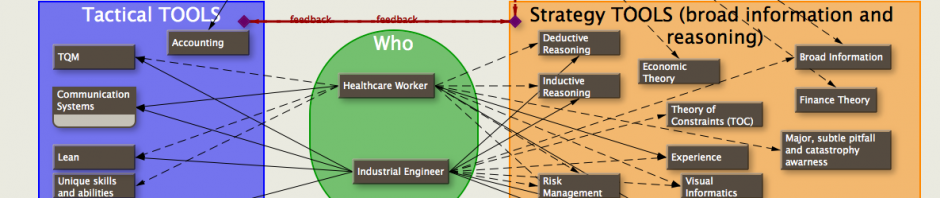
 Brian Gregory, MD, MBA • Robert- Very Zen, by the way. 🙂
Posted in Accounting, board of directors, CEO, healthcare reform | Tagged , , , , , , , , | 1 Comment

constraint theory and Pareto Optimals…


Brian Gregory, MD, MBA • Wayne, good question. Healthcare is a funny animal–you have constraints within constraints.

One of the main tenets of ToC is to pick what you want to be the constraint.

In the case of the OR (ER, radiology, and many other places in the hospital) you have multiple agents (surgeon, anesthesiologist, nurses, hospital administration) each wanting to be the top constraint. By that I mean each wants the others to subordinate their schedules and manpower to their own.

With simulation, you focus on one agent to exploit and subordinate all the activities around that agent. You’ll create a system that maximizes throughput for that agent.

Pick a different agent and do it again. Rinse and repeat until you run out of agents.

So…who decides who gets to be the top constraint? Yep, its political…

Now comes the fun part:
(1) Healthcare is a service industry, and time is the biggest factor in cost and revenue.
(2) The value (in utils) of a unit of time varies throughout the day with each agent. (a surgeon who needs to wiz will gladly depart from the OR and slow down the case).
(3) With the appropriate software (::grin::) you can change the constraint to whomever is valuing time the most at any point.
(4) Maximizing and splitting total economic return (a discussion all its own)

Not so surprisingly, most people controlling the schedules in those ORs don’t understand ToC, and can’t analyze the tradeoffs so that everyone comes out ahead. It’s more of a tug-of-war with the not surprising inefficient result.

In the OR, it’s easy to increase everyone’s utils (and economic return) by understanding these concepts and scheduling accordingly.

That’s why its easy to achieve some pareto optimals (and better total economic return).

I’ll send you our paper when we’re finished with it.

Posted in Ambulatory Surgical Center, board of directors, healthcare reform, scheduling | Tagged , , , | Leave a comment

bad research…or bad reporting?


This is an example of the perils (morbidity, mortality, and financial) of mathematical manipulation of data by researchers in basing broad conclusions without more fully understanding the processes and externalities involved:

Unnecessary anesthesia adds $1B to health spending – FierceHealthcare

Very misleading…

Trained anesthesia is called for in healthy patients because untrained surgeons and nurses were harming or killing ‘healthy’ people by over sedating them. I personally saw this on a couple of occasions, and also know that close calls are often not reported.

A similar problem occurred with liposuction in physicians offices in Florida…untrained people in charge of sedating, or CRNAs being coerced by surgeons to take bad risks in the interest of decreasing cost.

In both situations, facilities were later required (or by their own volition chose) to have adequate anesthesia supervision.

Ask any anesthesiologist about the mishaps at their facilities that have occurred during colonoscopies when left to the GI docs and nurses.  This isn’t a one-in-a-million possibility of a mishap, it’s common.

To clarify:

The procedure is not dangerous if someone is there who has had years of experience evaluating and handling sedation and airways. That means a CRNA, AA, or Anesthesiologist.


To attack the conclusion of this article from another viewpoint…

The throughput of scope procedures when anesthesia personnel are present can be double or triple that without anesthetists present. This needs to be taken into account when calculating costs.

The researcher should have focused on the cost due to incidence of bowel perforation under deeper anesthesia when the anesthetist is present vs the cost of prolonged hospital stay due to poor sedation technique without anesthetist plus the expense of awards and defending against lawsuits.

Also, opportunity costs saved to all participants from the additional time would be similar (though less) to those accrued in a study where anesthetist were involved in pediatric radiation (higher ratio of 6 to 1 return in time saved, multiplied by the number of people involved).  The value of these costs are often dispersed among different agents (patient, surgeon, radiologists, anesthetists, nurses, patient guardian or helper).

Externalities that are harder to quantify financially relate to the fact that anesthetists can sedate/sleep patients much faster, deeper, safer, and bring them back much quicker. The surgeon/GI, nurses, and patient can have an order of magnitude better experience.

Playing with numbers can be dangerous!…

Posted in Accounting, Ambulatory Surgical Center, anesthesiologist, ASC, board of directors, CEO, surgeon | Tagged , , , , , | Leave a comment

throughput accounting (TA) vs activity based costing (abc)…


see also: TA (throughput accounting) and TDABC (time driven activity based costing)…the fabric, the ‘warp and woof’ of healthcare accounting?

from a Linkedin topic:

Just thought I’d expand on some thoughts about Acitivity Based Costing (ABC) vs Thoughput Accounting (TPA): [not quite sure how TDABC is handled]

Idea of TOC:
Optimize the application of resources (with many abilities) to any or all activities to achieve a goal.
=(resource x activity) cross product

Parameters of throughput goal:
(1) Defined goal/purpose/gain

(2) Time period (this month, this year, this life, life of planet) of this goal

(3) Risk your willing to take of running out of specific resources during that time period (some resource shortages merely cause delays, others such as cash or oxygen could cause the end)

This makes an accounting system a little more complicated. The “resource x activity” refers to the cross product of the resource and activity. That means that you need to keep track of both at the same time if you’re trying to improve things.

So, in my view, Activity Based Accounting is a simplified view of TPA. The parameters 1,2,and 3 are essential to TOC and hence TPA. You might also assume that parameters 2 and 3 can include the concepts of real options (hellaciously branching decision trees) that require a good bit of strategizing.

Then again, isn’t top management supposed to be ‘strategizing’ all the time? If so, then TPA would be the act of carrying the strategy down to the process level on an informed basis (sure…let administration run the machines:).

It looks as though true TPA would require more coordination and transfer of information from the people actually designing and doing the processes and the administration strategizers. ABC would not require such coordination of effort, and might not consider parameters 1,2, and 3 adequately (inadequate strategizing).

 ——-
 continuing…
If the goal of TOC is to maximize cash flow, then TPA should correlate with the cash flow in the company.However, it’s conceivable the the TOC goal is something other than maximizing cash flow (charity?, or ::ROFL:: not-for profit hospital!), in which case you’ll still have to maintain sufficient cash flow to stay in business (unless you’re the VA).Often it seems that current hospital cost accounting does not appear to emphasize cash flow…nor charity…nor long term patient health. I’m not sure what the strategy is…nor if the strategy is frequently reevaluated.
———
 continuing…
The goal in TOC would determine the clumping of actions into activities. Different goals can easily imply a different set of actions that lead to specific activities and the measured TPA activity expenses and revenues would change accordingly.This means that a ‘randomly’ set up definition of activities for ABC might, or might not, jive with the TPA system. Same goals, though, could cause ABC and TPA to be indistinguishable in effect.
———
continuing…
 Paul- So I agree with you that a partial implementation of TOC/TA would be less than optimal for the hospital as a whole. But…there will be politics everywhere –the GI department will have a goal that is more aligned with the gastroenterologist, the pulmonology department will have a goal more aligned with that of the pulmonologist, etc. The goal may still be cash flow…but whose cash flow? Throughput accounting could be used to quantify by cash flow how far the goals of a particular department veer from those of the hospital, and what or who is the cause. Negotiations could ensue: possible recognition of the amount of loss in the potential total economic return, and ways to indirectly share income. An example is that of paying surgeons to cover surgical call. Ten years ago I remember a hospital claiming (in the newspaper) that a group of neurosurgeons was holding it hostage by demanding to be reimbursed for coverage (the group of three covered three hospitals every night with no reimbursement). Nowadays, compensation for call is the norm. Another example is guaranteed income for anesthesiologists who wander all over the hospital expediting sedations, intubations, epidurals, doing medicaid/medicare cases etc. for which they often are poorly directly reimbursed, but for which the hospital makes lots of money (eventually).
——–
continuing…
Robert Gordon • Brian,This last string of your comments has brought a whole new ray of enlightenment into the dusty loft of my mind.  As we have discussed elsewhere, stereotypical healthcare activity essentially value-optimizes intra-operative decision making above the reduction of process variability. You have here made me remember and better understand something I was working on a couple of years ago, namely, the fact that the main value killer (“waste” for Lean) occurs in transitions or hand-offs during hospital care, both within and among disciplinary siloes. [I believe you are well aware that this process “articulation” is the focus of research and experiments in process modelling, DEM.] But the fact that transitions are a problem in hospital care probably has a homolog in the inescapable variability of healthcare processes. You say TOC (but QI methodologies in general) try to aggregate “actions into activities”. That is because of the all-unifying Goal. But in health/hospital care, there is no “goal” in this sense. You could say that the “Goal” of healthcare (health) is transcendent and equally present to every action, but that really just shows that “goal” is not the right concept. Ooo! it is all coming together! Thanks.
Posted in Accounting, CEO, healthcare reform | Tagged , , , , | Leave a comment

accounting and scheduling come together…


It took a few days (alright… quite a few days), but now my accounting software (great company-versatile software) collects accounting data in the standard cost accounting  manner, yet reports it in a Throughput Accounting or Activity-based Accounting way so that it correlates with the results from my systems engineered scheduling system.

The CFO can look at daily reports and see the effects of non-efficient scheduling vs lean scheduling  vs throughput scheduling (TOC) in the OR (and elsewhere).  It’s a bit like a Rosetta Stone between the accounting department and systems engineering.

I suspect that it would take the accounting department a while to become accustomed to the different groupings of their costs and revenue, but the systems engineers should be able to immediately understand and use the reports.

It should also be possible to compare the different accounting system reports to ‘reality’ and wise decision making with the goal to eventually stop using the misleading accounting systems.  Who knows?—maybe different accounting systems will work better in different departments.  Time (and throughput) will tell.

Posted in Accounting, anesthesiologist, ASC, CEO, healthcare reform, scheduling | Leave a comment

increase strategy to increase throughput: …data in context…lean in context…flipped rooms…


Why is this important?

  • It can significantly increase total throughput and throughput as referenced by a particular agent (surgeon, anesthesiologist, hospital).
  • Increased throughput can be converted into large increases in revenue.
  • It can decrease cost for all agents.
  • It can decrease risk.
  • It can increase satisfaction for all involved.

More accurate predictions give the PACU staff, OR staff, and Anesthesia staff the ability to anticipate a time slot in the OR schedule. It changes the feeling of frenzy and chaos to one of control and accomplishment. Minor changes before the day starts, or as the day progresses, make a big difference.

Below are some of the charts that go with analysis of a hypothetical OR case schedule.  The charts are dynamic (within the software program) and can be used for analysis before, during, or after the cases are actually being done. The data is relevant for algorithm creation depending on policies for PACU, surgeons, anesthesia, OR and PACU expansion and architecture design, etc.; or for just maximizing throughput as changes occur.

The Gantt chart on the bottom right shows 19 cases. Four of the surgeons, each with 4 cases, are running parallel rooms (flipping) to decrease their total time in the OR. There are 3 other surgeons, each who does a single case.  It would be an easy matter to decrease the number of rooms by 3 (and concomitant staffing) with simple adjustments to the schedule beforehand, or taking advantage of the normal variance in case length as it manifests.  Additional surgeon time would be minimal and the effects on staffing can be seen (more so with additional charts). Cases could also be strategically delayed or expedited to decrease costs.

Top left chart:         the number of cases starting in the OR for each time slot.

Bottom left chart:  the number of cases ending in the OR for each time slot.

Top right chart:      the number of cases starting or ending in the OR for each time slot.

 –

click to enlarge

Data in context

Give Information To Those Who Can Immediately Use It

STRATEGY!

The point of these charts is that different groups can incorporate the same information for their own purposes.
The PACU nurses (pre-op side) will incorporate the information to what they already know and decide which patients  to send for depending on the distance from the OR, number of orderlies, floor policies, hold time in pre-op area for patients depending on surgeon (always late?) and policies, number of bed slots, number of pre-op nurses and policies for nurse-to-patient ratio, whether to delay sending for patients due to back up through recovery, and adjust factors for same.
The PACU nurses (post-op) will know when to give breaks (and to whom), when to set up equipment, when to expedite patients to the floor depending on incoming patients and orderly availabilities, and adjust factors for same.
The Anesthesiologists will know how many and when  CRNAs and MDAs are needed (adjusting  quickly for type of case, surgeon, etc), when to give breaks, more, and how to adjust the flow to accommodate  for any constraints. [There are other charts that adjust for all of this automatically.]
Surgeons can adjust for available gaps in the schedule, or for planning ahead of time and afterward with regards to PAs, office hours, completing charts, etc.
Analysis can be done later for causes of bad ‘clumping’ of surgical starts, best types of surgical cases to schedule at the same time or same day, and of course all the data from the Gantt chart on lengths of cases related to surgeon, procedure, and (with other charts) more details of intra-case events.
The floor units can use the data for anticipating sending or receiving patients to or from surgery (this can take 30 minutes or more to organize– sometimes much more depending on medicines, tests, and procedures also scheduled).
Similar charts can be adapted for use in the ER.
Posted in Ambulatory Surgical Center, anesthesiologist, ASC, scheduling, surgeon | Tagged , , , , , , | Leave a comment

flipping rooms…get started


If you’re in charge of the OR, whether nursing or an anesthesia or surgical group, and want to decrease turnover time, risks, and costs while increasing revenue — you could greatly benefit from flipping rooms. With internet connectivity in your OR, we could be conferencing within minutes and help flip rooms for your current day’s schedule.
With proprietary software and 20+ years of clinical experience as an anesthesiologist flipping rooms I can lead you through the theory and  details as questions and glitches emerge. The best way to learn is by doing. Later, if you decide that  flipping rooms is for you, we can analyze data from your schedule and devise algorithms that work well for your typical case loads, staff, and physicians. We can tell you where to focus your lean and six-sigma efforts. If desired, we can arrange for a long term engagement to help each day as cases are going on.
For more information and complimentary demo, contact: brian@ortimes.org
Posted in ASC, CEO, scheduling, surgeon | Tagged , , , , , , , | Leave a comment

the art of flipping rooms…


There are two main parts to flipping rooms: intra-case and inter-case. They are complementary and work together iteratively.
An analogy of this iterative type of scheduling –adjusting individual cases(intra-case) and schedule (inter-case) to make a good fit– is that of a stone-mason building a wall or a fireplace: You work with what you have, but you can chisel and mortar individual stones (cases) and fit them next to complementary stones where they work best for structure and appearance (flow and satisfaction). You end up with solid art instead of a pile of rocks like so many schedulers give you.

One observation that has arisen from multiple webinars is that some people do not have the talent for this. They can’t envision a structure nor have use of software tools that help them productively schedule.  Since a normal OR has frequent change-overs of the person directing cases throughout the day, there will be many times when someone not adept at case flow, or the software, will be in charge.

A possible solution for this is for scheduling to be done as a service. People trained with good software tools that aid their natural organizing ability can run an OR from off-site. The on-site OR crew’s knowledge of individual OR rooms, surgeons, nurses, and anesthesiologists can be leveraged to good advantage by the off-site scheduler. For long term engagements, dedicated off-site schedulers will come to know the intricacies of an individual OR well and be able to free up the on-site schedulers when needed.

Scheduling affects too many people, involves too much revenue (millions), and can incur too much cost to be relegated to poorly trained staff using meeting-room software if a facility wants to continue to be competitive.

Posted in Ambulatory Surgical Center, anesthesiologist, ASC, board of directors, CEO, healthcare reform, scheduling, surgeon, Uncategorized | Tagged , , , , , , , , , , , , | Leave a comment

book recommendation: Models.Behaving.Badly by Emanuel Derman (Why Confusing Illusion With Reality Can Lead To Disaster, On Wall Street And In Life)


It’s nice to see one’s thoughts echoed by others who are much better known and established— even to the point of the same words and phrases used to categorize and clarify a universal problem and possible approaches to understanding and solutions.  This book was just published:

—-

Models.Behaving.Badly by Emanuel Derman (Why Confusing Illusion With Reality Can Lead To Disaster, On Wall Street And In Life)

—-
In the HME group, in the HIMMS, and in the HFMA group we’ve had several discussions on this topic in various forms –that of inappropriate models. This book is a delightful read and provides insight into the current economics problems along with interesting history and insight into model building.

Emanuel Derman started as a physicist delving into much the same work as Richard Feynman, then he switched to working with economist Fischer Black at Goldman Sachs.

This book wanders from South African Apartheid in the 1960s as viewed from the eyes of a jewish child to Spinoza’s theories on emotion to Classic and Quantum physics to Fischer Black developing derivatives on Wall Street. What they all have in common is attempts to create models of reality.

Emanuel separates the definitions of theories and models, models being analogies or metaphors to real life and as such requiring a priori observation for their existence. Theories, on the other hand, spring full blown from observation and intuition to stand on their own merits—to be proven or disproven. Models are not as powerful as theories, and it requires ‘intimate knowledge’ of a subject for intuition to develop a theory.

Posted in Uncategorized | Tagged , , , | Leave a comment

Healthcare Administrator-Physician divide


The following is an excerpt from an ongoing discussion in the Linkedin group ‘Healthcare Executives Network’. It broaches several problems and approaches that are necessary to understand before finding workable solutions, and could be taken as a preface for a book that delves into the ramifications of each sentence.  The overall discussion has generated an inordinate amount of lucid viewpoints and experienced comments—a pleasant surprise!
—–
Richard-
In the US healthcare industry, there are multiple agents (physicians, hospitals, HMOs) with different goals. Many alternatives (business structures) are available for some of the agents (physicians). What’s optimal for one group (agent) might not be for another.  The solution (if possible) is through sharing knowledge and clarification of goals.
The more knowledge, intuition, skill, and imagination of both agents—the greater the feasibility of non-mutually exclusive goals. A deficiency in abilities by one of the agents requires a greater amount of ability by the other in order to clarify and accomplish the essential goals. Of course, certain people have personal goals that will always be mutually exclusive to every other agent’s goals—probably best to not deal with them.
In the US, lots of independent agents with a multitude of goals and many alternatives makes for lots of divides.  An administrator has not one physician divide- but multiple.  Fewer goals and alternatives is one reason that dealing with groups (radiology, anesthesia, ER) are preferred over individuals by administrators so that many debates are decided within the group before meeting with the groups representative.  Unfortunately, sometimes those individual groups will be dysfunctional and other groups are sought out.  But often the groups have the the legal and social ability to remedy dysfunctional individuals in ways that administrators don’t.
From your description of work in England, it sounds as though similar conflicts are occurring within a different set of groups, maybe at a level where they are resolved due to fewer alternatives and a smaller subset of goals than in the free wheeling US healthcare market.
Brian
Posted in CEO, Uncategorized | Tagged , , , | Leave a comment

a little data goes a long ways…


Time sheet and scheduling analysis ... before, during, and after

Although the expression –‘it’s not what you have, but how you use it’– is not entirely true, knowing how to massage whatever data you have can be very productive.  The data needed for this display is easily available from the OR, and can be updated as the day progresses.
Clicking on any of the rows (when in my program) shows other useful representations of the data such as gantt charts.
Posted in anesthesiologist, scheduling, surgeon, Uncategorized | Tagged , , , , , , | Leave a comment

unfounded confidence…anesthesiologists excluded :)


Don’t Blink! The Hazards of Confidence – NYTimes.com


Posted in Uncategorized | Leave a comment

Foldit….human pattern recognition trumps algorithms…


One of my tenets is that creating tools that help people recognize patterns can create better results than creating an algorithm than cannot take into account all the parameters of a situation.  Just like the saying “One picture is worth a thousand words”, you could say that ‘one person is worth a million lines of code’.   An algorithm sees only a shadow, a projection of a few dimensions of the reality of a situation.

People are limited in dimensions they see also, but they can handle variation, and alter the dimensions they focus on in a matter of seconds or minutes, whereas a computer algorithm could take a year to code to do the same thing (if it can be coded at all).

Gamers discover protein structure that could help in war on HIV

Posted in healthcare reform, scheduling | Tagged , , , , , , | Leave a comment

FTE, utilization, and cost accounting … when PUNs equal CUEs


Cost accounting (whether standard costing or TDABC) is based on the concept that ‘bits’ of the cost of a resource can be allocated to any product (service) produced. FTE (Full Time Employee/Equivalent) tracking is based on the concept that the maximization of productivity is based solely on the cumulative number of employees hours and not on the timing and coordination of those hours worked.  Accountants use fixed cost allocations, utilization metrics and FTEs (all are reduced parameter models) to try to measure productivity costs instead of a more robust multiparameter model.
A common problem is the need to staff for peak resource requirements.  The use of  part-time employees — those who work for a few hours each day only during peak hours– is a way to decrease FTEs and still cover the peak hours.  Rarely have I seen significant effort in altering the other part of the equation—that of leveling the peaks. Occasionally, resource duties are expanded in an attempt to increase utilization of that resource, but one has to be careful not to make the resource become a constraint due to overlapping duties.
In constraint theory, you decide what you want your constraint to be which will then become the drumbeat for your activities.  In the OR, the surgeons’ scheduling of cases is the constraint.  But, in most ORs, the case load varies significantly throughout the day .  This implies that FTEs will have peak and slack periods of activity.  Unfortunately, the peak and slack periods are usually scattered randomly throughout the day which makes the use of part-time employees to decrease FTEs difficult to coordinate effectively.
Firefighters and electric companies are more extreme examples of very ‘peaked’ industries.  Firefighters have a lot of downtime; many communities even have volunteer firefighters with other jobs because the ‘peak’ activity required during a fire is a rare event.  Electric companies have to build capacity for the peak electric use (particularly during the summer) but could otherwise significantly decrease their capacity if electric use were constant (total use divided by capacity) or they could store electricity ( a lot of work being done on this, particularly in the solar energy industry).  Do the accounting measures  of ‘allocated costs’ and ‘FTEs’ adequately describe the resource requirements?
Maybe we should rename these accounting measures CUE (Constant Use Equivalent) and PUN (Peak Use Need) instead of ‘allocated cost’ and FTEs.  This would focus on the cause behind these two measurements and how to alter them to decrease negative cash flow related to the amount of product (megawatts, fires extinguished, patient throughput, revenue) produced. The need to ‘level’ the peaks by better scheduling (firefighters do not have this luxury) would become more apparent. (see for instance blog Graph of CRNA usage for Optimized Surgeon Schedule)
Many places in hospitals, particularly ORs, do not have scheduling software powerful and flexible enough to show how to alter the peaks that occur throughout the day.  Surgeons scheduling demands and variability in arrivals and lengths of cases makes constant resource use difficult, but adequate software and the knowledge of how to use it (not just the technical use, but also the theory and practice of how it applies to the OR) can significantly help clarify the causes and blunt the peaks which will decrease the required FTEs and allocated costs.  Someday, the ratio of PUN to CUE (PUN/CUE) might be followed with the goal of achieving unity.
In this discussion, FTE has represented a Full Time Equivalent.  It could also stand for Full Time Equipment.  The concept is the same and the problematic relationship of FTE, utilization, and fixed allocated costs to productivity and the bottom line is the same.
Posted in Ambulatory Surgical Center, anesthesiologist, CEO, healthcare reform, scheduling, surgeon, Uncategorized | Tagged , , , , , | 1 Comment

not your father’s OR scheduler…


Want to know who’s doing what, when: With what?  What’s starting when? Who’s got to be there? How many whos? Can you let a few people off early?  Can you start a few people late?  How many people need to be broken for lunch? How many (and which) cases are starting in the next 15 minutes?  The next 30 minutes? The next hour?

The vertical colored bars are moveable and help provide filtering for input into multiple hierarchial outline structures.

Flip specific cases and see what the effect is? Got a few seconds?  See if  moving a couple of cases by a few minutes decreases the number of OR crews you need that day, or the number of CRNAs you need.  Can you shift a few things slightly and take off earlier for your 3 day weekend?

Need to calm a surgeon by visually explaining what’s going on? Show how he benefits?  Help him offer reasonable suggestions that benefit you and him while you look at the effects of changes to the schedule.

Want a simpler view?  Just your cases?  Just your people? Only the cholecystectomies? Move a tailored view to another monitor so people can look at it without interfering with those inputting data and running the schedule.

The constraint in scheduling will no longer be the ability to follow the cases, it will be in not having a scheduler who understands lean, risk, constraint theory, economics…and politics.

Posted in Ambulatory Surgical Center, anesthesiologist, ASC, scheduling, surgeon | Tagged , , , , , | Leave a comment

labor analysis of CRNA from collectible time data…


6:00 Labor Analysis 482 230 280 0.5809 150 102 14:02

The above shows information about the work of a CRNA during the day.

The CRNA clocked in at 6:00 am and out at 14:02 for total Time-on-the-Clock wage minutes of 482.

230 is the amount of time from the beginning of the CRNA’s first case, to the end of his last case.

280 is the total amount of time billed for the CRNA doing cases that day.  Obviously there’s a potential problem since there must be some overlap of time being billed for the CRNA on two or more cases.

.5809 is the ratio of time billed for the CRNA vs Time-on-the-Clock. When the prior problem of overlap billing is resolved, the ratio of billable hours to paid salary hours will be .4772 –significantly less.

150 is the amount of minutes from clocking-in until the CRNA starts his first billable case.

102 is the amount of minutes from finishing the last billable case and the CRNA clocking-out.

There’s lots of information in this simple code, along with lots of details that need to be addressed:

1. Overlap billing could spell trouble with an insurance agent, HMO, medicare…

2. Why is the CRNA clocking-in 150 minutes (2.5 hrs) before doing his first case? He might be busy, or he might not.  Can the non-billable time required for maintenance activities be accomplished during the unavoidable down time between cases?

3. Why is the CRNA clocking-out 102 minutes (1.7 hrs) after doing the last billable case? There are several reasons for this: some good, some bad, most economically bad (for whomever is paying his salary).

4. A gantt chart should also be available that helps visually with interpreting the times within the context of the entire OR schedule such as the spacing of downtime between cases.

Most often, none of this information is collected, and rarely is it ever available immediately to deal with problems during the time when it is best addressed.

As an anesthesiologist, while actually supervising the CRNAs during the day, if you were watching a list of 20 of these numbers (representing 20 CRNAs) and saw:

6:00 Bob Smith CRNA 115 0 0 0 -540 540 15:00      (15:00 is Bob’s scheduled quitting time)

…you’d explore why Bob Smith has not started any cases.  If there were 9 or 10 more CRNAs with similar numbers, you could infer that there is a systematic problem occuring: maybe a meeting, maybe most of the orderlies who get the patients called in sick, maybe you’ve greatly overstaffed (or poorly supervised) your CRNAs, equipment might be broken (the same equipment 3 days out of every five?), maybe you need to have your CRNAs clock-in an hour before their first case instead of 6:00 am since most of the cases begin at 8:00 am.  It’s still 7:55 in the morning, though–time enough to change things for today…and tomorrow.

Posted in anesthesiologist, CEO, scheduling | Tagged , , , , , , , , , , | Leave a comment

conundrum…


After trying to modify the simulation part of my OR scheduler, and encountering various conundrums, I decided to try to formally clarify the source of the conundrums which led me to other realizations:

To wit:
The important parts of decision making involving processes in a healthcare setting are:
1. Are the results available when they are needed
2. In what context (place and time) can the task be parallel processed (interfere least with other processes)
3. What beneficial or detrimental effects will the process have on other processes?
4. Is the process marginally income efficient.
Each of these questions is very context dependent, usually not independent, and can be interpreted only in the FOR (frame of reference) of a particular agent (hospital, physician, insurance company).  If you were to try to write a computer program to cover every contingency, you’d have ‘if and else’ stretching from here to the next galaxy.
Clinicians are used to dealing with context and micro-managing processes to optimize risk, time, cost and income. Their failing is in not having sufficient training to broaden their awareness of risks, time, cost, income and 1,2,3,4 above.
So, it’s a matter of clinicians being educated to ask the right questions.  The right questions asked, and rapid answers to those pertinent questions  will improve the necessary and normal micro-management by the clinician to optimize risk, time, cost and income.
Statistics:
With regards to statistics, statistical programs are cheap and omnipresent. Also the value (accuracy?) of statistics depends on pertinent and accurate data.  Questions that a particular statistic answers has to be phrased with lots of premises and caveats.  In clinical care, often the premises (existing situation) is constantly changing, and the value of a statistic has to be in the context of a particular question.
Like the game of 10 questions, an answer for the clinical problem or process can sometimes be answered by different sets of questions.  If you can come up with a set of statistics that are sufficient and reliably accurate to answer the 10 questions….then you have a winner.  That’s a difficult job to do, and requires a lot of interaction with the clinicians.
So once again, we’re back to the situation in which educating people to ask the right questions is of the utmost importance.
Result:
Maybe we should be educating clinicians so they can broaden the use of their clinical acumen to answer process questions they never thought to ask.
Posted in healthcare reform | Tagged , , , , , | Leave a comment

a box lunch to go…


It looks as though healthcare funding will be cut shortly.  Medicare will be on the chopping block soon, reimbursements for hospitals will be down.  Those who don’t think outside the box–who never saw the lid of  the box closing–will be the ones boxed in.

Would you call this survival of the fittest?  Or genocide for US healthcare?  The coming healthcare crisis has been obvious for years as was the financial meltdown in 2008. But unlike the financial industry…no one will (or can) bail out the big healthcare companies.  Instead of improving productivity (more results for less expense through better processes), too many healthcare institutions have emphasized trying to grab a bigger piece of the pie.  The pie has been divided, there’s nothing more to share.  Time for cannibalism to begin.

Would you like that box lunch to go?

Posted in board of directors, CEO, healthcare reform | Tagged , , , | Leave a comment

Do Doctors run Hospitals better?


internet: http://ftp.iza.org/dp5830.pdf

local: Who Needs an MBA


So which is better, an MD, MBA, or MD / MBA?

Posted in board of directors, CEO, healthcare reform | Tagged | Leave a comment

‘risk vs return’ or ‘when the shit hits the fan’ in the OR


Taken from a Linkedin post of mine with the HFMA group:

Sandra,

The ‘general’ rule is that ASA 1-3 is ok for free standing facilities. That rule is effectively bent for rational reasons.  The ASA classification has a lot of subjectivity to it, and the risk of a particular procedure can be unrelated to the reason for an ASA classification of 4 or 5. For those reasons, different classification systems of risk have be suggested (and used) over the years.  The concept of increased risk vs cost still holds.

In finance the concept is risk versus return.  The greater the risk of an investment, the greater the return should be.  Lots of people have PhDs in finance from research and papers discussing that concept (Nobel prizes, too).  Bond ratings (risk) and subsequent return (interest rate) are based on that.  The current Greek solvency crisis and possible crash of some European banks (like the crash in 2008) revolve around that. Insurance premiums for healthcare (and investments) are based on that.

In healthcare reimbursement, the cost of risk seems to be ignored when compensating for the care of a patient. Is that due to ignorance of those paying for the service, or just an attempt to not pay for something.  Specific risks are often not understood by those not highly trained in a specific area or for a specific event.  A major source of stress for anesthesiologists is derived from surgeons who do not understand why anesthesia sometimes takes longer for certain patients in order to decrease risk of serious morbidity and even mortality.

If a surgeon doesn’t understand the risk…should we expect someone in the insurance industry to understand the risk (and associated compensation) increase?  Even if they don’t, the anesthesiologist does and may ‘game’ the system so as to not be on the wrong side of the risk-return curve.

Then there’s the concept of ‘game theory’ which, when applied to risk in anesthesia, involves proceeding through a specific serious of steps in anesthesia —any one of which can be halted or backed out of safely so that the patient never need to be coded. Game theory (strategy) is not taught as well as it should be in many places, and some anesthesia providers are much better at it than others (due to better training resulting in more techniques, or just better strategy skills).  The result being that the same case for one anesthesiologist may not be as risky to the patient as for another anesthesiologist.

Back to finance:

The reason why a portfolio of stocks, bonds, mortgages, or insurance contracts can be less risky than a single stock (etc) and hence earns less return (interest paid) is that the systemic risk has been decreased.  Along the same lines, if the risk of a patient can be decreased by application of game-theory, should the anesthesiologist be compensated less?

Even if the insurers do not take any of this into account, the facility hiring the anesthesiologist or anesthesia group should recognize this and choose to contract with those that give more value by decreasing risk (and inversely increasing return).  Usually, though, the shit has to hit the fan before any of this risk-return analysis takes place (same thing happened in 2008 with the economy).  Waiting for malpractice premiums to go up, dropping of coverage, or a massive law suit  to signal risk (or dropping of coverage) is too late for all concerned.

But even if the evaluation of these costs in a procedure are difficult to measure (though need to be taken into account), some of the other costs which are more easily quantifiable and can be followed but generally aren’t–should be.

Posted in anesthesiologist, surgeon | Tagged , | 3 Comments

OR scheduling concept map (concept diagram)…


A few years ago I diagrammed several concepts involved in scheduling an OR onto this graph.  The intent was to take advantage (or nullify disadvantages) of characteristics of individual surgeons and anesthetists. The interplay of these concepts and individual factors result in how many cases are done in a set amount of time.  Sooner or later I’ll get around to re-doing this graph, but it was initially created to remind myself of the factors involved as I modified software to use for scheduling in the OR.  Since I’ve  finished the software, all these concepts seem obvious; but I realize they aren’t for many people.

I love puzzles, so I’m posting this graph. There’s a wealth of information for those who can seen the patterns. It is ‘dense’ with concepts. (sorry about the resolution..it’s a scan of an old file)

<click on the graph to enlarge it>

Posted in anesthesiologist, concept graph, concept map, healthcare reform, scheduling, surgeon | Tagged , , , , , , | 2 Comments

the dark side of hospital patient flow…Part 2


I received this email last week.

Have you ever seen the drawings with the title ‘Where’s Waldo?’

Let’s play “Where’s the constraint?’ Think in terms of the discussion from my prior post ‘the dark side of hospital flow…Part 1’.

Start the music please (open in a separate window):    Urgent

Posted in board of directors, healthcare reform, scheduling, Uncategorized | Tagged , , , , | Leave a comment

the dark side of hospital patient flow… Part 1


Flow is defined as the quantity of some item (units of an item) passing by, leaving, or arriving at some point in a designated unit of time.  So, flow is defined by four parameters: units(1) of an item(1) , a specified point(1), and units of time(1).

When we talk about hospital patient flow, what are the units we’re referring to? And what is the point to which we’re referring?  Obviously, that depends upon the context.  Let’s take a simple example: Lab tests could be defined by the number of samples being processed by a piece of equipment in a day. But even this simple example has defining problems.  The total number of test performed in a day might be irrelevant if the peak rate (think electric power company in the summer when everyone gets home from work) determines if the system crashes, so you build for peak times.  Even the peak rate might not be the best determinant if an essential electrolyte test from the ER or surgery can’t bypass the waiting line in order to determine a life saving intervention, so you might design for emergency times (with a higher investment involved for both).

Then there’s the question, ‘Is faster, better?’, and the companion question of ‘who is the observer?’. In a work place where people are paid a flat salary or by the hour, a slow steady pace beats a frenetic pace.  If the worker is paid by CPT codes completed, then a faster pace would be much more desirable.  Hospitals have a mix of these two sets of people: those paid by time worked, and those paid piecemeal.  Conflict over the best rate of flow naturally arises.  There’s an additional problem with the value of the piecemeal work being influenced by the value of the CPT code, with the calculation of ‘CPT compensation divided by time’ coming into play.

In this highly monetized culture of ours, we could be cynical and say that the best hospital patient flow is the one that brings in the most money. But, even that definition has problems. Hospitals are not known for being in the forefront of modern financial developments.  Finance has taught, and many corporations and investors have realized, that it’s the cash flow that matters when valuing the continued functioning of the company.Calculations to value a company (and its stock) can require painstakingly detailed analysis of accounting information to tease out the actual free cash flow of a company. Many companies keep two sets of accounting books (figurative): one for public consumption, and one for managing the company.  Unfortunately, hospital senior administrators are sometimes reimbursed on the basis of the public consumption set of accounting books.  There are also whisperings that hospital administrators feel that they should be paid comparable salaries to the heads of other corporations. So there is pressure to make the public accounting books look ‘good’.

This can cause an increase in the time a patient is in the hospital (decrease in patient flow) in-order-to increase cash flow or accounting profits.  It’s a common joke that a patient is discharged from a hospital only after the insurance runs out.  I can name at least one hospital that was dropped by a major HMO after churning patients; and I suspect you can give a few examples yourself of the inverse relationship of a hospital’s assessment of a patient’s need for care and the availabilty of insurance compensation for the hospital.

So, when you’re trying to optimize a hospital patient flow, whose definition of flow are you optimizing?  The patients?, the surgeon’s?, the nurse’s?, the radiologists?, the ob-gynecologists?, the CFO’s?, the lab’s?, an administrator’s?  No wonder it’s hard to make everyone happy.  You can optimize a particular ‘flow’, but it might be cutting into someone’s pocketbook, lounge time, or year-end bonus.

Posted in board of directors, CEO, healthcare reform, scheduling, surgeon | Tagged , , , | 1 Comment

getting your hands dirty…


Sometimes, to get what you want, you have to jump in and get your hands dirty...

It’s been a month since my last post, a series of posts dealing with ‘what ifs’ and some simple simulations dealing with scheduling OR cases. During that time I’ve been giving feedback on the alpha version of the scheduling software to the company developing the program. It’s a nice arrangement. I send them 3 to 6 bug reports a day (sometimes a lot more) and a few suggestions for features or how to implement some of their current features–they find the bugs, take some of my suggestions–and the cycle begins again. I’m happy to say they’re a great group of people and will have a great product. I’ve joked with friends about having my software development subdivision without all the hassle or need to pay salaries. The software company probably jokes about having a OCD bug finder and consultant who they don’t need to pay. It’s a nice relationship. They do the software…I help keep it real.

My spending hours a days ‘hacking’ the alpha has helped me get the features I need. I dare say that without me dedicating that time for feedback, the program may not have been suitable for my purposes. The ‘simulation’ posts from last month used the initial features once they were stable. It took another month to work out the bugs and ‘flow’ for a system that can be actively used every day in the OR to adapt and optimize the schedule on the fly. That was the hard part–developing a way of getting the information to people in a timely manner in a form that could confidently and routinely be used. By comparison, the initial simulations were a cinch.7

Developing a system for scheduling takes a lot of trial and error–creating and destroying systems and work flow to arrive at something that is powerful, adaptable, gives instant feedback, and augments the knowledge one intrinsically possesses. When I think of people using ‘meeting-room schedulers’ to run an OR….I cringe. It’s like using an abacus instead of a spreadsheet.

Own the OR…

Would changing the block time for certain surgeons improve the flow of the OR? …no problem. I can reliably tell what would happen with resources and flow when altering block times, and I can implement them.

Are certain equipment, surgeons, nurses or anesthetists assets or liabilities? …no problem. It will show up on the graphs and other analysis.

Can simple changes be made to minimize personnel deficiencies and work with their strengths? …the possible changes will be much more apparent now.

What’s the marginal cost and revenue for doing this case? ..no problem.

The list goes on.

The only caveat is that ‘political’ motivations for decisions will also stand out. Is this a good thing? That’s your call.

Posted in anesthesiologist, CEO, healthcare reform, scheduling, Uncategorized | Tagged , , , , | Leave a comment

putting it all together…intra-case and inter-case….TOT and more


There are a thousand variations of the following examples, but I hope these four graphs will get across some ideas.  For potential economic effects, see:  Wasting $2.7 million dollars a year.

Each of the following graphs has 5 bars. Each bar represents a case and is derived from, and can be easily altered by, the many factors that I’ve shown in my previous blogs. Each bar represents an identical case, all of which 1 surgeon is trying to finish in one day.

This first graph shows 1 surgeon, 1 anesthetist, and 1 OR room. The surgeon has block booked one OR room for the entire day.  He takes almost 16 hours to finish. The room is the constraint:

This second graph shows 1 surgeon, 1 anesthetist, and 2 OR rooms. The anesthetist runs from one room to the next, alternating rooms like the surgeon.  The total time for the cases is about 14 hours (2 hours less than when using only one room). Anesthesia is the constraint:

This third graph shows 1 surgeon, 3 anesthetists, and 3 OR rooms. The total time for the cases is about 9 hours (5 hours less than the second graph with 1 anesthetist and 2 rooms, and 7 hours less than the first graph with 1 anesthetist and 1 room). You can see that the first case ends at 11:09, and the third case begins at 10:58, therefore 3 rooms are needed for flipping in this graph if the surgeon demands that he never has to wait.  If the surgeon were willing to wait an additional 11 minutes (not bad for turnover) you could get by with 2 anesthetists and 2 rooms which would be much more cost effective.  The extra room, nursing crew, and anesthetist could be assigned to a different surgeon, while both nurses and anesthetists are kept constantly working. The surgeon is the constraint:

This fourth and last graph is similar to the third graph in that the surgeon is the constraint.  However, it’s the next day and  some cleaning was done intra-op before the patient left the room so that only 10 minutes instead of 15 were needed to  finish at the end of the case; better coordination decreased the anesthetic induction from 10 minutes to 5 minutes; and a different anesthetic technique decreased wake up time from 10 minutes to 5 minutes.  Notice that the first case ended at 10:54 and the third case started at 10:58.  That means that only 2 anesthetists and 2 rooms were needed to keep the surgeon continuously working with no TOT at all for him.  In this scenario, the total time for all cases is only 17 minutes less than the third graph, but the economic savings were significantly more because one less room, one less nursing crew, and one less anesthetist were needed to keep the cases going and the surgeon happy.  The big payoff would be in having an extra room, nursing crew, and anesthetist available for an additional day’s worth of cases and revenue from another surgeon. Also, the fact that any rational surgeon would rather spend 9 hours in your OR than 16 hours in your competitor’s would make it easier to recruit other surgeons to do all their cases at your hospital.

To summarize:  A more efficient scheduling paradigm (flipping rooms) can have dramatic effects on patient throughput and TOT. And, as is indicated in the last graph, targeting minor changes in efficiency (lean management) of specific tasks (I searched for non-surgeon tasks that I could realistically speed up) ended up saving the use of a room, nursing crew and an anesthetist.

For clarification of  TOT, see: sTOT, aTOT, rTOT

Posted in anesthesiologist, board of directors, CEO, healthcare reform, scheduling, surgeon, Uncategorized | Tagged , , , , | Leave a comment

things you’ll probably never see…


Turnover Time (TOT) does not have an ideal value of  zero.  When you finally learn how to make it zero (or negative) you’ll discover the idiosyncrasies of your surgeon.  If fact, you will have achieved the proper TOT for your surgeon when you learn what those idiosyncrasies are.

Some surgeons write long surgical notes immediately following each surgery… they may need 10-30 minutes.

Some want to see patients on the floor.  (this can really screw up your surgical case flow)

Some older male surgeons may need a few extra minutes in the loo.

Some surgeons want 5 minutes to check their stocks between cases.

Some need a smoke…

Some want coffee for a few minutes between cases.

Some need 5 or 10 minutes to check with their offices between each case.

The point is (once again) that you need to communicate frequently and coordinate activities.  You don’t need to know why the surgeon wants 5, 10 or 30 minutes—just that he wants them.  Of course, if you never get your TOT that low, you might never discover your surgeon’s more interesting habits.

Then there’s the question of whether it’s the surgeon’s TOT that you should be concerned about.

Posted in scheduling, surgeon | Tagged , , , | Leave a comment

absolute loss of time…


In medicine, almost nothing is absolute.  Absolutes are strictly enforced, unless the person who decided that it was  an absolute changes his mind.  In the narrow world of OR throughput, this is an important factor why surgeons (and anesthesiologists) should be readily available to change an absolute to a ‘not really needed’.  Too often I’ve seen patients held up for lab values that could be quickly OK’d by the anesthesiologist.  Right equipment, wrong equipment….  right table, wrong table… right antibiotic, wrong antibiotic… right sedative, wrong sedative… The physician can consider it reasonable to modify his order….the nurse can consider it as potentially losing her job to modify the physician’s order….the schedule can consider it a loss of time trying to find the physician to clarify and modify the routine or order.

Posted in anesthesiologist, scheduling, surgeon | Tagged , , | Leave a comment

clinical resolution of systems engineering scheduling in the OR…


No new graphs today…  Let’s discuss the resolution of a systems engineer in improving turnover time (TOT).

In the last few blogs I showed the difference in TOT due solely to who sees the patient in the pre-op holding area, and the sequence of seeing the patient. Depending on random variables, the optimal sequence will vary for each case.  A good team (nurses, anesthesiologist, surgeon) will adapt to these random variables and together choose the most efficient way to get the patient into the room.  Think of an OR team as an American football team: the team members act and adapt to each others needs to get the ball over the goal; each has skills that the others recognize and use together to score points.

There are many of this team’s savings in the OR.  When all the potential time savings are added, they can often cut the TOT in half or more.

Caveats:

1. There must be incentive for the team members to work together.

2. Egos must be left at home, political meetings, the bar…but not brought into the OR.

3. Some people are better at spontaneously organizing than others (give me a mother with 5 kids who are never late for appointments)

4. Some people are better at certain tasks than others

All it takes to increase TOT is for any member of the group to not want to decrease TOT.  It can be hard to detect when a person purposely makes a suboptimal choice, or when that person acts by inaction. (see Caveats)

So, there’s a bottom layer at which a systems engineer can’t affect the TOT, it’s in the hands of the clinical people.  However, above that layer are policies and paradigms used to schedule patients.  I’ll talk about policies and room flipping in another blog.  But for a sample, see a previous blog:   2.7 Million dollars a year. The graph below shows the savings (loss) from TOT after I rescheduled (simulated) the cases following a different paradigm which I’ve used for years.

Total surgeons’ time wasted was more that 55 hours.

Posted in anesthesiologist, CEO, healthcare reform, scheduling, surgeon | Tagged , , , , , , , | Leave a comment

coffee and donuts…. time for a break


Oh what fun…       This is just one of many factors affecting turnover time  (TOT).

For the sake of  smaller graphs and clarity, I’m showing only the times till anesthesia induces the patient to show the comparison of surgery cut times.  The time from anesthesia induction till surgical incision will stay the same, so will not add to the overall decrease.

LEGEND:    nurse -> lighter purple       anesthesiologist -> green

Here we have a common scenario in which the nurse who is setting up the room also has to wheel the patient from the pre-op holding area to the OR room.  This is not including the situation in which the same nurse who sets up the room is also the nurse who does the pre-OR check-in in the pre-op holding area (the cut time would be delayed even longer).

In the first graph, with the nurse doing all the work, the start time for the anesthesiologist would be 9:17 am (last green bar).  And–as you can see–the anesthesiologist has a 13.75 minute (6m + 7.5m) slack period between the time he sees the patient in pre-op holding till the time he has to start setting up his anesthesia equipment.  That’s plenty of time for a cup of coffee and donut (bathroom break, too).

Now we have a different policy in which the nurse who is setting up the room is different from the nurse who brings the patient from pre-op holding to the OR room.  In this scenario, the anesthesia start time is 9:10 am (last green bar)–which is 7 minutes earlier, which means the surgical cut time is 7 minutes earlier, which means turnover time is 7 minutes shorter.  The anesthesiologist does not get coffee, nor a donut, nor a bathroom break.

The additional risk from this is that you’ll have a sleepy, hypoglycemic anesthesiologist who is anxious because he needs to use the restroom.  It could affect the induction.


Posted in anesthesiologist, scheduling, surgeon | Tagged , , , | 2 Comments

difficulties with start times and TOT in the OR…


The following are excerpts from a discussion concerning Turn-Around-Time (TOT) in the OR.  They relate to my recent posts on scheduling, and show the complexity/difficulty in defining the problems and solving them:

____

she:

There are benchmarks out in the industry, Advisory Board and OR Manager are two that compare procedures and organizations. The definitions for turn around time are different depending on whom you are talking to. Wheels in to wheels out is used by many facilities and staff. The surgeons consider downtime (close to cut) as the turn around time.
There are many factors which impact turn around time and it can be a complex to address. I would be interested in your experience with aligning the expectations of the identified groups.

_____

me:

The turnaround time can adjusted to whatever you want, even a negative time. It just depends on how you define benchmarks, and what resources you want to throw at it. The trick is to not make the other resources angry when you’re focusing on appeasing a particular subgroup of people.

As for benchmarks:
The benchmarks just tell you what other facilities have done, and may be a terrible goal. There’s been a long discussion on the hme sites about the meaning of benchmarks, and the consensus is that it should not be a goal. In fact, a particular benchmark might make no sense at all in your situation.

_____

she:

I agree with your comments on benchmarks. It is difficult to compare apples to apples with so many variables between hospitals. However the clients I work with ask for various benchmarks. I prefer to look at the current state, where the opportunities are to improve and work on practices that have had an impact on TOT.

______

me:

Sounds good. If we define the question well enough, the answer becomes a bit simpler. I’ve put together a model that takes into account most of the common factors that affect TOT (and can easily throw in those weird, idiosyncratic factors in particular facilities) and can give you TOT to the minute depending on what you want or need to adjust. I suppose the most valuable part of the model is that it keeps you from wasting resources on improving factors that have only minimal or no effect on the TOT that you define. So, if you define a little further what they’ll let you alter, and what’s a sacred cow, you can come up with the different costs in time and money for the different agents (hospital, anesthesiologist, surgeon) involved. You tell me what you can change…and I can tell you in detail what you need to change. How you change it will involve varying amounts of money, politics, and patience. And, ideally, you’ll have some bright person in charge at the appropriate operational level who will say “Yeah…I can do that!”

Posted in anesthesiologist, scheduling, surgeon | Tagged , , , , | Leave a comment

constraints, risk, and ego in OR start delays… simple example


First off, there must be a 100 different reasons for late OR starts.  Everything from surgeons, anesthesiologist, nurses, equipment, meetings, policies, traffic, school age children and equipment…to a mix of any of the above.  The trick is in understanding the goals of the participants (ffs vs salary, etc) and to design the system so that enough people (maybe not everyone) like it to support it whole heartily.  A good system does not play favorites, but does reward those who use it efficiently.

LEGEND:   Anesthesia -> green          Surgeon-> lavender           Nursing-> red

The scenario for these three graphs is that of a single anesthesiologist checking the patient in pre-op holding(starting IV), setting up the anesthesia machine and drugs, and doing the induction.  The first two tasks can be done in reverse order: setting up the anesthesia machine and drugs first, then seeing the patient in pre-op holding.

In this first graph, the anesthesiologist has priority over the surgeon and nurse to interview the patient in pre-op holding: anesthesia(line 5, green bar), then the OR nurse(line 4, red), then the surgeon (line 6, lavender).  With this priority, the surgeon can cut at 9:40 (last line on graph); and the anesthesiologist has an extra 15 minute buffer to deal with any problems that might arise getting the patient asleep (12th line down).

Now, suppose the surgeon (lavender, 6th line down) demands to see the patient first and doesn’t let the anesthesiologist (green, 5th line down) see the patient immediately.  The savvy anesthesiologist will use that time to set up the room (green, 13th line down), then return to see the patient in pre-op after the OR nurse (red, 4th line down) has seen the patient. In this situation, the surgeon can still cut at 9:40 (last line), but there is no buffer time for the anesthesiologist if there’s a problem getting the patient to sleep.  A corollary to not having a buffer is that the anesthetic risk increases because of the perceived need to hurry.

In this last case, the anesthesiologist chooses not to be savvy, and interviews the patient after both surgeon and nurse.  The anesthesiologist then sets up the room and puts the patient to sleep.  The surgeon’s cut-time is delayed 10 minutes until 9:50 (last line).  There is no buffer for the anesthesiologist in case of problems, and risk to the patient increases because of the perceived need to rush.

Posted in anesthesiologist, CEO, healthcare reform, scheduling, surgeon, Uncategorized | Tagged , , , , | 1 Comment

predicting scheduled starts for surgery…


also see: Graphic Simulation Interactions of Constraint Theory and Lean

This is getting to be fun.  Now, for a bit of applied constraint theory…

In this simulation we’re considering the surgeon as the most important person…the constraint.  We don’t want him to wait for the case to start, but neither do we want to waste the nurses’ time nor the anesthesiologist’s time waiting on the surgeon.  In a different simulation, we could as easily have chosen the nurses or anesthesia as the constraint (nursing shortage or anesthesia shortage).

Each bar in the following graphs represents a task or event involved in a normal surgical case.  The first graph is a scenario for a surgeon who is normally ready to cut 15 min before the scheduled start of his case.  For him, setting up for the case needs to begin 2 hours before he arrives (note ‘Free Slack’ 2h…the fifth line down):

Now, lets’s make a few changes:

1. A different surgeon is doing essentially the same case; this surgeon usually shows up early and can cut 45 min before start of case,

2. There’s an anesthesiologist who takes an extra 15 minutes to start because he puts in all the patient’s lines before letting the patient prep begin,

3. The patient takes an extra 10 minutes to get into the OR room because she’s being wheeled from the farthest wing of the hospital,

4. And the physician’s assistant for this surgeon always helps prep the patient which cuts off 5 minutes of prep time.

In this scenario, with these alterations, the room setup needs to start  2 hours and 50 minutes before the scheduled start time (5th line down); or 50 minutes earlier than the prior scenario:

Posted in anesthesiologist, board of directors, healthcare reform, scheduling, surgeon | Tagged , , , , | 3 Comments

micro real options in the OR…


One advantage of performing virtually identical cases—such as specialty ORs (cataract surgery would be an example) is that the room setup is virtually identical and a great deal of time can be saved (or avoided) by being able to put whichever patient and physician is ready into the next available room.  This is not used to full advantage when scheduling in most ORs.
.
The lower orange bar is longer than the one above it, mostly because of the initial time for setup.  The additional time at the end of the case is clean-up time and can’t be optimized as readily.  In finance, you could value this as a real option….
Posted in anesthesiologist, healthcare reform, scheduling, surgeon | Tagged , , , , | Leave a comment