Who’s in charge here, anyway?


A big problem in the OR is that not everyone is working for the same goal.  The major players are surgeons, anesthesiologists, and the hospital (nurses, orderlies, administrators, etc.), each wanting to maximize their income and minimize their work and time at work.   Unfortunately, this competition can lead to everyone losing.  Ideally, the system should be set up so that those who are in charge of running the schedule have incentives that also benefit the other two parties.  Furthermore, those incentives should be such that the system will naturally evolve to increase the benefits to everyone.  The attached file is an abbreviated version of a working paper that we’re submitting for publication to the finance community — it deals with, and attempts to solve this dilemma.

Mitigating agency problems in the OR suite – wp

Posted in anesthesiologist, CEO, scheduling, surgeon | Tagged , , , , | Leave a comment

With whom should I do my cases?


Where (and with whom) Should I Do My Cases

Decision Graph for Orthopedic Group

<click on the above graph for a larger image>

The above graph is an example of finished data analysis for three different orthopedic groups (Arizona Cutters, ORO Pods, Tucson Bones) which are deciding in which hospital, and with which anesthesia group (APA, PAA, ABC) they should do their cases.

Each colored dotted line represents data from an individual orthopedic case. The closer the lines are to each other, the faster their surgeon’s turnover. The dots on each line represent particular milestones that can be used for other analysis, but can be ignored at present.

ORO Pods works only with the anesthesia group PAA in two different hospitals (UMC, ORO Valley).  By looking at the chart, they can see that there are 7 cases finished at UMC in the same amount of time that 3 cases are finished at ORO Valley. Since the anesthesia group PAA is the only group they work with, they can conclude that PAA knows how to turn over cases quickly, and that the slow turnover at ORO Valley Hospital is due to the hospital, not PAA.

Tucson Bones can see that their cases are being turned over quickly by the anesthesia group ABC at the hospital TMC, so they don’t need to make any changes.

Arizona Cutters has a dilemma.  From the data it sees that it’s cases are being turned over slowly, but they don’t know if it’s because the anesthesia group APA is slow, or if the hospital TCH has a problem turning over cases.  They need to try another anesthesia group at TCH or try another hospital with the same or different anesthesia group.

An anesthesia group could use similar charts to decide which orthopedic groups and hospitals they want to work in.  Anesthesia groups are often reimbursed as much for starting a case as for an hour of sitting on a case.  For example, in the case of ORO Pods and PAA, if PAA received 4 units for starting each case it would receive 28(7×4) units for starting the cases at UMC, but only 12 (3×4) for starting the cases at ORO Valley. Where this usually comes into play is when there is a particularly slow surgeon.  Suppose that PAA was asked by a new orthopedic surgeon to cover him at UMC.  They try it a couple of times, but he is particularly slow (the colored lines would be more horizontal) and only gets 4 cases done in the same time that the other surgeons get 7 cases done.  The lost income (even though they are at the fast turnover hospital) would be [(7×4)-(4×4)=12] 12 units because of the slow surgeon even though they were working for just as long during the day.

A hospital could use the charts the same way.  They could court the faster anesthesia groups and faster surgeons to their facilities.

An orthopedic group could also use this data to monitor their own members.  The individual dots represent milestones during a case.  If a particular surgeon continuously has a long horizontal section during his cases, he may be taking a less than optimal approach during the surgery or using a prosthesis that is difficult to work with.  Post-op complications may also correlate with increased times during parts of the surgery which might make it easier to locate causes for the complications.

Posted in anesthesiologist, CEO, scheduling, surgeon | Tagged , , , , , , | Leave a comment

Do you know where your CRNAs are?


Excess CRNA Hours   $900,000 waste a year

<click on graph to enlarge in separate window>  [Note that the scale for the upper and lower graphs are different]

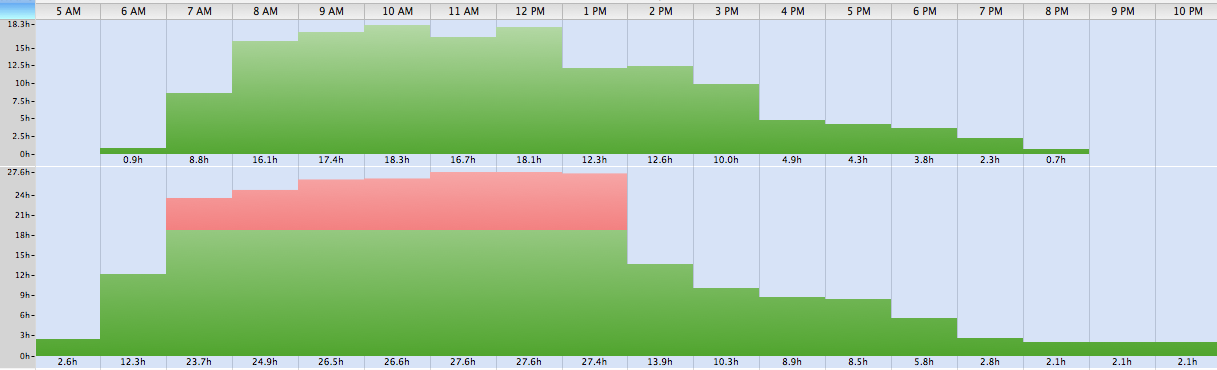
I mentioned in the prior post that my client had wanted an analysis of how well they were using their CRNAs.  By using the time sheets for the CRNAs, and the data from the anesthesia records, I came up with these two graphs.

The top graph shows times from the anesthesia records—the times that the CRNAs were doing cases (revenue for the anesthesia group).

The bottom graph shows the times the CRNAs were at the facility and being paid (expense for the anesthesia group).  The red part of the graph shows how many extra CRNAs present that were not needed during the peak hours.

(I suggest clicking on the chart which will enlarge it in another window so that you can more easily follow the description and analysis. Both graphs are scaled the same.  The actual hours used and hours available are at the bottom of each graph.)

Assuming the initial room preparation time by a CRNA of under an hour, there should be no more CRNAs present the hour before the first cases start than there are during the subsequent hour they are actually doing those cases.  There are 12.3 CRNAs available from 6 am to 7am, but only 8.8 CRNAs doing cases from 7 am to 8am which is [(12.3-8.8 =3.5)]; 3 CRNAs too many.  From 7 am to 8 am there are 23.7 CRNAs, but only 16.1 CRNAs doing cases from 8 am to 9 am [(23.7-16.1)=7.6]; 7 CRNAs too many.  The rest of the peak hours also show from 5 to 11 more CRNAs present than needed. From 2 pm to 4 pm there’s an appropriate amount of CRNAs present for the case load.  However, from 4 pm to 7 pm there are too many CRNAs.

Other important data is that the CRNAs are paid overtime after 40 hours of work in a week—there’s no overtime on a daily basis; the case scheduling is done by the nurses, not the anesthesiologists, and the anesthesiologists are guaranteed a minimum income which is just above what they would earn from the cases themselves.

While discussing the situation with my client, he said that a rough estimate of costs for 5 CRNAs a year would be close to $900,000. Looking at the graphs, even with the current system for scheduling cases and not adjusting anyone’s work schedule,  they could conservatively have 5 fewer CRNAs for the entire normal work day without making lack of CRNAs the constraint in the OR.  That’s $900,000 a year that if divided among a group of 25 anesthesiologists a year would be valued at $36,000 per anesthesiologist per year. If you then add the extra CRNAs that are  around from 4 pm to 7 pm [(8.9-4.9)+(8.5-4.3)+(5.8-3.8)=10.2]; you add an additional 10 hours of CRNAs not needed.

Depending on how conservative you want to be in your calculations, just with better scheduling they could hire 5 to 7 fewer CRNAs  and save between $36,000 to $42,400 per year for each of the 25 anesthesiologist.  If there were only 20 anesthesiologists, this would save up to $53,000 per year per anesthesiologist; this increase in income is in addition to the [25/20=1.25] 25 percent increased income due to dividing the revenue among fewer anesthesiologists.

Why don’t they schedule the CRNAs better? One reason is they lose track of their CRNAs—and they aren’t aware of the easy and inexpensive ways to tightly coordinate their activities with modern technology.  Another reason is hospital politics.

Where things get really exciting is when the anesthesiologists control the schedule.  This is possible when the anesthesiology group has an exclusive contract with the hospital, common in the southeastern US but not allowed in some other states. Even where exclusive contracts aren’t permitted, there is still a way to simulate the incentives and gains that can come with an exclusive contract.  More on that later…
Posted in anesthesiologist, scheduling | Tagged , , , , , | 1 Comment

Wasting surgeons’ time? One hospital– $27 Million opportunity Loss per Year from scheduling


$2000/hr x 55 hours saved = $110,000 opportunity cost in one day …  Who’s in charge here?.

click here:  3 Graphs of Actual and Optimized Surgical Schedule « ORTimes – Healthcare Systems Engineering Analysis

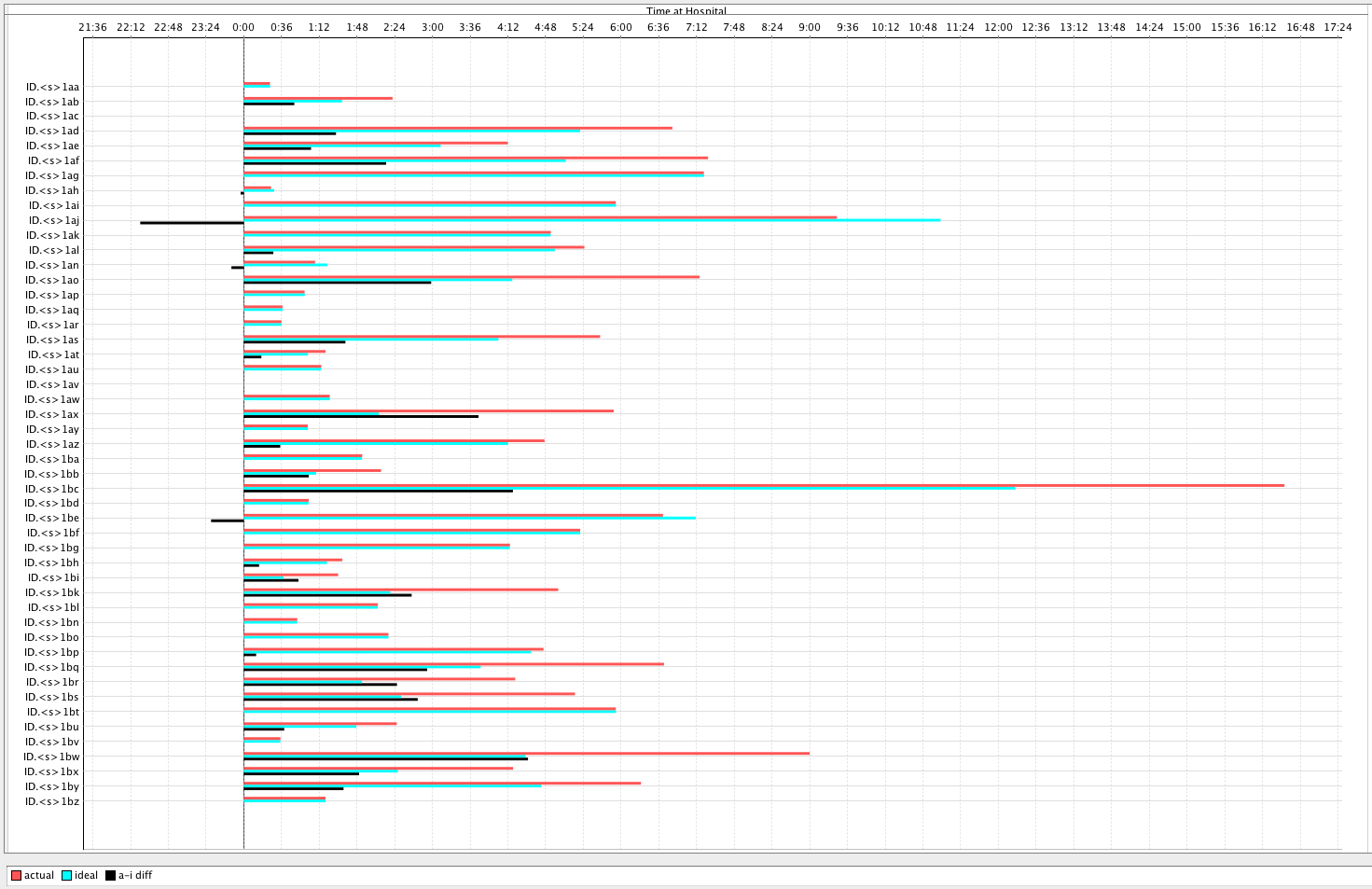
The above chart was derived from data from a client who wanted to know if they were using their CRNAs efficiently. (we’ll show that another time). We decided to use the data to show information that would be of interest to a wider audience.

Beside each surgeon’s name is a red bar and a green bar. These bars represent the total time the surgeon had to be in the OR to finish his cases. The red bar is from ‘actual’ time recorded on the anesthesia records. The green ‘ideal’ bar is from a simulation using the actual durations, but scheduled differently. The black bar measures ‘actual’ – ‘real’.

You’ll notice that for two cases the green bars are longer than the red bars, but for all the rest the red bars are as long or longer than the green. In some cases they are over twice as long. This means most surgeons spent much longer than they needed to finish their case schedules. In fact, the total number of surgeons’ wasted hours is about 55.

In this case the OR was very busy, with most rooms being used. In the ‘ideal’ simulation, the OR did not use any extra rooms and did not stay open as long. I like analogies, and this scenario reminds me of packing a suitcase or the trunk of a car. The amount of space doesn’t change, but given the know how (and the right tools for scheduling) you can make a big difference.

The significance? If you were a surgeon, would you move your patients to a hospital where you could finish your cases in half the time? Would you do more surgery?

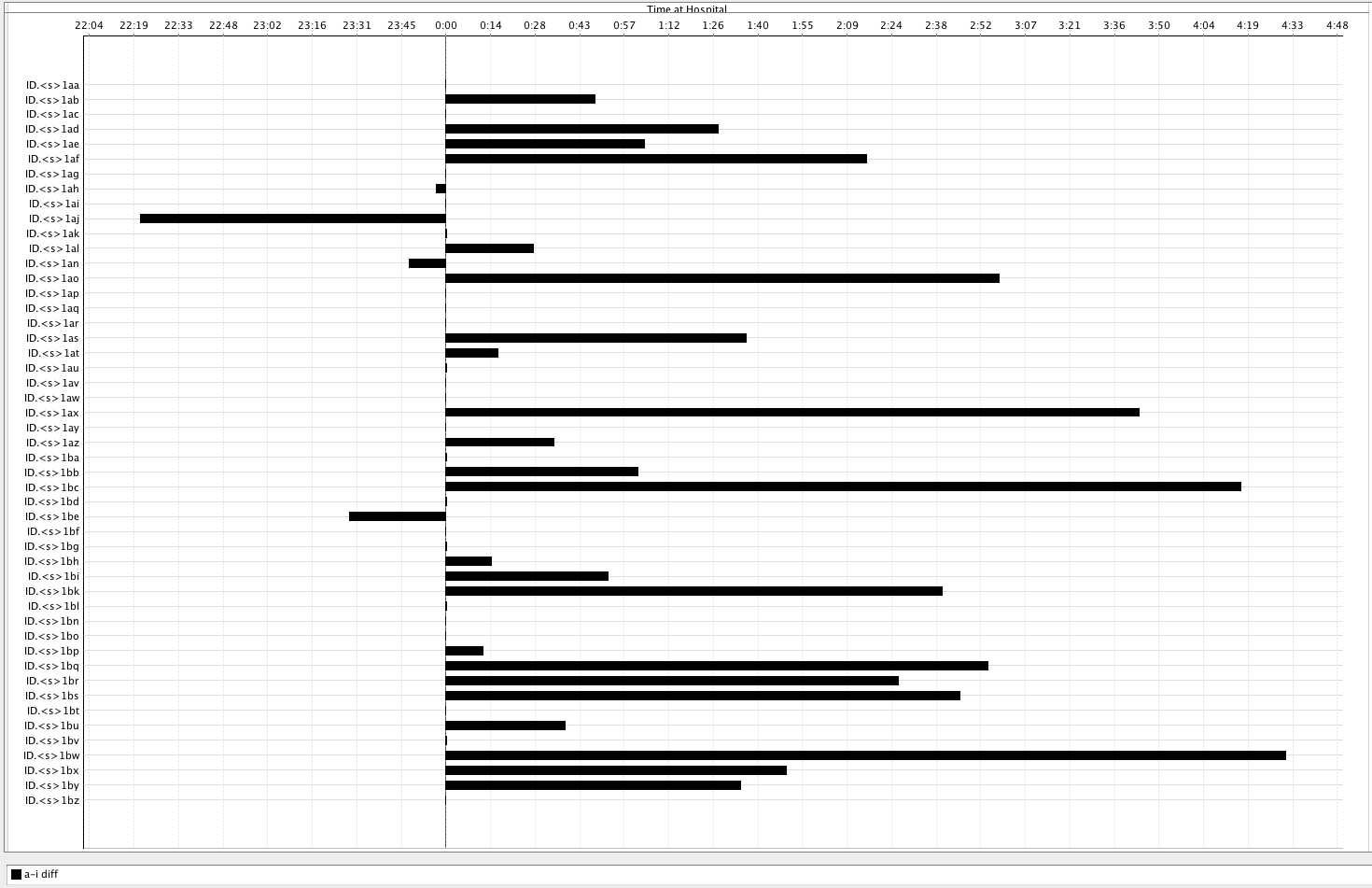
Below is the same chart but with only the ‘actual – ideal’ times showing. The black bars to the right of 0.00 indicated potential saved time. Those to the left of 0.00 indicate the surgeons’ whose time actually increased with the new schedule. Ways to avoid that can be discussed at another time.

update: Graphs of actual and optimized surgical schedule are on blog post dated January 20, 2010.

Time potentially saved by individual surgeons (actual – ideal)

Posted in anesthesiologist, CEO, healthcare reform, scheduling, surgeon | Tagged , , , , , , , , , , , , , , | 1 Comment